





Already an Interactive Brokers Client?
New to Interactive Brokers?
As mentioned in our previous lesson, traders and investors can use futures contracts to transact these commodities on the Chicago Board of Trade (or “CBOT”), which falls under the umbrella of the Chicago Mercantile Exchange (or “CME Group”), and they can also be traded on ICE Futures U.S.

Let’s examine these contracts – and provide some details about their background, how they work, why they matter, and some of the key elements to look for when deciding to trade or invest in these products.
Brief Background
Futures contracts for agricultural commodities have been traded in the United States for more than 150 years and have been under federal regulation since the 1920s – namely by the Commodity Futures Trading Commission, or “CFTC”, which was established in 1974 under the Commodity Futures Trading Commission Act.
Contract Basics
A futures contract is essentially a legal agreement to buy or sell a particular commodity at a predetermined price at a specific time in the future. These contracts are standardized and, as mentioned, traded on futures exchanges like the CME Group and the Intercontinental Exchange, or “ICE”.

As an example, let’s say a corn farmer wants to lock in a good price for their harvest six months from now. They can sella corn futures contract, locking in today’s price to avoid the risk of falling prices later; or a cereal manufacturer might buy a corn contract to hedge against future price increases.
And with these contracts, there are two sides – each looking at the equation from different vantage points. On the one side are hedgers – like farmers or food companies – who try to reduce risk; and, on the other, speculators – like traders or investors – who aim to profit from price changes.
Contract Elements
As for the futures contracts themselves, there are several important pieces of information to cover:
First, each contract has a specific size, or quantity, of the commodity being bought or sold – for example, a standard corn futures contract on the CME represents 5,000 bushels of corn.
The contract also has an expiration (or “delivery”) month, where it expires on a specific date – typically aligned with harvest or seasonal patterns. To plan positions accordingly, it’s important that traders and investors know when a contract expires. For corn, for instance, delivery months are on March, May, July, September, and December.

In terms of price, futures prices fluctuate constantly based on market supply and demand dynamics, along with weather conditions, global trade activity, and other factors, as we illustrated for coffee in our prior lesson.
The futures contract may also specify “tick size”, reflecting the smallest price movement a contract can make, where each tick has a corresponding dollar value.
For example, for corn futures, one tick is typically one-quarterof a cent per bushel, or $12.50 per contract – since each contract represents 5,000 bushels.
The futures contract should also include the margin requirements associated with the trade – where those requirements indicate the amount of money market participants must deposit to open or maintain a futures position. Margins help manage risk but can vary based on volatility.
Settlement is another important feature of the futures contract – where delivery may be physical – meaning the actual delivery of the commodity, or it may be settled financially – where the cash difference is paid out to the trader or investor. Most speculators, for example, typically close their contracts before delivery to avoid dealing with physical goods.
To illustrate, let’s take a closer look at the CME’s corn futures contract:
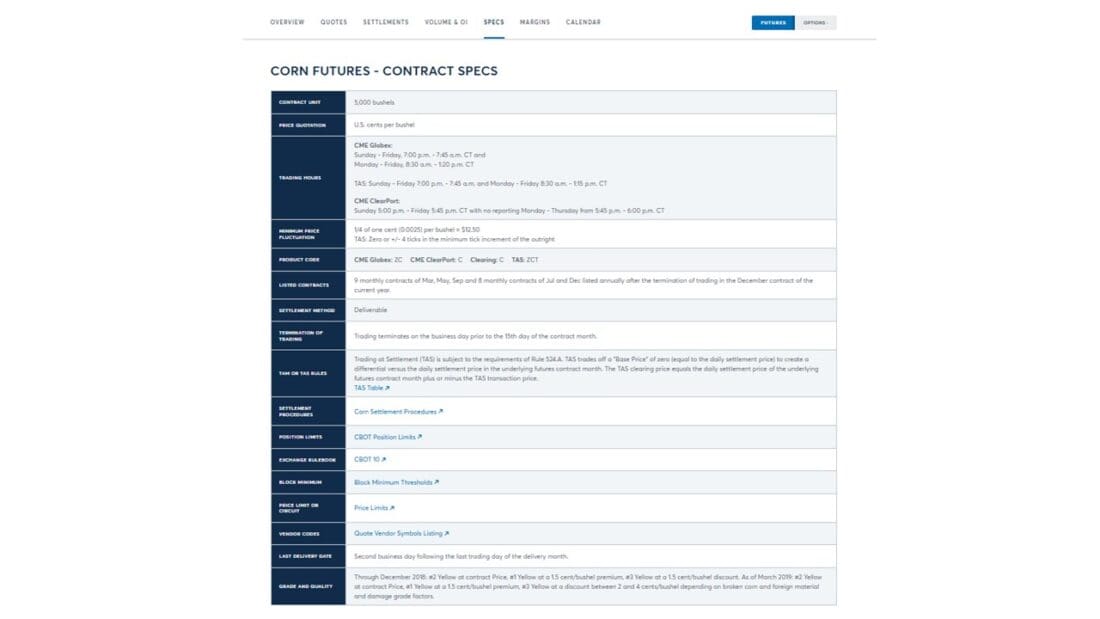
In the contract image above, you will see:
- the contract unit,
- price quotation,
- trading hours,
- minimum price fluctuation in tick size and value,
- the product code,
- listed contracts and delivery months,
- settlement method,
- certain market trading or settlement rules, along with
- various other details.
On the CME Group’s site, where this contract resides, you’ll also see other pertinent product and trading information, including an overview of trading volume, reports, commentary, and more. There are also tables with quotes, margins, settlements, open interest, and a trading calendar.
Why Contracts Matter
Understanding these contract elements can be crucial for your trading and investing activity. For example, if you’re trading wheat and don’t know when the contract expires, you might get stuck with a delivery obligation. Or, if you overlook margin requirements, your account could be liquidated in a volatile market.
Also, different contracts can have seasonal price patterns or react differently to weather and geopolitical risks. A soybean contract in July, for instance, might behave quite differently than one in November.
And remember—just because a contract is listed doesn’t mean it has enough liquidity to support efficient trading – to trade more efficiently, traders and investors might want to home-in on high-volume contracts, which can be considered less risky.
In short, agricultural futures contracts are essential tools in both risk management and speculative strategies. Knowing the structure and details of these contracts can help traders make more informed, timely decisions.
Learn More
Product Codes & Exchanges
IBKR Podcasts
When Trade Wars Hit the Farm… Who Gets Plowed Under?
Lean Hog Futures – Is Anyone Bringing Home the Bacon?
Live Cattle Futures – Herd Around the World
Sugar Futures – Talk About a Cereal Killer
Eyepopping Corn Prices – Fueling Food Inflation
The War on Wheat – How Much Bread Is on The Table?
Traders’ Academy
Introduction to Grains and Oilseeds
Understanding South American Soybean Futures
Hedging with Grain and Oilseed Futures and Options
Traders’ Insight
Corn Sustainability in the United States
Navigating the U.S. Planting Season with Enhanced Risk Management
A Brewing Storm for Arabica Coffee
How Commodity Prices Impact Inflation
Explore CME Market Pulse for in-depth details on agricultural futures contracts, including corn, soybeans, Chicago wheat, live cattle, and more! This tool offers timely, AI-powered insights into futures markets, providing updates daily, including settlement prices, daily changes, highs and lows, and year-over-year comparisons – helping traders to make more informed decisions by highlighting significant market movements and trends.
Join The Conversation
If you have a general question, it may already be covered in our FAQs page. go to: IBKR Ireland FAQs or IBKR U.K. FAQs. If you have an account-specific question or concern, please reach out to Client Services: IBKR Ireland or IBKR U.K..
Visit IBKR U.K. Open an IBKR U.K. Account