





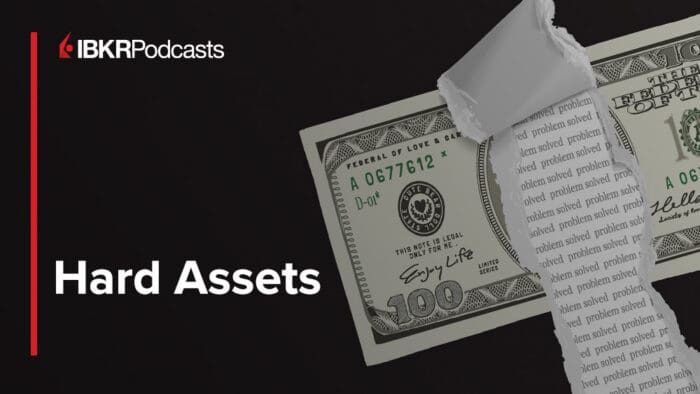




Why are investors around the world moving away from paper money and toward hard assets? In this episode, IBKR’s Elizaveta Gridneva speaks with CME Group economist Erik Norland about the growing role of gold and silver amid rising global deficits, central bank rate cuts, and geopolitical uncertainty.
Summary – IBKR Podcasts Ep. 351
The following is a summary of a live audio recording and may contain errors in spelling or grammar. Although IBKR has edited for clarity no material changes have been made.
Elizaveta Gridneva
Welcome to our latest podcast. My name is Elizaveta Gridneva, and today I’m joined by Erik Norland, CME Group’s economist. Hi, Erik.
Erik Norland
Hi. Thank you so much for having me.
Elizaveta Gridneva
We’re very excited to have you. Let’s start today’s discussion with China, where equity markets have recovered lately. What are your expectations for the Chinese economy and Chinese stock market in 2026? And what are some noticeable changes in China’s export strategy caused by Trump’s tariffs?
Erik Norland
Well, you know, the Chinese equity market, despite the fact that it’s rallied in many ways, still looks like a bargain. The valuation ratios on Chinese stocks are a lot lower than they are in the United States, so there are some very interesting investment opportunities. On the other hand, the Chinese stock market—I think it’s fascinating, as you say—has recovered, but it’s trading at about the same level today on some of the big indices, like the CSI 300, as it was in July 2007. So for 18 and a half years, the stock market there has largely gone sideways, while the U.S. market has gone up.
But I think that means there may be some incredible bargains among these Chinese stocks that could potentially allow the market to go higher, although it’s always very hard to say with the Chinese economy. The Chinese economy has been growing very slowly, really since 2022. So they’ve had basically three, three-and-a-half, four years now of very slow growth by Chinese standards. Now, the Chinese economy is still growing faster than most economies around the world, but the Chinese government releases enormous amounts of economic data.
And what those data show is that there are some areas of strength. Industrial production and exports are very strong. But there are also a lot of areas of softness, including very weak consumer spending numbers and very soft figures in terms of things like electricity consumption and rail freight volumes. The sector that’s doing the worst is probably construction. Construction activity in China, which was a major portion of their economy during the 2010s, is falling at around 15 to 20% year over year. Home prices are also falling, which is a problem for many Chinese households, since the average Chinese household has about 68% of its net worth in its primary residence. And that’s kind of what’s causing the weak consumer spending. But the outlook for China is starting to change. He Lifeng, the Chinese Vice Premier, spoke at Davos last week, and he indicated that the Chinese government is thinking about taking actions that would boost consumer spending. If they do that, and if it works, we could have a very optimistic scenario for the Chinese economy—but we’ll have to wait and see what they do and how effective those measures are.
Elizaveta Gridneva
Let’s wait and see. Moving over to Japan—Japan recently went through elections, and the new leader, the KHSN, has already called a snap election for early February to secure an even stronger position for the LDP. She’s supportive of expansionary fiscal policy and is also expected to cut the food consumption tax. Market reaction to her plans was mixed, and although equity markets rose, a drop in long-dated bonds shows that there are concerns over fiscal spending as well. What is your view on the Japanese economic and political situation in 2026? Do you have concerns over fiscal spending and instability?
Erik Norland
You know, I think the market definitely has concerns about fiscal stability and yen stability. The yen has fallen in half versus the U.S. dollar since 2012. Back in 2012, one dollar bought about 80 yen; now it buys around 155 yen. The yen has been recovering in the last few days versus the dollar, but that’s mainly because the dollar has been falling versus just about every currency. So the yen hasn’t really recovered very much versus, say, the euro, the Brazilian real, or the Mexican peso, et cetera.
The concern here is that Japan has an enormous level of public-sector debt. There’s a lot of concern about debt in Europe and the United States as well, but in Europe and the U.S., government debt is around 100% of GDP. In Japan, it’s around 200% of GDP—twice as high. For many years, Japan had interest rates near zero, even slightly negative at the short end of the curve, so it didn’t really matter if they had a lot of debt. But now the bond market there has had a very steep sell-off. You’ve seen 30-year yields go from about half a percent all the way up to three-and-a-half percent, even close to 4% in recent weeks. Ten-year yields are soaring past 2%. So the cost of financing this debt is beginning to rise, and that’s making the market worried about a sort of downward spiral where bond yields rise, which increases the cost of financing the debt, which means a bigger deficit, which in turn means more debt issuance, which potentially means even higher interest rates.
Then you add to that the stimulus package that the new prime minister has proposed—roughly 2.8% of GDP. It expands the deficit and will add even more debt to the market. So on the one hand, that fiscal stimulus could create faster growth. On the other hand, it could create a lot of concern about the stability of Japanese finances.
Elizaveta Gridneva
Got it. Great overview—thank you. Now moving to precious metals: we’re all witnessing a historic rally in metals over the last few months. I’m sure many investors are struggling to understand the exact drivers behind it, as well as its implications for the real economy. Can you tell us what you see as the major forces behind this move? And do you think we’re at risk of another inflation wave caused by a rally in commodities?
Erik Norland
Well, that’s a great question. I think there are basically five forces driving this. The first one we’ve already talked a little bit about, which is deficits. Japan is running a huge budget deficit, and so is China. China has a deficit of 8.5% of GDP, which is enormous. Over the last several years, Chinese tax revenues have dropped from 29% to 21% of GDP.
The United States is running a large budget deficit of about 6% of GDP. The administration in Washington has just announced that it wants to increase defense spending by half a trillion dollars per year, which would likely add another 1.5% of GDP to that deficit, taking it closer to 7%. The Germans, who had been very fiscally responsible and very fiscally tight until recently, have announced a one-trillion-euro investment program in their economy—that’s about 20% of GDP in spending. The Canadians are committing 140 billion Canadian dollars to defense spending to build up their military. Many other European countries are also adding to their military budgets. So around the world, you have these gigantic budget deficits. In addition to that, secondly, you have inflation running above target in almost every major economy outside of China and Switzerland. Third, despite the fact that inflation is running above target, you have almost every central bank cutting interest rates. Fourth, there are concerns about the independence of central banks around the world and whether they’re being asked to finance these public deficits. And lastly, you have geopolitical uncertainty.
All of these factors are contributing to an environment in which people would rather own gold, silver, platinum, and palladium because central banks can’t print them. They would rather own those assets than currencies that central banks can create.
Elizaveta Gridneva
Great. And just one question, Erik—does the rally in silver surprise you more than the rally in gold?
Erik Norland
Well, not really, no. Since the beginning of last year, gold prices are up about 110%, while silver prices are up close to 300%. So silver is rallying for numerous reasons. First of all, it tends to move more—it tends to move in the same direction as gold, but by a larger amount. That’s partly because, imagine you live in a country where it’s traditional to give gold as a gift at weddings. Now that gold is at $2,500 an ounce, you might not be able to afford it. But even with the rise in silver prices, it’s still about one-forty-seventh the price of gold. In other words, one ounce of gold can buy 47 ounces of silver, so you could still afford to buy silver.
Secondly, China has placed some export restrictions, or export licensing requirements, on silver, which is boosting the price. On top of that, you also have technological change. Silver is being used in solar panels and in batteries, so it’s finding a lot of new uses that are boosting its industrial demand.
Elizaveta Gridneva
Understood. Thank you, Erik, for joining me. If you enjoyed today’s podcast episode, please subscribe to our channel wherever you download your podcasts.
Disclosure: CME Group
© [2023] CME Group Inc. All rights reserved. This information is reproduced by permission of CME Group Inc. and its affiliates under license. CME Group Inc. and its affiliates accept no liability or responsibility for the information contained herein, including but not limited to the currency, accuracy and/or completeness of this information, and delays, interruptions, errors or omissions. This information is an unofficial copy and may not reflect the official and accurate version. For the definitive and up-to-date version of any of this information, please see cmegroup.com.
Disclosure: Interactive Brokers
The analysis in this material is provided for information only and is not and should not be construed as an offer to sell or the solicitation of an offer to buy any security. To the extent that this material discusses general market activity, industry or sector trends or other broad-based economic or political conditions, it should not be construed as research or investment advice. To the extent that it includes references to specific securities, commodities, currencies, or other instruments, those references do not constitute a recommendation by IBKR to buy, sell or hold such investments. This material does not and is not intended to take into account the particular financial conditions, investment objectives or requirements of individual customers. Before acting on this material, you should consider whether it is suitable for your particular circumstances and, as necessary, seek professional advice.
The views and opinions expressed herein are those of the author and do not necessarily reflect the views of Interactive Brokers, its affiliates, or its employees.
Disclosure: Interactive Brokers Third Party
Information posted on IBKR Campus that is provided by third-parties does NOT constitute a recommendation that you should contract for the services of that third party. Third-party participants who contribute to IBKR Campus are independent of Interactive Brokers and Interactive Brokers does not make any representations or warranties concerning the services offered, their past or future performance, or the accuracy of the information provided by the third party. Past performance is no guarantee of future results.
This material is from CME Group and is being posted with its permission. The views expressed in this material are solely those of the author and/or CME Group and Interactive Brokers is not endorsing or recommending any investment or trading discussed in the material. This material is not and should not be construed as an offer to buy or sell any security. It should not be construed as research or investment advice or a recommendation to buy, sell or hold any security or commodity. This material does not and is not intended to take into account the particular financial conditions, investment objectives or requirements of individual customers. Before acting on this material, you should consider whether it is suitable for your particular circumstances and, as necessary, seek professional advice.
Disclosure: Forex
There is a substantial risk of loss in foreign exchange trading. The settlement date of foreign exchange trades can vary due to time zone differences and bank holidays. When trading across foreign exchange markets, this may necessitate borrowing funds to settle foreign exchange trades. The interest rate on borrowed funds must be considered when computing the cost of trades across multiple markets.
Disclosure: Precious Metals
Precious metals may not be available in all locations, please check your local IBKR website for availability.
Disclosure: Bonds
As with all investments, your capital is at risk.
Join The Conversation
If you have a general question, it may already be covered in our FAQs page. go to: IBKR Ireland FAQs or IBKR U.K. FAQs. If you have an account-specific question or concern, please reach out to Client Services: IBKR Ireland or IBKR U.K..
Visit IBKR U.K. Open an IBKR U.K. Account