











As you might expect, a key element of my job involves discussing markets with members of the media. Don’t get me wrong – it’s a highly enjoyable privilege. But there are days (generally volatile ones) where I’m more popular than others. And almost every discussion involved some version of “why did Nvidia (NVDA) get hit so hard?” Funny, when the stock rallied about 30% in two weeks last month, adding a cool $1 trillion to its market capitalization, no one asked me why. And bear in mind that we haven’t been at these low levels since… checks notes… less than a month ago.
NVDA remains by far the most active stock on our platform, with buying activity far outpacing selling. Many investors have understandably become true believers. Frankly speaking, a lot of people have made A LOT of money in a fairly short period of time, so it makes sense. And the belief is based upon results. I can’t recall a company so consistently beating on the top and bottom lines, raising guidance, then doing it all again the next quarter. The growth has been stupendous, justifying a big rally, and thrilling many investors.
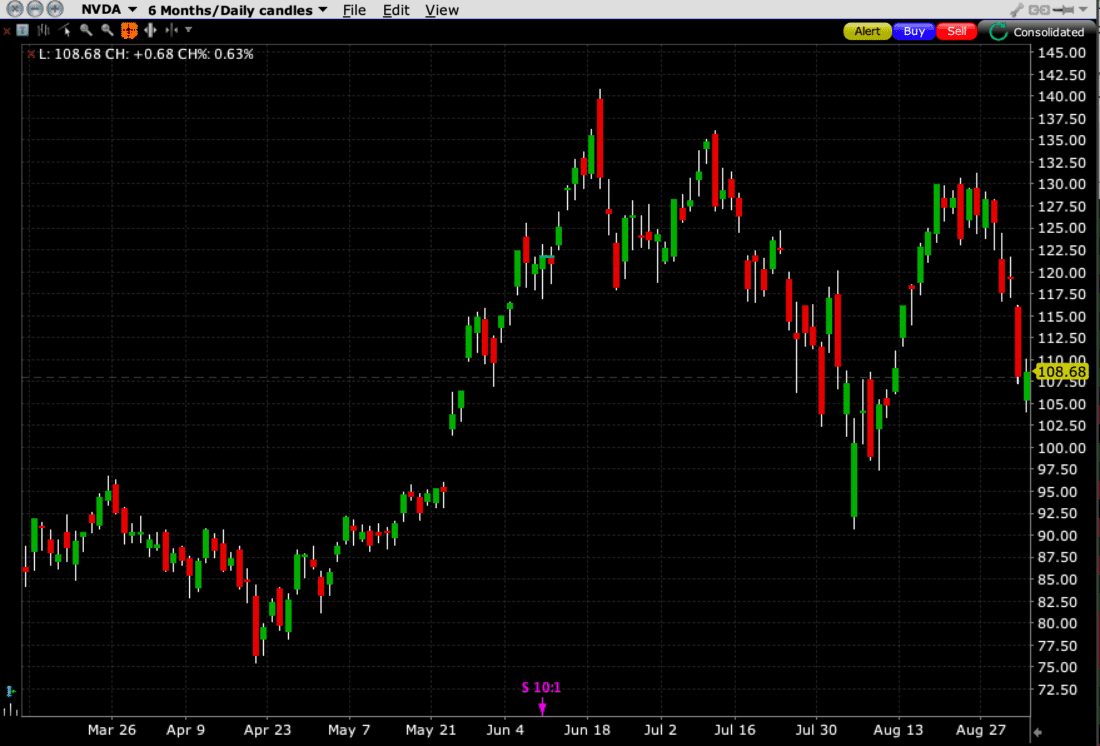
The current NVDA sell-off is a gut check for sanguine investors. But first, bear in mind that we haven’t been at these low levels since… checks notes… less than a month ago. It’s easy to forget that the stock rallied from under $100 to over $130 from August 7th -21st. I heard no complaints when the stock was shooting higher because we’ve come to expect that the stock will go up rapidly. It’s become a very volatile stock, so investors who believe in the company had better get used to the swings. Investors love volatility on the way up (aka “socially acceptable volatility”) but hate it on the way down. Unfortunately, one usually brings the other.
NVDA 6-Months, Daily Candles
Source: Interactive Brokers
Past performance is not indicative of future results
(Note that the peak occurred shortly after the 10:1 split went into effect. Buy the rumor, sell the news…)
However, I think we’re at a point where individual investor enthusiasm remains sky high (it never occurred to me to attend an earnings watch party) at a time when institutional investors seem to be taking a more sober view. And, because traders react while investors consider, it is understandable why institutional investors might have waited until yesterday to make a move. Many portfolio managers take vacations and send their kids off to college in late August, rather than focus on their work. Some might attribute this to seasonality, which we noted yesterday, but there are less emotional, more sober reasons why investors may choose to protect their well-earned profits.
Last week’s earnings report reminded us that we have become quite spoiled by NVDA’s consistent ability to beat revenue and earnings estimates, raise guidance, then do it again next quarter. But the magnitude of the beats has been shrinking. As we pointed out last week, NVDA’s EPS beat consensus by 31.07% last August. The level of “beat” has declined since then to 19.64%, 11.69% and 8.51% ahead of last week’s 5.43%. NVDA’s EPS beats have gone from enormous to pedestrian. A stock with a 50 P/E needs to be more than pedestrian. At that valuation it needs to be excellent.
It’s clear that investors have not given up their well-deserved faith in NVDA yet. Only the most robust stocks could be essentially unchanged after receiving a subpoena from the Department of Justice. But the stock’s smooth upward trajectory has become quite a bit bumpier in recent weeks. Turbulence is often unsettling.
New to Interactive Brokers?
Open AccountAlready an Interactive Brokers Client?
Request Trading PermissionDisclosure: Interactive Brokers
The analysis in this material is provided for information only and is not and should not be construed as an offer to sell or the solicitation of an offer to buy any security. To the extent that this material discusses general market activity, industry or sector trends or other broad-based economic or political conditions, it should not be construed as research or investment advice. To the extent that it includes references to specific securities, commodities, currencies, or other instruments, those references do not constitute a recommendation by IBKR to buy, sell or hold such investments. This material does not and is not intended to take into account the particular financial conditions, investment objectives or requirements of individual customers. Before acting on this material, you should consider whether it is suitable for your particular circumstances and, as necessary, seek professional advice.
The views and opinions expressed herein are those of the author and do not necessarily reflect the views of Interactive Brokers, its affiliates, or its employees.
Disclosure: ETFs
Any discussion or mention of an ETF is not to be construed as recommendation, promotion or solicitation. All investors should review and consider associated investment risks, charges and expenses of the investment company or fund prior to investing. Before acting on this material, you should consider whether it is suitable for your particular circumstances and, as necessary, seek professional advice.
Disclosure: Futures Trading
Futures are not suitable for all investors. The amount you may lose may be greater than your initial investment. Before trading futures, please read the CFTC Risk Disclosure. A copy and additional information are available at the Warnings and Disclosures section of your local Interactive Brokers website.






Join The Conversation
If you have a general question, it may already be covered in our FAQs page. go to: IBKR Ireland FAQs or IBKR U.K. FAQs. If you have an account-specific question or concern, please reach out to Client Services: IBKR Ireland or IBKR U.K..
Visit IBKR U.K. Open an IBKR U.K. Account