










1/ What Does the Dollar Keep Telling Us?
2/ JPYUSD
3/ Bank of America: Momentum Following the Breakout
4/ Growth Try One More Time
Investopedia is partnering with CMT Association on this newsletter. The contents of this newsletter are for informational and educational purposes only, however, and do not constitute investing advice. The guest authors, which may sell research to investors, and may trade or hold positions in securities mentioned herein do not represent the views of CMT Association or Investopedia. Please consult a financial advisor for investment recommendations and services.
1/
What Does the Dollar Keep Telling Us?
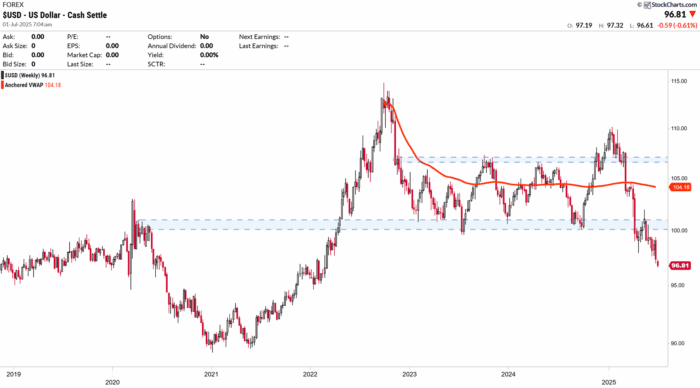
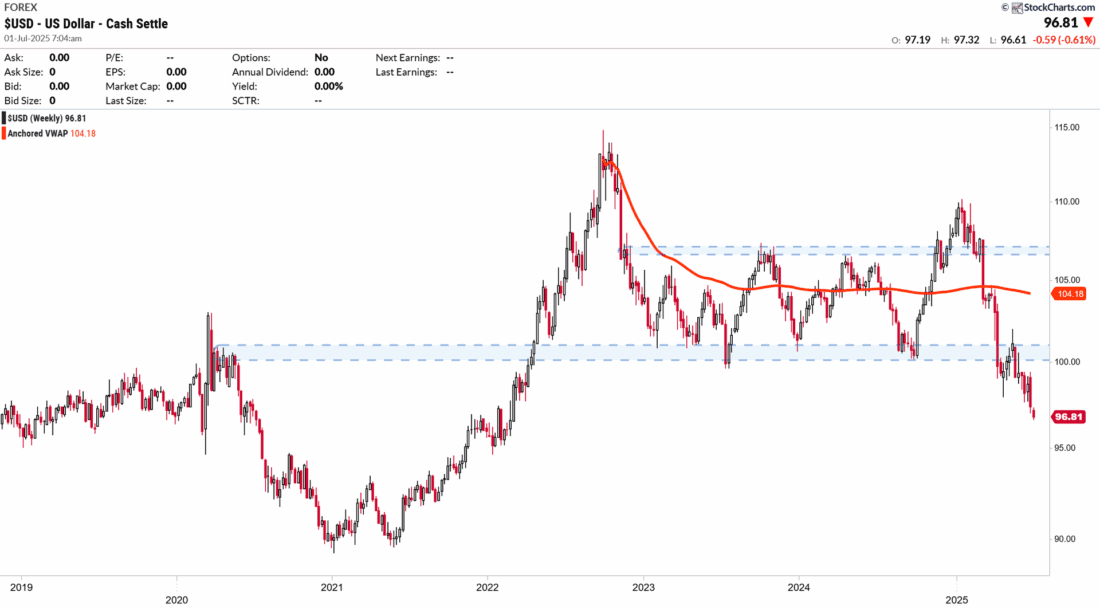
In my last contribution to the Chart Advisor Report back in April, we discussed what the U.S. dollar was signaling as the DXY hovered around the 100 level. A few months later, that support zone failed once again. Downward momentum has prevailed, and the dollar is now trading near the 97 mark.
Past performance is not indicative of future results
The recent drop from 104.18 suggests a renewed selling impulse, likely driven by recent macroeconomic developments—such as this week’s ECB decision. The dollar’s depreciation in 2025 aligns with the Federal Reserve’s 100 basis points in rate cuts so far this year, narrowing the interest rate differential with other economies. If the ECB announces further accommodative measures on Thursday, it could accelerate this trend.
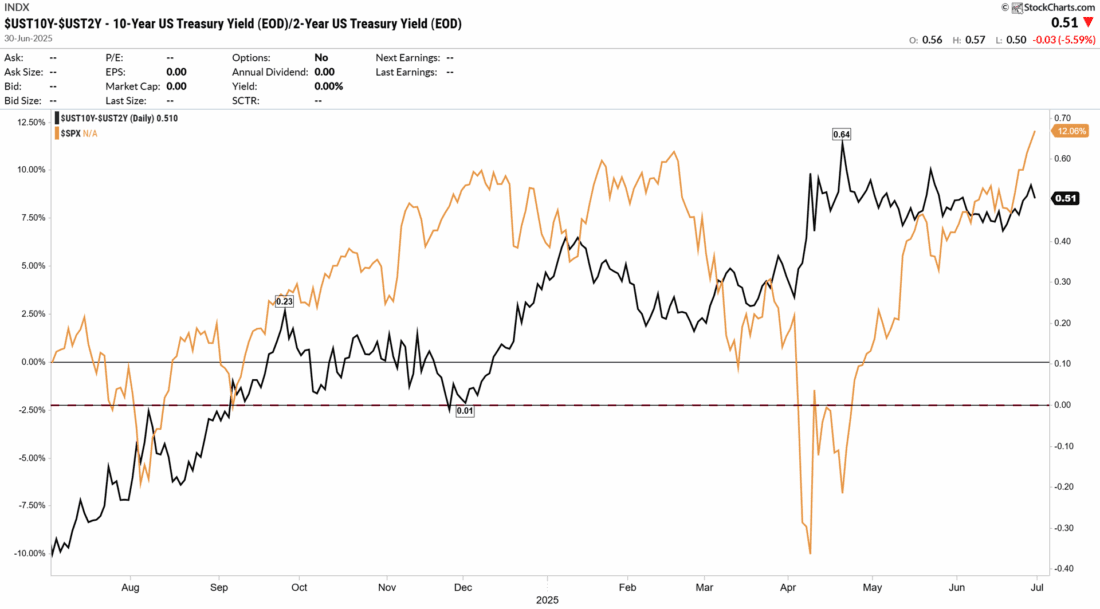
At the same time, the normalization of the yield curve (2-year vs. 10-year) points to moderate economic growth, reducing the dollar’s appeal as a safe haven. Combined with a lower risk aversion in markets, this environment favors alternative currencies.
Past performance is not indicative of future results
A normalized yield curve tends to favor cyclical equities while reducing demand for long-duration bonds.
2/
JPYUSD
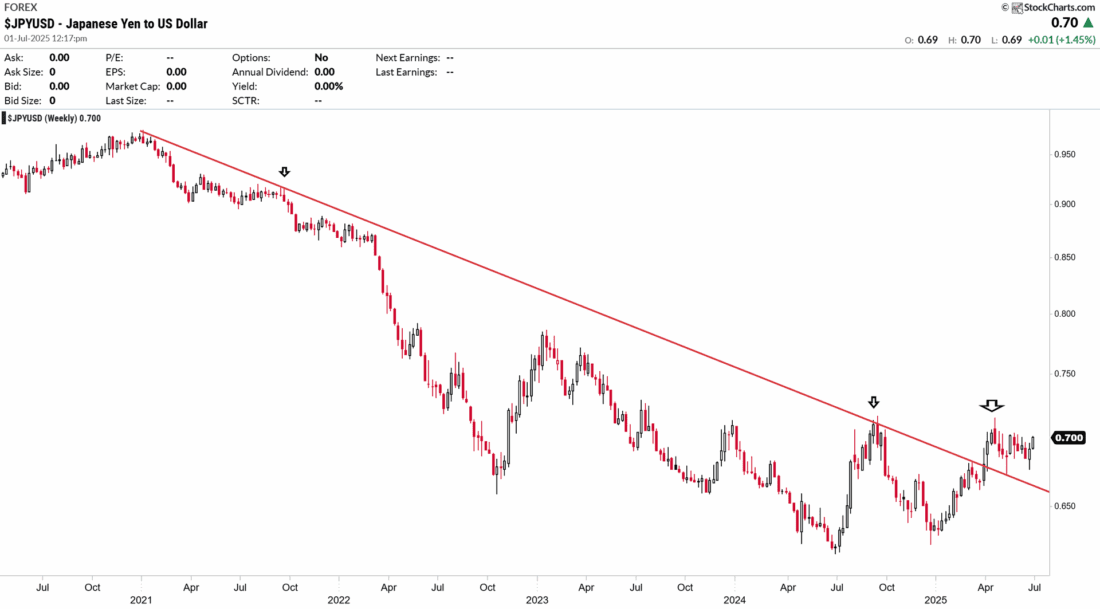
The Bank of Japan has maintained an accommodative stance throughout 2025, keeping interest rates near zero. This has strengthened the yen by making Japanese assets less attractive to foreign investors. Meanwhile, the Federal Reserve’s 100 basis points in rate cuts this year have weakened the U.S. dollar, amplifying the downward trend in USD/JPY.
Past performance is not indicative of future results
The narrowing rate differential between the U.S. and Japan—reflected in the U.S. yield curve (10Y–2Y spread at 0.54%, as previously noted)—has favored the yen, as investors seek higher returns in other currencies.
Geopolitical Tensions: The yen has gained appeal as a safe-haven currency amid rising trade tensions (e.g., 50% tariffs on steel and aluminum) and global uncertainty, adding to the downward pressure on USD/JPY.
ECB Decision: This week’s European Central Bank meeting (Thursday) could impact the euro, indirectly influencing the yen through its effect on dollar dynamics (USD last seen at 97.21, per our previous analysis).
USD/JPY continues to display a clear downward trend, with the pair trading at 0.693 after a sustained decline since 2021, driven by divergent monetary policies and the yen’s appeal as a safe-haven asset. The proximity to the 0.69 level and current technical oversold conditions suggest the possibility of a short-term rebound. However, the broader bearish trend remains intact unless a significant macroeconomic shift occurs—such as direct intervention by the Bank of Japan or a meaningful strengthening of the U.S. dollar.
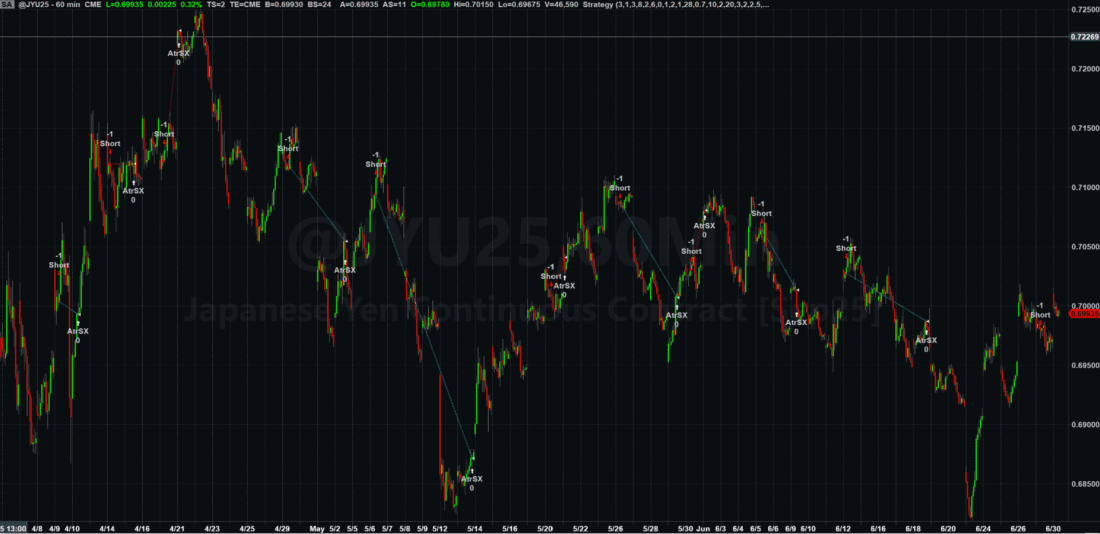
Traders should favor short setups or range strategies, while closely monitoring key support and resistance levels.
One of our JPY systems is maintaining a short position this week.
Past performance is not indicative of future results
3/
Bank of America: Momentum Following the Breakout
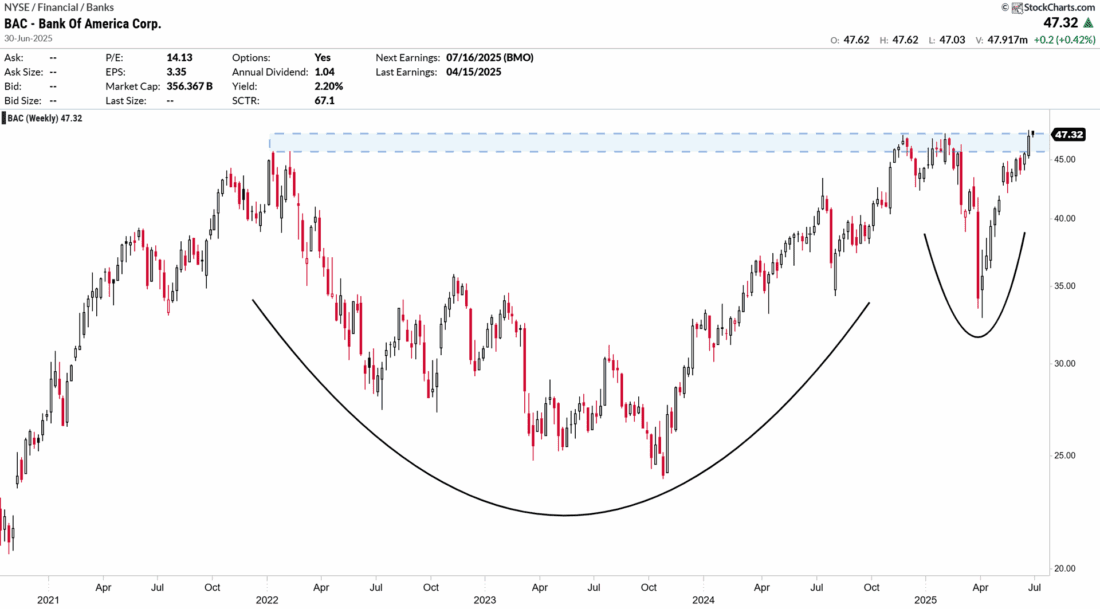
Bank of America presents a constructive technical and fundamental outlook, with the stock attempting to break above its recently reached all-time high. While the move above $47.12 is promising, the proximity of upcoming earnings and broader macroeconomic risks warrant caution. Short-term investors may look for buying opportunities on pullbacks toward $45, while long-term investors could consider accumulating positions if the price decisively breaks above $50 with strong volume. This week will be critical, as earnings results and the ECB’s policy decision are both expected.
The 67.4% Sector SCTR score reflects strong performance in the banking sector in 2025, driven by economic stability and a recovery in lending following the inflationary surge of 2024. As a sector leader, BAC stands to benefit from this trend.
The Federal Reserve’s 100 basis point rate cut in 2025 has eased pressure on net interest margins, supporting bank profitability. However, rising trade tensions—such as the imposition of 50% tariffs on steel and aluminum—could weigh on consumer confidence and, consequently, on loan demand.
Past performance is not indicative of future results
The short-term trend remains bullish following the breakout, but the stock may enter a consolidation phase ahead of the July 16, 2025 earnings release, potentially adding volatility.
4/
Growth Try One More Time
The VUG:VTV ratio indicates the relative strength between VUG (growth) and VTV (value). The relationship peaked in 2021 near 2.70, followed by a correction in 2022, likely influenced by rising rates and inflation. Since then, it has regained ground, consolidating around 2.40-2.50 in 2025.
Recent movements show an attempt to break the resistance at 2.49, but the lack of momentum suggests possible consolidation or correction.

Past performance is not indicative of future results
The Federal Reserve’s rate cuts (100 basis points in 2025) have favored growth stocks (VUG), which typically benefit from low-rate environments.
The “magnificent seven” tech companies (Apple, Microsoft, etc.) have boosted VUG, with a combined market cap of 10 trillion dollars. VUG’s strength aligns with a weak dollar (USD at 97.21) and a strong Nasdaq.
The VUG:VTV ratio at 2.48 reflects a preference for growth in 2025, with a long-term upward trend but a potential consolidation or correction in the short term near the 2.49 resistance. Investors should monitor movements following the ECB decision and economic data, adjusting their exposure between growth and value based on the ratio’s direction.
—
Originally posted 1st July 2025
Disclosure: Investopedia
Investopedia.com: The comments, opinions and analyses expressed herein are for informational purposes only and should not be considered individual investment advice or recommendations to invest in any security or to adopt any investment strategy. While we believe the information provided herein is reliable, we do not warrant its accuracy or completeness. The views and strategies described on our content may not be suitable for all investors. Because market and economic conditions are subject to rapid change, all comments, opinions and analyses contained within our content are rendered as of the date of the posting and may change without notice. The material is not intended as a complete analysis of every material fact regarding any country, region, market, industry, investment or strategy. This information is intended for US residents only.
Disclosure: Interactive Brokers Third Party
Information posted on IBKR Campus that is provided by third-parties does NOT constitute a recommendation that you should contract for the services of that third party. Third-party participants who contribute to IBKR Campus are independent of Interactive Brokers and Interactive Brokers does not make any representations or warranties concerning the services offered, their past or future performance, or the accuracy of the information provided by the third party. Past performance is no guarantee of future results.
This material is from Investopedia and is being posted with its permission. The views expressed in this material are solely those of the author and/or Investopedia and Interactive Brokers is not endorsing or recommending any investment or trading discussed in the material. This material is not and should not be construed as an offer to buy or sell any security. It should not be construed as research or investment advice or a recommendation to buy, sell or hold any security or commodity. This material does not and is not intended to take into account the particular financial conditions, investment objectives or requirements of individual customers. Before acting on this material, you should consider whether it is suitable for your particular circumstances and, as necessary, seek professional advice.
Disclosure: Forex
There is a substantial risk of loss in foreign exchange trading. The settlement date of foreign exchange trades can vary due to time zone differences and bank holidays. When trading across foreign exchange markets, this may necessitate borrowing funds to settle foreign exchange trades. The interest rate on borrowed funds must be considered when computing the cost of trades across multiple markets.






Join The Conversation
If you have a general question, it may already be covered in our FAQs page. go to: IBKR Ireland FAQs or IBKR U.K. FAQs. If you have an account-specific question or concern, please reach out to Client Services: IBKR Ireland or IBKR U.K..
Visit IBKR U.K. Open an IBKR U.K. Account