








Originally Posted 16 September 2025 – Mapping the sustainable investing spectrum of capital
Examining the sustainable investing spectrum can help clarify the interplay between investors’ specific financial objectives—measured by risk and return—and their sustainability-driven objectives.
As some investors, particularly in Europe and APAC, increase their focus on the sustainability characteristics of their portfolios, there are both links and implications when it comes to the order of priority between their sustainability-related and financial objectives.
Many are now seeking to understand—and in some cases, actively target—a specific impact that they want their investments to have on the world.
As investors introduce sustainability objectives into portfolio construction, we believe it becomes essential to understand and articulate the interplay between their financial and sustainability-related goals.
Identifying investor objectives: A conscious prioritization exercise
Financial and sustainability-related goals can, at times, appear to be made independently. However, it is important for investors to understand the interaction between the two.
Some investors maintain a primary focus on their financial objective—managing risk and return effectively. If these investors have sustainability-related objectives, they are likely secondary to meeting their primary objective.
On the other hand, some investors explicitly aim to prioritise sustainability considerations—though the way in which they incorporate these considerations may differ. Some investors may seek to understand how companies operate, looking to invest in companies that manage sustainability risks effectively to improve their operational resilience. Others may be focused on the impact that their investment could have on people and/or the planet. These investors may consider what products and services a company creates and how they contribute to a sustainability goal.
The spectrum of capital
Figure 1 represents State Street Investment Management’s view of the sustainable investing spectrum of capital. Looking at Figure 1, sustainability-related goals become more pronounced and explicit as we move from left to right, and the methods to achieve those goals change accordingly. For example, as an investor increasingly focuses on the impact their investments have on the world, their selection criteria for these assets will naturally change. This can have an effect on their financial objectives, too.
Figure 1: A view of the sustainable capital spectrum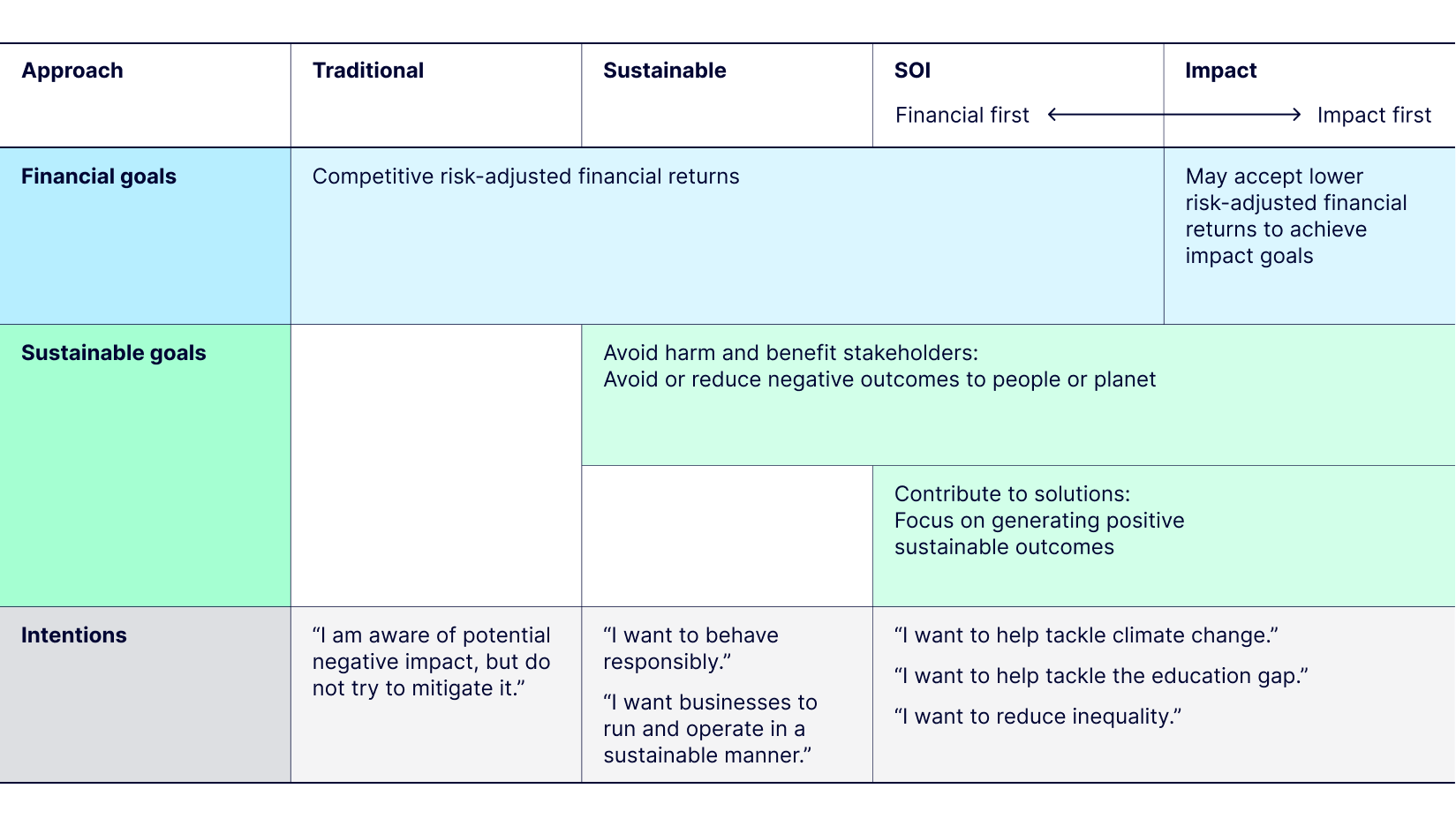
Source: State Street Investment Management’s interpretation of Impact Investing Institute’s Spectrum of Capital, modified to meet State Street Investment Management’s guidelines. Utilises Impact Frontiers ABC Framework and Bridges Spectrum of Capital.
Traditional approach
Investors who don’t explicitly incorporate sustainability elements are in the ‘traditional’ investments column. While they may or may not be aware of the sustainability-related characteristics of their investments, they do not target any sustainability-related improvements as a defined objective. In other words, their investment objective is purely financially driven.
Sustainable approach
These investors incorporate sustainable factors into their investment decision making, though the rationale for why and how can vary. Some may seek to avoid harm by excluding certain business activities and apply norms-based screens. Others may go further to focus on benefiting stakeholders, meaning they consider the wider sustainability factors of an investment, how a company manages its sustainability risk, and if it operates in a sustainable manner. Here, investors may seek to align with their own values or manage towards sustainability frameworks such as a net-zero pathway. But financial returns are typically still a primary objective for these investors.
Sustainable outcome investing (SOI) approach
For SOI investors, sustainable objectives go hand-in-hand with financial objectives. They seek to invest in assets that contribute to solutions and generate positive sustainability-related outcomes through their products and services. In short, these investors consider dual objectives—both financial and sustainability-related objectives— maintaining a primary focus on achieving competitive risk-adjusted returns.
Impact approach
Impact investors are, first and foremost, focused on having a direct positive effect on the world via a pre-defined sustainability-related objective. While these investors also consider both financial and sustainability-related objectives, for impact investors, achieving their sustainability-related objectives retains primacy.
A key distinction between the sustainable approach and an SOI or impact approach is their focus on how their investments contribute to solutions. SOI and impact approaches seek to target assets that are actively generating solutions through products and services—not just reducing their own negative impact.
Implications for portfolio construction
As investors consider these approaches, a key consideration is the effect that each will have on portfolio construction. As an investment approach incorporates specific sustainability or impact criteria—for example, aiming to hold companies that are deemed to be positively contributing to an environmental or social outcome—the composition of the portfolio will naturally diverge from a broad market cap benchmark.
Take a conscious approach
We believe defining objectives consciously is a foundational step when positioning and implementing a sustainable investment approach. Different points along the spectrum correspond with different investor goals, methodologies, and potential impacts on portfolio diversification and, as a result, risk and return profiles.
Disclosure: State Street Global Advisors
Do not reproduce or reprint without the written permission of SSGA.
All information has been obtained from sources believed to be reliable, but its accuracy is not guaranteed. There is no representation or warranty as to the current accuracy, reliability or completeness of, nor liability for, decisions based on such information and it should not be relied on as such.
State Street Global Advisors and its affiliates (“SSGA”) have not taken into consideration the circumstances of any particular investor in producing this material and are not making an investment recommendation or acting in fiduciary capacity in connection with the provision of the information contained herein.
ETFs trade like stocks, are subject to investment risk, fluctuate in market value and may trade at prices above or below the ETF’s net asset value. Brokerage commissions and ETF expenses will reduce returns.
Bonds generally present less short-term risk and volatility than stocks, but contain interest rate risk (as interest rates raise, bond prices usually fall); issuer default risk; issuer credit risk; liquidity risk; and inflation risk. These effects are usually pronounced for longer-term securities. Any fixed income security sold or redeemed prior to maturity may be subject to a substantial gain or loss.
Investing involves risk including the risk of loss of principal.
The whole or any part of this work may not be reproduced, copied or transmitted or any of its contents disclosed to third parties without SSGA’s express written consent.
Investing in high yield fixed income securities, otherwise known as “junk bonds”, is considered speculative and involves greater risk of loss of principal and interest than investing in investment grade fixed income securities. These Lower-quality debt securities involve greater risk of default or price changes due to potential changes in the credit quality of the issuer.
COPYRIGHT AND OTHER RIGHTS
Other third party content is the intellectual property of the respective third party and all rights are reserved to them. All rights reserved. No organization or individual is permitted to reproduce, distribute or otherwise use the statistics and information in this report without the written agreement of the copyright owners.
Definition:
Arbitrage: the simultaneous buying and selling of securities, currency, or commodities in different markets or in derivative forms in order to take advantage of differing prices for the same asset.
Fund Objectives:
SPY: The investment seeks to provide investment results that, before expenses, correspond generally to the price and yield performance of the S&P 500® Index. The Trust seeks to achieve its investment objective by holding a portfolio of the common stocks that are included in the index (the “Portfolio”), with the weight of each stock in the Portfolio substantially corresponding to the weight of such stock in the index.
VOO: The investment seeks to track the performance of a benchmark index that measures the investment return of large-capitalization stocks. The fund employs an indexing investment approach designed to track the performance of the Standard & Poor’s 500 Index, a widely recognized benchmark of U.S. stock market performance that is dominated by the stocks of large U.S. companies. The advisor attempts to replicate the target index by investing all, or substantially all, of its assets in the stocks that make up the index, holding each stock in approximately the same proportion as its weighting in the index.
IVV: The investment seeks to track the investment results of the S&P 500 (the “underlying index”), which measures the performance of the large-capitalization sector of the U.S. equity market. The fund generally invests at least 90% of its assets in securities of the underlying index and in depositary receipts representing securities of the underlying index. It may invest the remainder of its assets in certain futures, options and swap contracts, cash and cash equivalents, as well as in securities not included in the underlying index, but which the advisor believes will help the fund track the underlying index.
The funds presented herein have different investment objectives, costs and expenses. Each fund is managed by a different investment firm, and the performance of each fund will necessarily depend on the ability of their respective managers to select portfolio investments. These differences, among others, may result in significant disparity in the funds’ portfolio assets and performance. For further information on the funds, please review their respective prospectuses.
Entity Disclosures:
The trademarks and service marks referenced herein are the property of their respective owners. Third party data providers make no warranties or representations of any kind relating to the accuracy, completeness or timeliness of the data and have no liability for damages of any kind relating to the use of such data.
SSGA Funds Management, Inc. serves as the investment advisor to the SPDR ETFs that are registered with the United States Securities and Exchange Commission under the Investment Company Act of 1940. SSGA Funds Management, Inc. is an affiliate of State Street Global Advisors Limited.
Intellectual Property Disclosures:
Standard & Poor’s®, S&P® and SPDR® are registered trademarks of Standard & Poor’s® Financial Services LLC (S&P); Dow Jones is a registered trademark of Dow Jones Trademark Holdings LLC (Dow Jones); and these trademarks have been licensed for use by S&P Dow Jones Indices LLC (SPDJI) and sublicensed for certain purposes by State Street Corporation. State Street Corporation’s financial products are not sponsored, endorsed, sold or promoted by SPDJI, Dow Jones, S&P, their respective affiliates and third party licensors and none of such parties make any representation regarding the advisability of investing in such product(s) nor do they have any liability in relation thereto, including for any errors, omissions, or interruptions of any index.
BLOOMBERG®, a trademark and service mark of Bloomberg Finance, L.P. and its affiliates, and BARCLAYS®, a trademark and service mark of Barclays Bank Plc., have each been licensed for use in connection with the listing and trading of the SPDR Bloomberg Barclays ETFs.
Distributor: State Street Global Advisors Funds Distributors, LLC, member FINRA, SIPC, an indirect wholly owned subsidiary of State Street Corporation. References to State Street may include State Street Corporation and its affiliates. Certain State Street affiliates provide services and receive fees from the SPDR ETFs.
ALPS Distributors, Inc., member FINRA, is distributor for SPDR® S&P 500®, SPDR® S&P MidCap 400® and SPDR® Dow Jones Industrial Average, all unit investment trusts. ALPS Distributors, Inc. is not affiliated with State Street Global Advisors Funds Distributors, LLC.
Before investing, consider the funds’ investment objectives, risks, charges, and expenses. For SPDR funds, you may obtain a prospectus or summary prospectus containing this and other information by calling 1‐866‐787‐2257 or visiting www.spdrs.com. Please read the prospectus carefully before investing.
Disclosure: Interactive Brokers Third Party
Information posted on IBKR Campus that is provided by third-parties does NOT constitute a recommendation that you should contract for the services of that third party. Third-party participants who contribute to IBKR Campus are independent of Interactive Brokers and Interactive Brokers does not make any representations or warranties concerning the services offered, their past or future performance, or the accuracy of the information provided by the third party. Past performance is no guarantee of future results.
This material is from State Street Global Advisors and is being posted with its permission. The views expressed in this material are solely those of the author and/or State Street Global Advisors and Interactive Brokers is not endorsing or recommending any investment or trading discussed in the material. This material is not and should not be construed as an offer to buy or sell any security. It should not be construed as research or investment advice or a recommendation to buy, sell or hold any security or commodity. This material does not and is not intended to take into account the particular financial conditions, investment objectives or requirements of individual customers. Before acting on this material, you should consider whether it is suitable for your particular circumstances and, as necessary, seek professional advice.





Join The Conversation
If you have a general question, it may already be covered in our FAQs page. go to: IBKR Ireland FAQs or IBKR U.K. FAQs. If you have an account-specific question or concern, please reach out to Client Services: IBKR Ireland or IBKR U.K..
Visit IBKR U.K. Open an IBKR U.K. Account