







Originally Posted, 14 July 2025 – Why semiconductors appeal to tactical investors
Key Takeaways
- Semiconductors are more volatile than the NASDAQ and the S&P 500.
- Macro, tech trends, and geopolitics keep the sector moving.
Most people don’t even know what they are or what they do, but our lives revolve around them. Until not too long ago, very few people even knew about their existence, let alone their importance. But today, almost everyone counts them. No, they are not calories. They are semiconductors.
Semiconductors are tiny electronic components that power modern technology. While the foundation of semiconductors was laid by John Bardeen, Walter Brattain, and William Shockley at Bell Labs in 19471, the technology started entering mainstream consciousness during COVID-19, when things ranging from cars to laptops were getting delayed because of a so-called chip shortage. In the world of financial markets, however, semiconductors became lead actors when ChatGPT took the world by storm and Nvidia went from a relatively lesser-known company that, supposedly, made something for video games to a behemoth providing the infrastructure that powers the most transformative technology of our time.
But alongside this spectacular surge to fame, semiconductors have exhibited one property that particularly appeals to tactical investors: they exhibit sharp price movements, in either direction. For those inclined to express directional views in stock markets, semiconductors have – and continue to – provide fertile ground.
This blog post demonstrates what makes semiconductors so appealing to tactical investors and the factors that drive their prices now that they are in the spotlight.
If you seek volatility, you’re looking in the right place
Based on our experience at WisdomTree, the NASDAQ 100 tends to be more popular than the S&P 500 among tactical investors in US equity markets. This is because the NASDAQ has a higher exposure to technology stocks, which creates sharper price movements and, hence, more interesting trading opportunities. Indeed, the chart below confirms how the rolling volatility of the NASDAQ 100 tends to be consistently higher than that of the S&P 500 Index.
Semiconductors exhibit even higher levels of volatility compared to the NASDAQ 100. Not only do they do this consistently, but the differential between semiconductors and the NASDAQ is often much bigger than the differential in rolling volatility between the NASDAQ and the S&P. At times when volatility has spiked, the spike in semiconductors is much more pronounced. The most recent and vivid example of this is President Trump’s Liberation Day on 2 April 2025.
Figure 1: Semiconductors consistently exhibit relatively higher levels of volatility
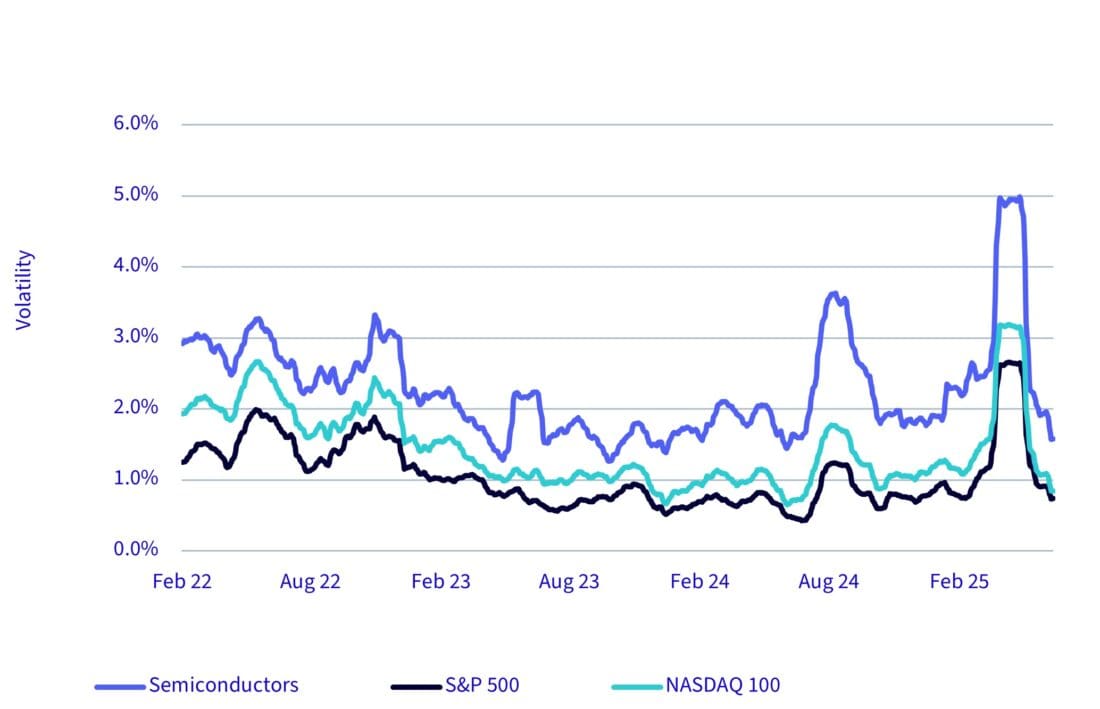
Source: Bloomberg, as of 30 June 2025. Chart shows the 5-day moving average of the 30-day rolling standard deviation of daily returns. ‘Semiconductors’ is the PHLX Semiconductor Sector Total Return Index. S&P 500 is the S&P 500 Total Return Index. Historical performance is not an indication of future performance and any investments may go down in value.
Big promise and big daily moves
Stronger, faster, more efficient semiconductor chips promise to change the world around us. Artificial intelligence (AI) on our computers is not enough. We want it on our mobile phones, our watches, our headphones, and even our lawnmowers. Better chips, better AI, quicker results, happier customers.
But with high expectations comes high market sensitivity. This means excitement when Jensen Huang announces the next generation of chips from Nvidia, or when Broadcom announces earnings above expectations. Equally, it means disappointment when the threat of tariffs raises concerns about the flow of chips around the world.
The chart below shows how semiconductors have much fatter tails in the distribution compared to the S&P 500 and the NASDAQ 100. In other words, since the start of 2022, the number of days when semiconductors have exhibited large price moves – both positive and negative – is much higher than that of the S&P and NASDAQ. Whether they are chasing momentum or taking contrarian positions, such price moves appeal to traders who are prepared to make directional bets.
Figure 2: Distribution of daily returns – semiconductors have fatter tails
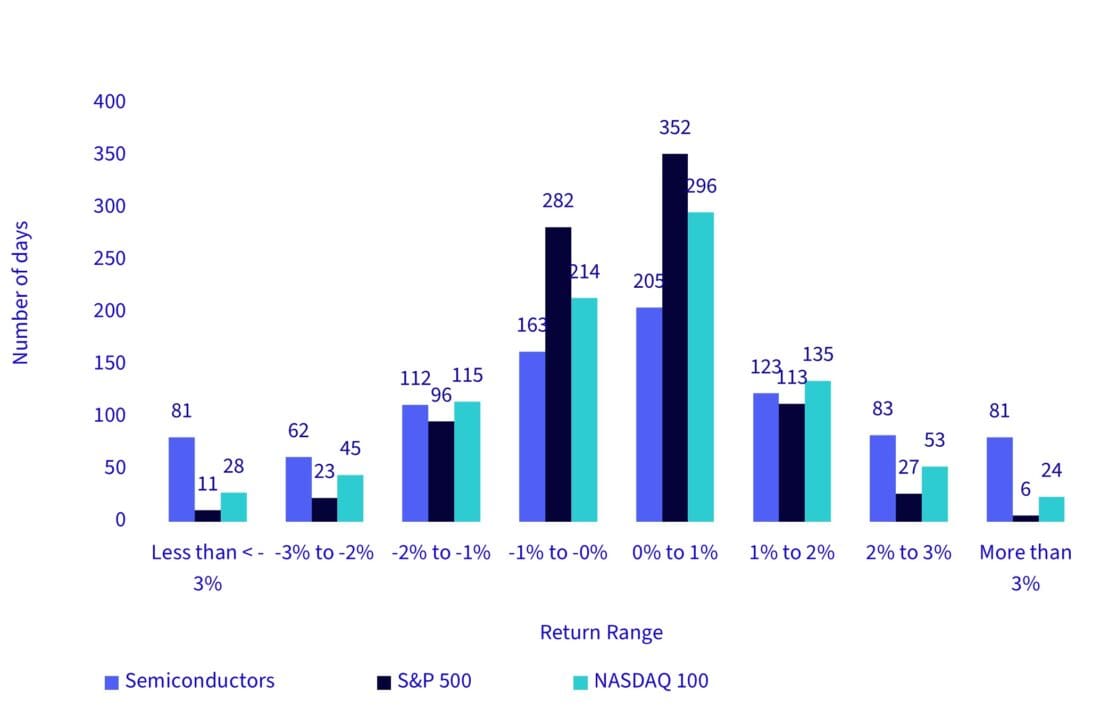
Source: Bloomberg, as of 30 June 2025. Chart shows the number of days for each index when the daily return was in the given range. ‘Semiconductors’ is the PHLX Semiconductor Sector Total Return Index. S&P 500 is the S&P 500 Total Return Index. Historical performance is not an indication of future performance and any investments may go down in value.
There is always something going on
What causes semiconductors to exhibit such sharp price moves and generally higher levels of volatility? Several factors are at play.
There are macro influences. Interest rates and monetary policy affect all businesses, but they hit emerging or high-growth sectors – where future cash flows are less predictable – even harder.
Trade tensions are another driver, but for semiconductors, they carry added weight due to the geopolitical significance of the technology and the strategic importance of chips that are designed in the US and fabricated in Taiwan.
Excitement around major technology trends like AI, cloud computing, electric vehicles, autonomous driving, and robotics drives structural growth for the sector.
Supply chain disruptions, as seen during COVID-19 in 2021, can also trigger sharp market reactions.
Capital expenditure announcements often signal optimism – and, of course, company-specific catalysts like earnings are impossible to ignore.
Semiconductors are exciting, and they are here to stay
Semiconductors are like the beating heart of modern technology. The heart can be strengthened with cardiovascular exercise, but it cannot be replaced. Similarly, semiconductors are likely to keep getting stronger and capable of greater things, enabling the development of new technologies, but they are unlikely to be replaced. Certainly not for now.
Their importance keeps them on centre stage in markets. This makes them very appealing to tactical investors.
1 Computerhistory.org, 2025.
Disclosure: WisdomTree Europe
This material is prepared by WisdomTree and its affiliates and is not intended to be relied upon as a forecast, research or investment advice, and is not a recommendation, offer or solicitation to buy or sell any securities or to adopt any investment strategy. The opinions expressed are as of the date of production and may change as subsequent conditions vary. The information and opinions contained in this material are derived from proprietary and non-proprietary sources. As such, no warranty of accuracy or reliability is given and no responsibility arising in any other way for errors and omissions (including responsibility to any person by reason of negligence) is accepted by WisdomTree, nor any affiliate, nor any of their officers, employees or agents. Reliance upon information in this material is at the sole discretion of the reader. Past performance is not a reliable indicator of future performance.
Please click here for our full disclaimer.
Jurisdictions in the European Economic Area (“EEA”): This content has been provided by WisdomTree Ireland Limited, which is authorised and regulated by the Central Bank of Ireland.
Jurisdictions outside of the EEA: This content has been provided by WisdomTree UK Limited, which is authorised and regulated by the United Kingdom Financial Conduct Authority.
Disclosure: Interactive Brokers Third Party
Information posted on IBKR Campus that is provided by third-parties does NOT constitute a recommendation that you should contract for the services of that third party. Third-party participants who contribute to IBKR Campus are independent of Interactive Brokers and Interactive Brokers does not make any representations or warranties concerning the services offered, their past or future performance, or the accuracy of the information provided by the third party. Past performance is no guarantee of future results.
This material is from WisdomTree Europe and is being posted with its permission. The views expressed in this material are solely those of the author and/or WisdomTree Europe and Interactive Brokers is not endorsing or recommending any investment or trading discussed in the material. This material is not and should not be construed as an offer to buy or sell any security. It should not be construed as research or investment advice or a recommendation to buy, sell or hold any security or commodity. This material does not and is not intended to take into account the particular financial conditions, investment objectives or requirements of individual customers. Before acting on this material, you should consider whether it is suitable for your particular circumstances and, as necessary, seek professional advice.
Disclosure: ETFs
Any discussion or mention of an ETF is not to be construed as recommendation, promotion or solicitation. All investors should review and consider associated investment risks, charges and expenses of the investment company or fund prior to investing. Before acting on this material, you should consider whether it is suitable for your particular circumstances and, as necessary, seek professional advice.
Disclosure: Futures Trading
Futures are not suitable for all investors. The amount you may lose may be greater than your initial investment. Before trading futures, please read the CFTC Risk Disclosure. A copy and additional information are available at the Warnings and Disclosures section of your local Interactive Brokers website.






Join The Conversation
If you have a general question, it may already be covered in our FAQs page. go to: IBKR Ireland FAQs or IBKR U.K. FAQs. If you have an account-specific question or concern, please reach out to Client Services: IBKR Ireland or IBKR U.K..
Visit IBKR U.K. Open an IBKR U.K. Account