









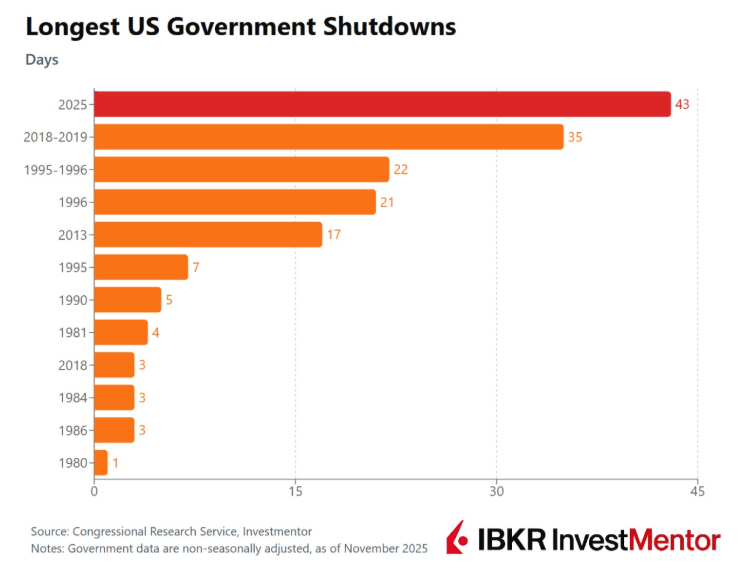
After 43 days of disruption, the longest government shutdown in US history is officially over. On Wednesday night, President Donald Trump signed a stopgap funding bill after the House passed it 222–209, restoring pay for federal workers and restarting suspended services. But the deal only funds most government operations through January 30, setting up another potential shutdown just weeks away.
The government’s closure left a visible mark on the economy, disrupted critical services, and exposed deep structural flaws in how the US funds its government. And while markets (so used to the annual standoffs) barely flinched, the fallout is far from over.
Economic Impact: Delays, Disruptions, and Lost Output
More than one million Americans went without pay for six weeks. Federal workers return to their jobs Thursday, but full-service recovery will take time. The Congressional Budget Office (CBO) estimates that the shutdown delayed over $50 billion in government spending, including food aid for 42 million low-income Americans. Thousands of flights were cancelled due to air traffic staffing shortages, according to Federal Aviation Administration.
The CBO expects most of the economic damage to be clawed back over the course of next year — with the big assumption of no further shutdowns. But some losses are permanent: missed meals, cancelled trips, and deferred purchases that won’t be rescheduled.
Markets Shrug, Investors Tune Out Washington
Markets greeted the shutdown’s end with a shrug. Treasury yields barely moved, the dollar dipped slightly, and global equities were flat to modestly higher. Wall Street had already priced in a resolution earlier this week, and even that reaction was subdued.
Investors have grown numb to annual budget fights. To them, Washington is noise, not a signal. The real source of volatility lately? Tech stock valuations, not Capitol Hill gridlock.
Fed in the Fog: Data Blackout Complicates Policy
The shutdown’s most lasting impact may be the data blackout. October’s inflation and jobs reports will likely never be released, leaving the Federal Reserve without key inputs ahead of its December rate decision.
Economists are urging the Labor Department to fast-track November CPI and payrolls. The Fed is still expected to cut rates by 25 basis points to 3.50%–3.75%, but may have to rely on September data and private estimates to make the call. As Chair Jerome Powell put it, “What do you do if you’re driving in the fog? You slow down.”
Why Shutdowns Keep Happening
Most democracies allow government services to continue even without a finalized budget. The US used to do this too, until a 1980 Attorney General ruling barred agencies from spending without approved funding. That ruling turned the start of each fiscal year into a shutdown risk.
Stopgap deals like this one keep the lights on temporarily, but they don’t solve the underlying problem. Without structural reform, multiple shutdowns in the same year are not just possible; they’re increasingly likely.


Learn more about InvestMentor
Disclosure: Interactive Brokers Affiliate
Information posted on IBKR Campus that is provided by third-parties does NOT constitute a recommendation that you should contract for the services of that third party. Third-party participants who contribute to IBKR Campus are independent of Interactive Brokers and Interactive Brokers does not make any representations or warranties concerning the services offered, their past or future performance, or the accuracy of the information provided by the third party. Past performance is no guarantee of future results.
This material is from IBKR InvestMentor, an affiliate of Interactive Brokers LLC, and is being posted with its permission. The views expressed in this material are solely those of the author and/or IBKR InvestMentor and Interactive Brokers is not endorsing or recommending any investment or trading discussed in the material. This material is not and should not be construed as an offer to buy or sell any security. It should not be construed as research or investment advice or a recommendation to buy, sell or hold any security or commodity. This material does not and is not intended to take into account the particular financial conditions, investment objectives or requirements of individual customers. Before acting on this material, you should consider whether it is suitable for your particular circumstances and, as necessary, seek professional advice.
Disclosure: Interview Relationship with IBKR
The interviewee’s employer or associated organization has a business relationship as a client and futures commission merchant, or FCM, with Interactive Brokers.






Join The Conversation
If you have a general question, it may already be covered in our FAQs page. go to: IBKR Ireland FAQs or IBKR U.K. FAQs. If you have an account-specific question or concern, please reach out to Client Services: IBKR Ireland or IBKR U.K..
Visit IBKR U.K. Open an IBKR U.K. Account