






GameStop is not shy about big gestures. But its $56 billion bid for eBay is in another league. This is a full‑blown attempt by a much smaller company to swallow a vastly larger one — financed with a mix of cash, debt, and swagger.
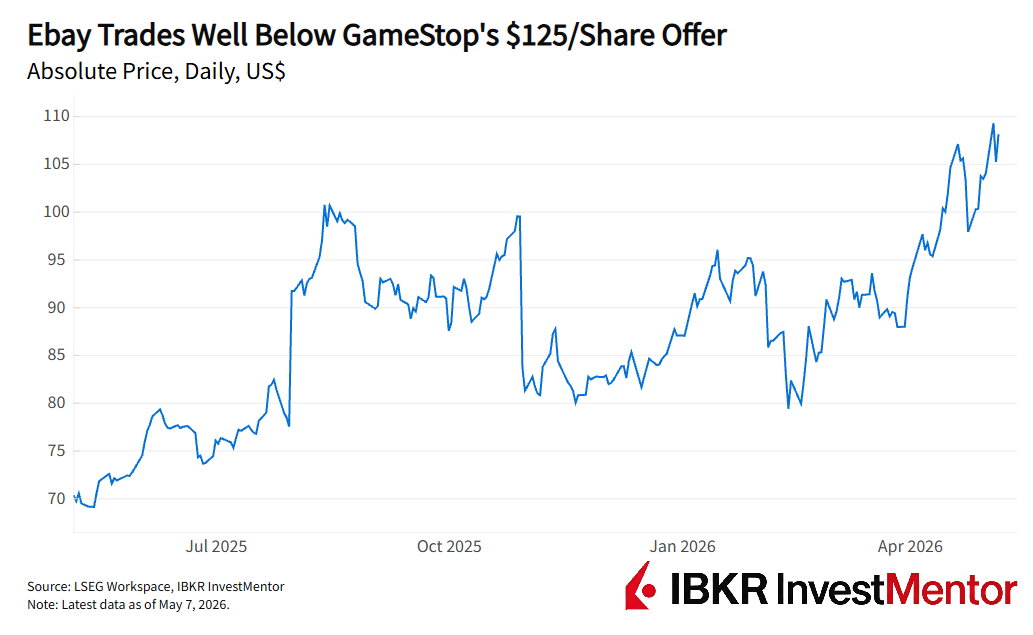
The proposal arrived unsolicited, dressed half in cash and half in GameStop stock, at $125 per eBay share, a 46% premium to where eBay traded before GameStop started buying shares. On paper, it is audacious. In practice, it has forced markets to ask an uncomfortable question: has meme‑era finance reached a new phase, where viral buzz can momentarily outrun balance sheets?
The answer matters far beyond these two companies.
An Asymmetric Chase
As of Thursday, GameStop is worth roughly $11 billion, eBay about $48 billion. Even by Wall Street standards, that is an extreme mismatch.
Only a handful of deals like this have ever worked — most recently, Paramount Skydance’s takeover of Warner Bros. Discovery, a lopsided merger made possible only by a deep‑pocketed investor consortium and dozens of billions in backing from Larry Ellison. And that one is still yet to close.
Yet GameStop already owns 5% of eBay and says it can line up $9 billion in cash, as much as $20 billion in debt, and additional equity issuance to bridge the gap.
The logic, according to CEO Ryan Cohen, is scale and fandom. GameStop brings a fiercely loyal retail investor base and 1,600 physical stores. eBay brings global online reach, logistics know‑how, and momentum in collectibles — a category both companies already orbit. Together, Cohen says, the duo could become a business worth “hundreds of billions.”
This would be a business that exists beyond logic, purely on a plane of emotion. GameStop sells, for example, a Pokémon card bundle for $5,000, with some individual cards fetching tens of thousands of dollars on platforms like eBay.
Past performance is not indicative of future returns.
Fandom, Not Finance
Markets are unconvinced. After the announcement, eBay shares rose about 5%, but trading well below the offer price — a classic signal that investors doubt the deal will close. GameStop shares fell. Skeptics point out that taking on that much debt would be an immense risk for a company whose stock price rests heavily on sentiment. Issuing stock to close the gap would dilute existing shareholders, shrinking their slice of the future company.
This is what makes the bid unusual. It is not a clean industrial marriage. It is a faith‑based acquisition, asking investors to believe that fandom and narrative can substitute for size.
How Big Deals Normally Work
Large public takeovers tend to follow a rigid script. A buyer often builds a stake gradually and eventually offers a premium to win shareholders over. It lines up financing. The target’s board evaluates the proposal and recommends a vote. Sometimes, if talks fail, the bid goes hostile. Finally, the regulators weigh in.
GameStop has checked several of those boxes. But scale changes everything. At $56 billion, this transaction would rank among the largest leveraged buyouts ever attempted if mostly funded with debt. Deals at that size rarely hinge on vibes. Instead, they hinge on cash flow forecasts, integration plans, regulatory approvals, and lenders’ willingness to stay put when markets wobble.
That is why analysts keep circling the same questions: Where are the cost savings? What operational overlap exists? Does a brick-and-mortar retailer that buys inventory belong with a marketplace that never touches it?
Until those questions have convincing answers, investors and lenders will remain skeptical. Wild ideas alone don’t kill big M&A, but the deal will collapse if financing dries up.
Past performance is not indicative of future returns.
The Squeeze That Changed Everything
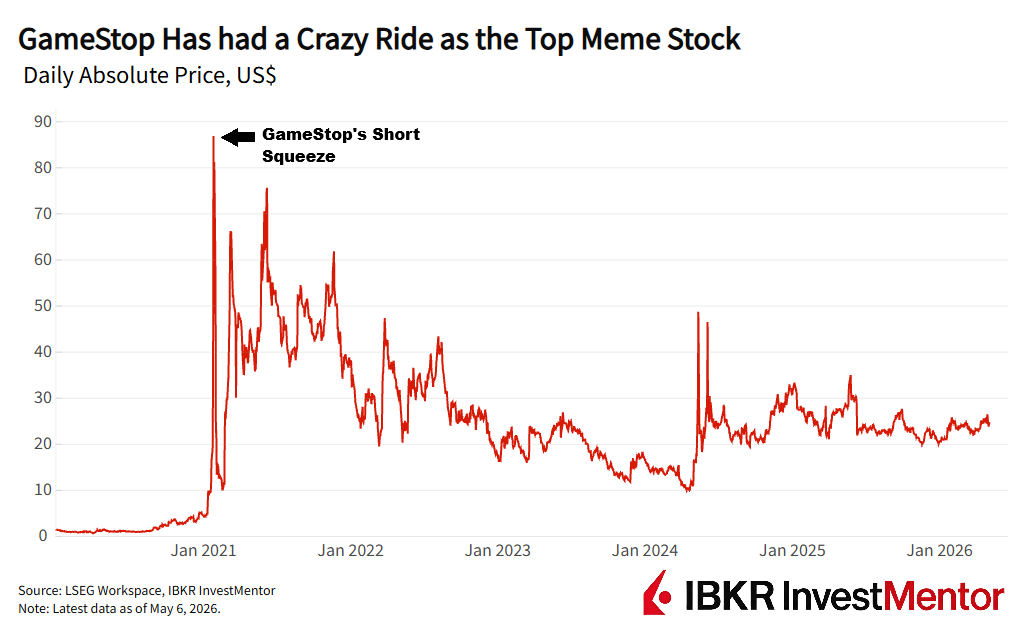
None of this is intelligible without revisiting 2021, when GameStop became the symbol of a generation of retail investors discovering markets in real time. Hedge funds had heavily shorted the stock, betting on its decline. Reddit’s WallStreetBets turned that logic inside out. As retail traders bought shares and call options en masse, short sellers were forced to buy back stock at soaring prices.
GameStop surged as much as 1,600% in two weeks. A struggling physical retailer was reborn as a financial phenomenon and a symbol of little people winning against big Wall Street institutions.
That episode gave GameStop two enduring assets: a massive retail following and the ability to raise billions through repeated share issuance. Today’s eBay bid is a direct descendant of that moment. Without the squeeze, this deal would never have been imaginable. Retail traders have returned, buying both GameStop and eBay shares, but so far there’s no full meme-mania revival.
According to BlackRock, retail participation in US stock trading has climbed to nearly 20% of daily volumes, up from low single digits before the pandemic. Meme stocks did not just entertain. They permanently altered who shows up at the market table, with pandemic checks and zero-commission trading feeding the boom too.
But participation does not neutralize gravity. Investor Michael Burry of the Big Short fame was once an admirer of Cohen’s playbook, encouraging GameStop to build a portfolio of companies. But he exited his entire GameStop stake after the bid, warning of debt. His message was blunt: ambition alone does not create Berkshire Hathaway.
Quixotic, But Not Pointless
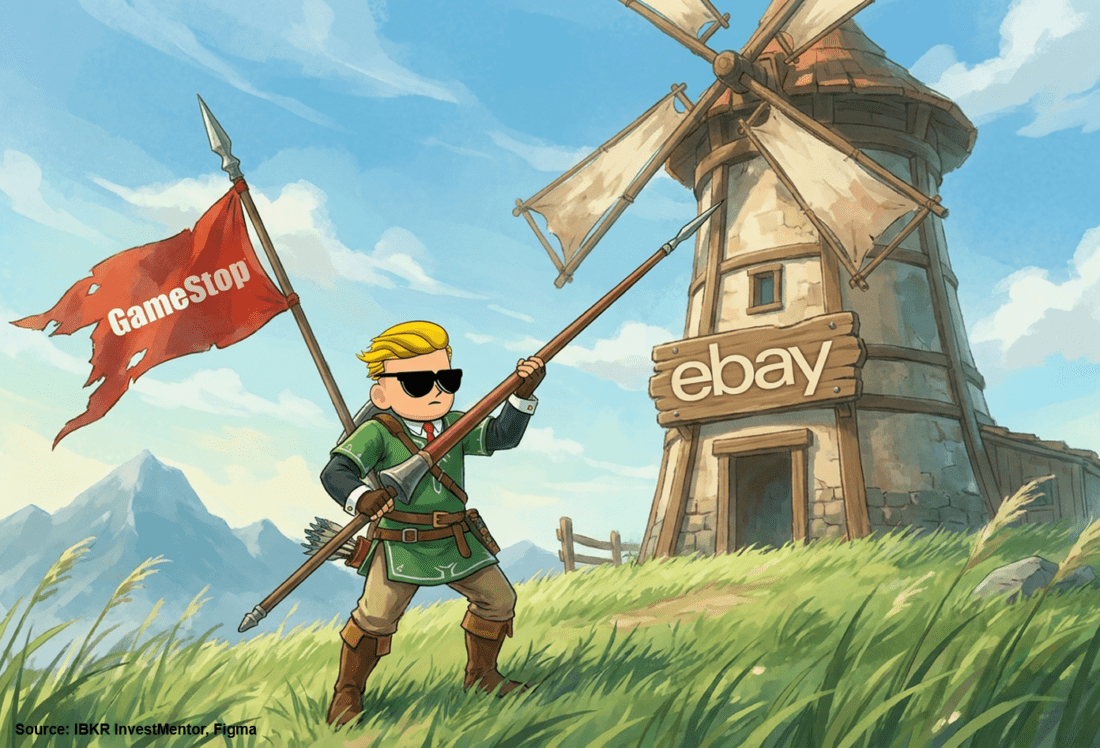
It is tempting to dismiss this chase as a spectacle or a joke. Some online already have, comparing Cohen and his WallStreetBets fans to Don Quixote tilting at corporate windmills.
But this bid exposes a deeper truth about modern markets and society as a whole. Capital is no longer just allocated by old, established institutions. It can be mobilized by online communities, and those communities can keep companies alive, liquid, and ambitious far longer than traditional finance models would predict.
Whether this deal closes or collapses, it marks a boundary test. It asks how far narrative, loyalty, and retail capital can stretch before hitting structural limits. It forces boards, bankers, investors, and regulators to grapple with a market that no longer moves solely on spreadsheets.
GameStop may not end up owning eBay. But its chase has already revealed something enduring: meme‑era capitalism refuses to be just an entertaining sideshow. It is capable of launching serious, destabilizing bids — even when logic is running to catch up.
Download IBKR InvestMentor for free lessons and news explainers to build your confidence as an investor.


Learn more about InvestMentor
Disclosure: Interactive Brokers Affiliate
Information posted on IBKR Campus that is provided by third-parties does NOT constitute a recommendation that you should contract for the services of that third party. Third-party participants who contribute to IBKR Campus are independent of Interactive Brokers and Interactive Brokers does not make any representations or warranties concerning the services offered, their past or future performance, or the accuracy of the information provided by the third party. Past performance is no guarantee of future results.
This material is from IBKR InvestMentor, an affiliate of Interactive Brokers LLC, and is being posted with its permission. The views expressed in this material are solely those of the author and/or IBKR InvestMentor and Interactive Brokers is not endorsing or recommending any investment or trading discussed in the material. This material is not and should not be construed as an offer to buy or sell any security. It should not be construed as research or investment advice or a recommendation to buy, sell or hold any security or commodity. This material does not and is not intended to take into account the particular financial conditions, investment objectives or requirements of individual customers. Before acting on this material, you should consider whether it is suitable for your particular circumstances and, as necessary, seek professional advice.
Disclosure: Interview Relationship with IBKR
The interviewee’s employer or associated organization has a business relationship as a client and futures commission merchant, or FCM, with Interactive Brokers.






Join The Conversation
If you have a general question, it may already be covered in our FAQs page. go to: IBKR Ireland FAQs or IBKR U.K. FAQs. If you have an account-specific question or concern, please reach out to Client Services: IBKR Ireland or IBKR U.K..
Visit IBKR U.K. Open an IBKR U.K. Account