






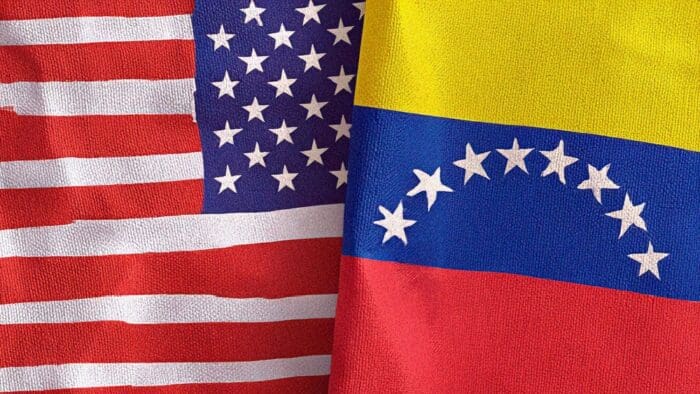


What does the Trump-ordered U.S. military strike on Venezuela mean for investors and oil markets?
Market recap
- Equity markets are off and running in 2026, with most major indices posting gains this week.
- The S&P 500 rose 1.6%, led by consumer discretionary and materials, leaving the index at all-time highs to start the 2026 campaign.
- Meantime, the TSX is similarly pushing all-time highs after adding 2.3% this week on the back of strong gains in materials and technology.
Venezuela
As the situation surrounding the U.S. military operation to capture former Venezuelan president Nicolás Maduro continues to play out, investors are left to grapple with the longer-term ramifications of a U.S. administration willing to resort to gunboat diplomacy to achieve its geopolitical aims. This is a persistent risk of this U.S. administration—as we saw throughout 2025, we rarely know what its next move will be, and we’d expect more unpredictability in 2026. In particular, we think the strike signals that the U.S. is unlikely to take a hands-off approach to any geopolitical situation that the Trump administration believes could affect its interests, which is potentially significant for Canada. The upcoming U.S. midterm elections in November may also be influencing Trump’s thinking, as it provides a strong incentive for his administration to try to lower gas prices. However, any increase in oil supply is not going to happen overnight: the infrastructure in Venezuela needs to be rebuilt, U.S. companies would need to be convinced to operate in the country (which would likely require some guaranteed money), and any sudden increase in supply could hurt U.S. shale producers. Ultimately, the impact on oil markets will depend on how much influence the Trump administration is willing—and able—to exert in the country.
Bottom line: The U.S. military’s operation in Venezuela underscores the unpredictability of the Trump administration, which we expect to continue to be a major theme in 2026.
Canada
The U.S. intervention in Venezuela could have a negative impact on Canadian oil markets—but the situation is complex. Venezuela has the largest reserves in the world. Hypothetically, if the U.S. takes some oil from Venezuela, then they might need less from Canada given they both produce similar heavy crude oil. However, Venezuelan and Canadian oil tend to serve different geographic regions of the U.S., so a one-for-one replacement may not be feasible in the short term. Notably, China is also a major buyer of Venezuelan oil (receiving over 80% of Venezuela’s oil exports). Any shortfall there could lead China to turn to Canada for supply, potentially making up for reduced U.S. demand. This dynamic would appear to raise the stakes for Prime Minister Mark Carney trip to China this week for trade talks with Chinese President Xi Jinping. Overall, the Venezuela situation underscores the need for Canada to reduce its reliance on the United States and work more closely with other nations. This strategy could include the creation of more oil pipelines, though that continues to be a contentious political debate. Beyond oil, closer trade relations between Canada and China could also have ramifications on Canada’s critical minerals industry given the supply required for China’s electric vehicle (E.V.) industry. This may also become another hurdle for Canada in its negotiations with the U.S. over the Canada-United States-Mexico Agreement (CUMSA) since we might have one less bargaining chip.
Bottom line: The potential for more Venezuelan oil to reach U.S. shores adds to our uncertainty about Canada’s economic outlook, but closer trade ties with China could help to compensate for any negative impacts.
Technology
Last week, the Wall Street Journal reported that artificial intelligence (A.I.) company Anthropic is considering an initial public offering (IPO) in the next twelve-to-sixteen months at a valuation of $350 billion.1 This will be a very high-profile IPO and is likely to add some positive sentiment to the A.I. story, in our view. However, elevated valuations are also likely to bring the A.I. bears out of the woods. This ties into one of our overarching risks for 2026, as periodic negativity on A.I. could cause market volatility to persist. Beyond Anthropic, we do expect more Technology IPOs, especially if the Anthropic offering is successful, though the biggest name out there—OpenAI—is still a question mark given Elon Musk’s ongoing fraud lawsuit against the company. Importantly, we do not think this is a case of Anthropic simply striking while the iron is hot. While there is always the potential for investor sentiment to shift, the A.I. story is not likely to go away, and the types of investors that will support Anthropic and other Tech companies’ IPOs are strong believers in the theme.
Bottom line: We expect the Anthropic IPO—and potentially other A.I.-related IPOs down the road—to be very well-received by markets.
—
Originally Posted January 12, 2026 – What the Venezuela situation means for investors
Disclosure: BMO Exchange Traded Funds
Commissions, management fees and expenses all may be associated with investments in exchange traded funds. Please read the ETF Facts or prospectus of the BMO ETFs before investing. Exchange traded funds are not guaranteed, their values change frequently and past performance may not be repeated.
For a summary of the risks of an investment in the BMO ETFs, please see the specific risks set out in the BMO ETF’s prospectus. BMO ETFs trade like stocks, fluctuate in market value and may trade at a discount to their net asset value, which may increase the risk of loss. Distributions are not guaranteed and are subject to change and/or elimination.
BMO ETFs are managed by BMO Asset Management Inc., which is an investment fund manager and a portfolio manager, and a separate legal entity from Bank of Montreal.
®/™Registered trade-marks/trade-mark of Bank of Montreal, used under licence.
Disclosure: Interactive Brokers Third Party
Information posted on IBKR Campus that is provided by third-parties does NOT constitute a recommendation that you should contract for the services of that third party. Third-party participants who contribute to IBKR Campus are independent of Interactive Brokers and Interactive Brokers does not make any representations or warranties concerning the services offered, their past or future performance, or the accuracy of the information provided by the third party. Past performance is no guarantee of future results.
This material is from BMO Exchange Traded Funds and is being posted with its permission. The views expressed in this material are solely those of the author and/or BMO Exchange Traded Funds and Interactive Brokers is not endorsing or recommending any investment or trading discussed in the material. This material is not and should not be construed as an offer to buy or sell any security. It should not be construed as research or investment advice or a recommendation to buy, sell or hold any security or commodity. This material does not and is not intended to take into account the particular financial conditions, investment objectives or requirements of individual customers. Before acting on this material, you should consider whether it is suitable for your particular circumstances and, as necessary, seek professional advice.



Join The Conversation
If you have a general question, it may already be covered in our FAQs page. go to: IBKR Ireland FAQs or IBKR U.K. FAQs. If you have an account-specific question or concern, please reach out to Client Services: IBKR Ireland or IBKR U.K..
Visit IBKR U.K. Open an IBKR U.K. Account