










Past performance is not indicative of future results.
Recent statements from the Federal Reserve have prompted discussions about potential changes to the future path of US interest rates. Historically, adjustments in monetary policy have coincided with movements in the small-cap sector, impacting stocks represented by the Russell 2000 Index.
A significant moment regarding interest rate changes occurred during Federal Reserve Chair Jerome Powell’s address at the annual Jackson Hole symposium. His remarks, coupled with a recent labour market report, have heightened interest in futures markets regarding potential rate changes. This has contributed to a market rally, with futures reflecting a 75% probability of a rate cut at the upcoming September Fed meeting.
The Russell 2000 Index, which tracks the performance of small-cap stocks, has responded to these developments with an increase. Since the beginning of August, the index has increased 7.3%, marking its best month relative to the S&P 500 since July 2024. This growth is linked to expectations of looser monetary policy, which may benefit regional banks and industrial companies that comprise a significant portion of the index.
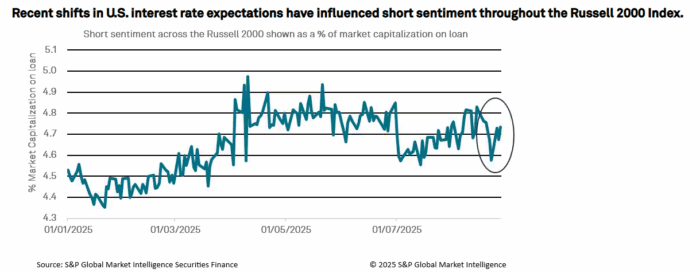
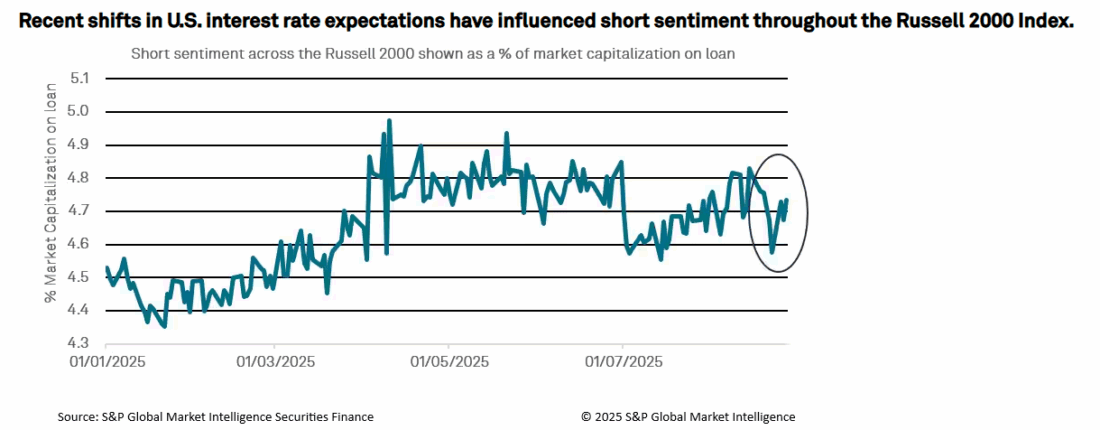
However, alongside this positive sentiment, there has been a notable rise in short interest, with currently 4.73% of market capitalization on loan, up from 4.58% as of August 22. This increase in short interest reflects a level of scepticism among certain investors regarding the sustainability of the small-cap rally. The rise in short positions suggests that while some investors anticipate gains from the Russell 2000 due to potential interest rate cuts, others are positioning themselves defensively in light of possible market corrections.
This situation prompts an examination of the relationship between short interest and the performance of small-cap stocks in the context of changing interest rates. Historically, lower interest rates have been associated with improved performance for small-cap stocks, primarily due to reduced borrowing costs that enhance profitability for smaller companies often reliant on debt for expansion. When the Fed cuts rates, it typically leads to increased consumer spending and business investment, fostering an economic environment conducive to growth for small-cap companies.
Moreover, as interest rates decline, small-cap stock valuations often rise. Investors tend to take more risks in a low-rate environment, leading to increased capital inflows into small-cap equities. This trend has been reflected in the Russell 2000’s recent performance, which has outpaced larger counterparts amid expectations of monetary easing.
However, the concurrent rise in short interest indicates that some investors are adopting a cautious approach. Concerns regarding the sustainability of upward momentum may arise from economic uncertainties or specific sector challenges. The increase in short positions could signal a belief among some investors that current valuations may not be entirely justified.
The relationship between rising short interest and the growth of the Russell 2000 Index is shaped by the Federal Reserve’s monetary policy. While the potential for rate cuts may suggest a positive outlook for small-cap stocks, the increase in short interest highlights scepticism among certain investors. As the market adjusts to these dynamics, the performance of the Russell 2000 may depend on the balance between investor optimism influenced by lower rates and the caution reflected in rising short positions.
—
Originally Posted August 28, 2025 – The Tug of War: Short Interest vs. R2K Growth.
Disclosure: Interactive Brokers Third Party
Information posted on IBKR Campus that is provided by third-parties does NOT constitute a recommendation that you should contract for the services of that third party. Third-party participants who contribute to IBKR Campus are independent of Interactive Brokers and Interactive Brokers does not make any representations or warranties concerning the services offered, their past or future performance, or the accuracy of the information provided by the third party. Past performance is no guarantee of future results.
This material is from S&P Global Market Intelligence and is being posted with its permission. The views expressed in this material are solely those of the author and/or S&P Global Market Intelligence and Interactive Brokers is not endorsing or recommending any investment or trading discussed in the material. This material is not and should not be construed as an offer to buy or sell any security. It should not be construed as research or investment advice or a recommendation to buy, sell or hold any security or commodity. This material does not and is not intended to take into account the particular financial conditions, investment objectives or requirements of individual customers. Before acting on this material, you should consider whether it is suitable for your particular circumstances and, as necessary, seek professional advice.





Join The Conversation
If you have a general question, it may already be covered in our FAQs page. go to: IBKR Ireland FAQs or IBKR U.K. FAQs. If you have an account-specific question or concern, please reach out to Client Services: IBKR Ireland or IBKR U.K..
Visit IBKR U.K. Open an IBKR U.K. Account