










Friday turned out to be a relatively ugly one. After a week when yields crossed above some key psychological levels, such as 4%, 4.5%, and 5% on the 2-year, 10-year, and 30-year Treasuries, the combination of higher yields and oil prices finally seemed to break the rampantly positive sentiment – at least for a day. Most of us in the US awoke to lower pre-market futures which gave way to slightly higher prices in the regular session, but those faded later in the morning. Where’s the dip buying?
Although some of the key yield levels were breached earlier in the week, Friday’s global bond selloff proved too much for stocks to ignore. We have seen countless examples of relatively material early selloffs that were treated as, and proved to be, buying opportunities. On Tuesday, the S&P 500 (SPX) fell nearly 1% in the morning but recovered to close only 0.16% lower. That recovery proved to be the launching pad for subsequent 0.58% and 0.77% jumps on the next two trading days. But we sensed that something felt different, closing our piece with:
As I finish this piece, traders don’t seem as willing as usual to try their hand at dip buying today. We’ll see if the usual attempt arrives later or not.
Despite some lackluster attempts at bounces, a solid bounce failed to emerge. Bear in mind that even after Friday’s -1.24% move, that still left SPX up 0.13% for the week. One relatively big down move was not sufficient to leave even a minor scar on the benchmark’s weekly performance, let alone dent the uptrends that underlie the advances in SPX, along with the Nasdaq 100 (NDX), and Philadelphia Semiconductor Index (SOX) that have been in place since the end of March.
As I type this, SPX and NDX are trading just around their 10-day moving averages, although SOX has pierced it more significantly. That said, all are well above their 30-day moving averages, with SOX specifically about 10% above that trendline.
SPX, 6-Months, Daily Candles with 10-day (yellow) and 30-day (purple) Moving Averages
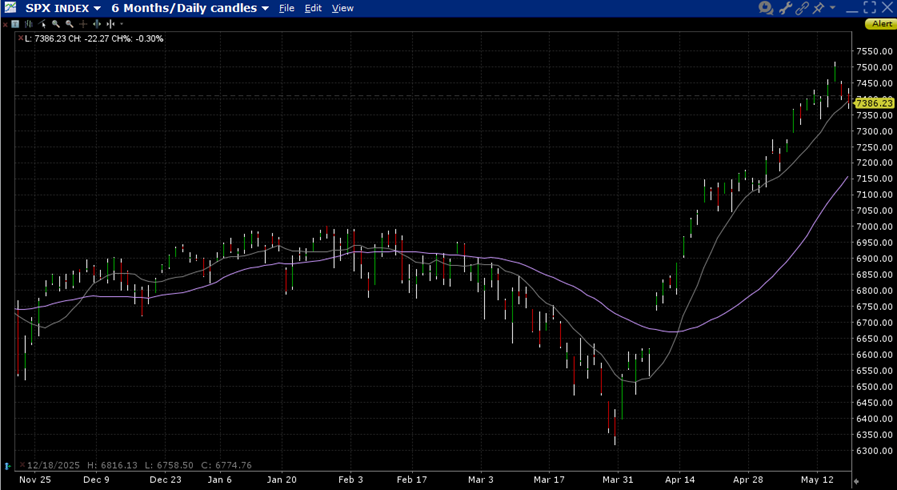
Source: Interactive Brokers, past performance is not indicative of future returns.
NDX, 6-Months, Daily Candles with 10-day (yellow) and 30-day (purple) Moving Averages
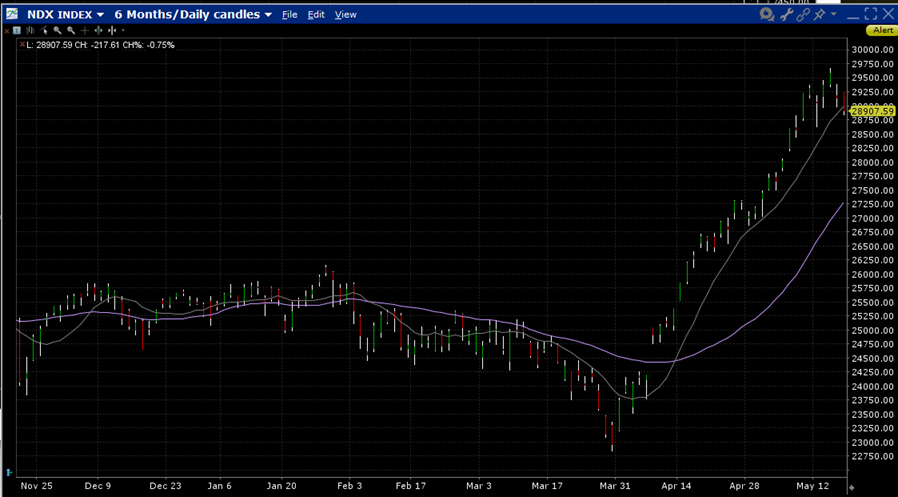
Source: Interactive Brokers, past performance is not indicative of future returns.
SOX, 6-Months, Daily Candles with 10-day (yellow) and 30-day (purple) Moving Averages
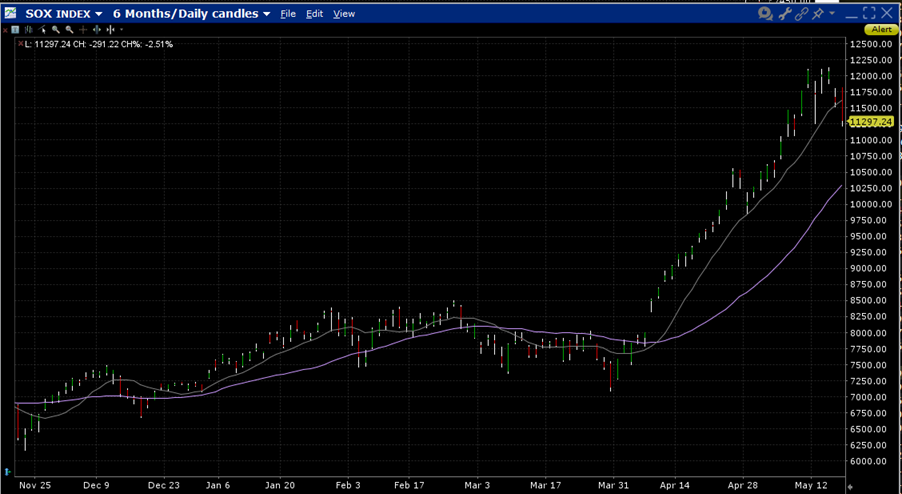
Source: Interactive Brokers, past performance is not indicative of future returns.
Thus, from a purely technical perspective, it is somewhat absurd even to suggest that we have truly defined a turning point for major equity indices. Nonetheless, it is not a preposterous consideration.
For starters, remember that stocks were able to shrug off concerns about rising bond yields and oil prices for weeks. Suddenly they mattered on Friday. Momentum, bolstered by solid earnings, has allowed traders to largely ignore those external factors since the end of March; Friday’s rise in global yields was far too large to simply be shrugged off. Today, we see relatively stable bond yields, but stocks have not been able to find their usual footing. Another rise in crude oil prices is likely another negative.
Also, we didn’t get our usual bounce after positive news about prospects for progress in the Persian Gulf. There was a story this morning, very well-timed at about 8 AM EDT, about an Iranian peace proposal, that lifted pre-market futures off their lows but failed to result in a solid rally. Instead, stocks sank again when that proposal was reported to be rejected. This differs from the recent pattern of a solid rise after any overtures toward a resolution to the conflict and no market consequences when the hoped-for results were for naught.
Taken together, these signals might be indicating a subtle change in market psychology. Of course, a turnaround in bond yields, oil prices, or the peace process will almost certainly cause the prior market psychology to return in a hurry. That may be why we continue to see VIX around 18.5 despite the recent drops. Bear in mind too that we get two important reads on the consumer and the pace of AI spending when Walmart (WMT) and Nvidia (NVDA) each report earnings later this week.
Fundamentals matter. They did on Friday and they should do so later this week.
New to Interactive Brokers?
Open AccountAlready an Interactive Brokers Client?
Request Trading PermissionDisclosure: Interactive Brokers
The analysis in this material is provided for information only and is not and should not be construed as an offer to sell or the solicitation of an offer to buy any security. To the extent that this material discusses general market activity, industry or sector trends or other broad-based economic or political conditions, it should not be construed as research or investment advice. To the extent that it includes references to specific securities, commodities, currencies, or other instruments, those references do not constitute a recommendation by IBKR to buy, sell or hold such investments. This material does not and is not intended to take into account the particular financial conditions, investment objectives or requirements of individual customers. Before acting on this material, you should consider whether it is suitable for your particular circumstances and, as necessary, seek professional advice.
The views and opinions expressed herein are those of the author and do not necessarily reflect the views of Interactive Brokers, its affiliates, or its employees.
Disclosure: Futures Trading
Futures are not suitable for all investors. The amount you may lose may be greater than your initial investment. Before trading futures, please read the CFTC Risk Disclosure. A copy and additional information are available at the Warnings and Disclosures section of your local Interactive Brokers website.
Disclosure: Bonds
As with all investments, your capital is at risk.






Join The Conversation
If you have a general question, it may already be covered in our FAQs page. go to: IBKR Ireland FAQs or IBKR U.K. FAQs. If you have an account-specific question or concern, please reach out to Client Services: IBKR Ireland or IBKR U.K..
Visit IBKR U.K. Open an IBKR U.K. Account