







A small group of mega-cap companies now steers the S&P 500. The top 10 control more than 40% of the index, according to LSEG data, making markets more sensitive to single-company moves than at any point in decades.
Typically when these firms rally, the whole index typically surges. When they stumble, everything often shakes. For traders, this concentration means overall index strength can mask weakness in the other 490 stocks, and portfolios lean heavily on a handful of winners.
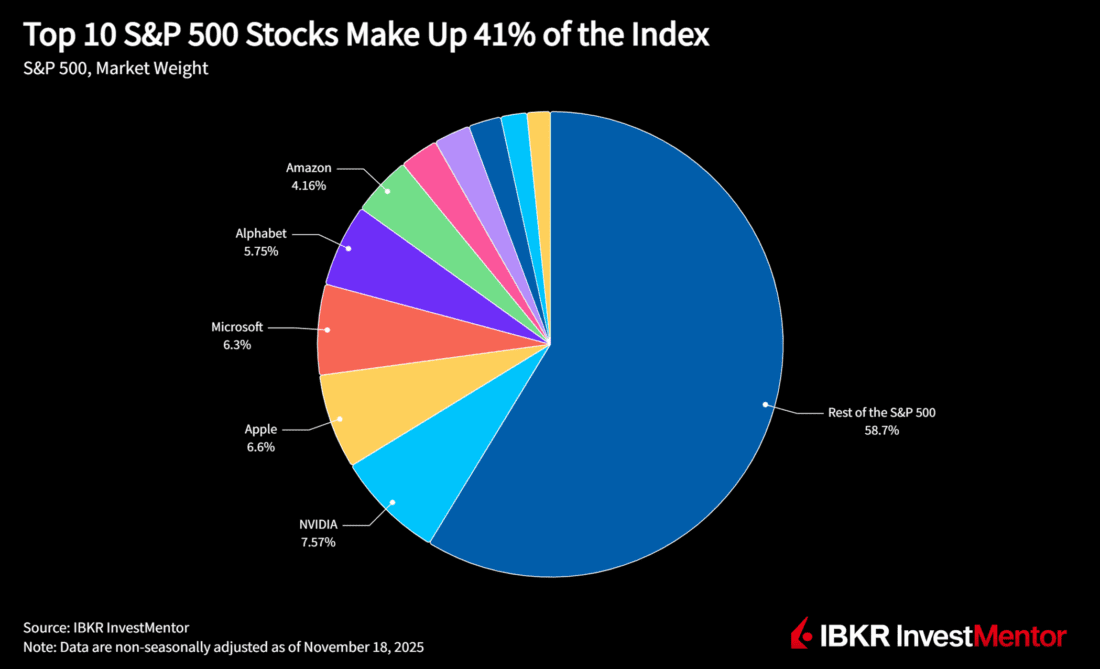
Past performance is not indicative of future results.
The Power of the Few
The S&P 500 heavyweights form a tight club of tech names: Nvidia, Apple, Microsoft, Alphabet, Amazon, Broadcom, and Meta. Even the “outsiders” tie back to tech.
Tesla is a car company, but its investments in AI and robotics keep it aligned with the sector. Warren Buffett’s investment juggernaut Berkshire Hathaway has large stakes in Apple and Alphabet. Pharmaceutical Eli Lilly’s rise is powered by weight-loss drugs, amplified by viral social media buzz.
Much rides on the performance of the largest of them, Nvidia. A beat or miss at earnings can swing the entire index, a dynamic that will be on full display when Q3 results arrive on Wednesday.
The Passive Flow Engine
Passive investing has reinforced this concentration. Funds tracking indices like the S&P 500 buy the largest companies simply because they are already large, adding to their weight and widening the gap with the rest of the market.
With nearly half the index sitting in ten stocks, the buying loop becomes self-strengthening.
Market-cap weighting means even broad funds can hinge on a few names. Equal-weighted indices avoid this bias by giving each stock the same weight.
Backed by Fundamentals
Concentration isn’t just a quirk of index mechanics. It reflects genuine fundamentals. Big tech delivers massive earnings growth, global reach, and innovation in areas like AI. Their digital models scale almost without limit: once platforms, chips, or clouds are built, each extra user costs very little.
That creates high margins, huge cash reserves, and tough-to-disrupt moats. These entrenched advantages give dominant firms the power to widen their lead, reinforcing their influence on the index.
Echoes of Past Bubbles
History shows concentrated markets magnify booms and busts. In the late 1990s, tech stocks dominated indices before the dotcom crash. But even then, the top 10 peaked at just 27% of the S&P 500, according to Goldman Sachs.
Today’s setup is different: megacaps are profitable and well-established. Yet the lesson remains — when a handful of companies drive the market, volatility rises. Investors should watch whether the AI boom broadens leadership to new winners or keeps spoils confined to a few names.
To learn more about stock investing in plain language with interactive lessons, download IBKR InvestMentor app.


Learn more about InvestMentor
Disclosure: Interactive Brokers Affiliate
Information posted on IBKR Campus that is provided by third-parties does NOT constitute a recommendation that you should contract for the services of that third party. Third-party participants who contribute to IBKR Campus are independent of Interactive Brokers and Interactive Brokers does not make any representations or warranties concerning the services offered, their past or future performance, or the accuracy of the information provided by the third party. Past performance is no guarantee of future results.
This material is from IBKR InvestMentor, an affiliate of Interactive Brokers LLC, and is being posted with its permission. The views expressed in this material are solely those of the author and/or IBKR InvestMentor and Interactive Brokers is not endorsing or recommending any investment or trading discussed in the material. This material is not and should not be construed as an offer to buy or sell any security. It should not be construed as research or investment advice or a recommendation to buy, sell or hold any security or commodity. This material does not and is not intended to take into account the particular financial conditions, investment objectives or requirements of individual customers. Before acting on this material, you should consider whether it is suitable for your particular circumstances and, as necessary, seek professional advice.
Disclosure: Interview Relationship with IBKR
The interviewee’s employer or associated organization has a business relationship as a client and futures commission merchant, or FCM, with Interactive Brokers.
Disclosure: ETFs
Any discussion or mention of an ETF is not to be construed as recommendation, promotion or solicitation. All investors should review and consider associated investment risks, charges and expenses of the investment company or fund prior to investing. Before acting on this material, you should consider whether it is suitable for your particular circumstances and, as necessary, seek professional advice.
Disclosure: Security Futures
Security futures involve a high degree of risk and are not suitable for all investors. The amount you may lose may be greater than your initial investment. Before trading security futures, please read the Security Futures Risk Disclosure Statement. For a copy visit the Warnings and Disclosures section of your local Interactive Brokers website.






Join The Conversation
If you have a general question, it may already be covered in our FAQs page. go to: IBKR Ireland FAQs or IBKR U.K. FAQs. If you have an account-specific question or concern, please reach out to Client Services: IBKR Ireland or IBKR U.K..
Visit IBKR U.K. Open an IBKR U.K. Account