






At the recent Italian Tech Week, Jeff Bezos—interviewed by John Elkann, CEO of Stellantis—shared a reflection that resonated deeply with many investors. His message was simple but powerful: “Artificial intelligence is in a bubble—and only after the dust settles will we know who the real winners are.”
This statement recalls a familiar pattern in market history. During the early days of the internet, countless companies raced to lay fiber-optic cables, build infrastructure, and capture the new online economy. Most of those firms no longer exist today—yet the infrastructure they created became the foundation of the modern digital world.
Bezos’ insight serves as a reminder that, while speculative periods can be turbulent, they often leave behind transformative technologies that shape future growth.
History Rhymes: From the Dot-Com Bubble to the AI Revolution
The two charts above reveal a striking similarity between past and present market dynamics. The first image, known as the technology adoption curve, illustrates how every major innovation passes through an initial phase of euphoria, followed by disillusionment, and finally reaches a plateau of productivity once real value emerges. The second chart—showing the price history of Cisco Systems, one of the leading tech companies during the late 1990s—perfectly mirrors that pattern.
During the dot-com bubble, Cisco’s stock surged as investors projected limitless potential for internet connectivity—reaching the peak of inflated expectations—before collapsing when those expectations proved premature. Yet, as the second part of the graph shows, over time the technology matured, and the company’s long-term growth resumed, aligning with the slope of enlightenment and plateau of productivity phases.
Today, artificial intelligence seems to be following a similar trajectory: rapid excitement, widespread speculation, and an inevitable phase of correction before sustainable adoption. History may not repeat exactly—but it often rhymes, reminding investors that technological revolutions tend to follow the same psychological and economic cycle.
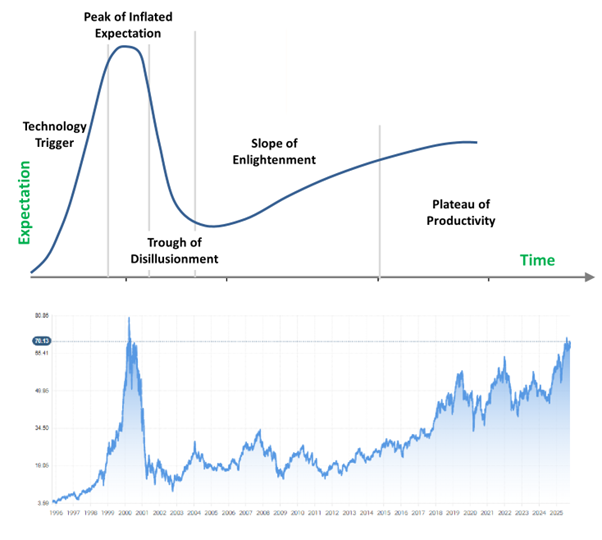
The pattern repeats: Cisco’s stock performance during the dot-com era mirrors the classic technology adoption curve—showing how hype, correction, and eventual productivity often define every major innovation cycle. Source: Forecaster.biz. Past performance is not indicative of future returns.
Beyond the Obvious AI Stocks
Today, investor attention is heavily concentrated on the companies directly associated with artificial intelligence—chipmakers, cloud providers, and software giants that dominate headlines and indexes. However, as Bezos suggested, history may reward those who look beyond the first wave.
The next stage of AI-driven value creation may come from firms that integrate these technologies to enhance their core operations rather than develop AI itself.
E-commerce platforms, financial-technology firms, education technology providers, and logistics companies are increasingly embedding AI into their business models—improving customer experience, operational efficiency, and decision-making.
When Innovation Meets Application
Recent data from OpenAI illustrates this shift. The company recognized over a hundred organizations worldwide for their high usage of AI tools and tokens—an indicator of deep integration rather than surface-level experimentation. Among those listed were well-known global names such as Duolingo, Salesforce, Shopify, and Mercado Libre—each leveraging AI to transform existing business processes.
Forecaster.biz was also honored in this group, receiving an award from OpenAI for surpassing 10 billion processed tokens, placing it among the first 140 organizations globally to achieve this milestone.
This trend underscores how artificial intelligence is evolving from a buzzword into a business utility. The firms most likely to endure are those that adopt AI not as a marketing concept, but as a driver of measurable productivity and user engagement. For investors, this evolution suggests that the most significant opportunities may eventually emerge where AI becomes invisible—embedded, efficient, and essential.
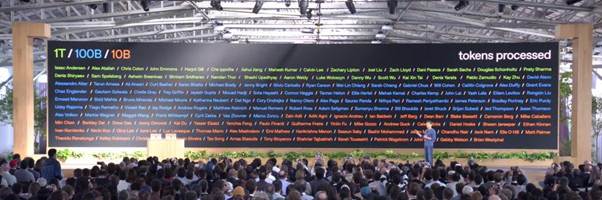
OpenAI Dev Day: recognition ceremony for the first organizations worldwide to surpass 10 billion tokens processed — including Forecaster.biz among global AI innovators.
Patience in Periods of Hype
Jeff Bezos’ comparison between the AI boom and the early internet serves as both a caution and an invitation. It reminds us that innovation cycles tend to follow a predictable rhythm: enthusiasm, overvaluation, correction, and then sustainable growth.
For long-term investors, understanding this cycle can encourage patience and perspective. The companies that endure past the hype are often those that combine strong fundamentals, technological adaptability, and prudent management. The challenge—and the opportunity—lies in identifying them after the noise fades.
From Bubble to Foundation
Artificial intelligence may indeed be in a bubble today, but history suggests that bubbles often finance the future. The fiber-optic networks of the 1990s paved the way for global connectivity; the AI infrastructure of the 2020s may do the same for automation, data analysis, and personalized digital experiences.
As the dust eventually settles, the most successful players will likely be those that not only build AI—but also use it effectively to create lasting value.
—
Originally Posted October 20, 2025
Disclaimer:
This article is for informational and educational purposes only and does not constitute investment advice, a recommendation, or an offer to buy or sell any financial instrument. Past performance is not indicative of future results. Investing involves risk, including the possible loss of principal.
Disclosure: Interactive Brokers Third Party
Information posted on IBKR Campus that is provided by third-parties does NOT constitute a recommendation that you should contract for the services of that third party. Third-party participants who contribute to IBKR Campus are independent of Interactive Brokers and Interactive Brokers does not make any representations or warranties concerning the services offered, their past or future performance, or the accuracy of the information provided by the third party. Past performance is no guarantee of future results.
This material is from Forecaster.biz and is being posted with its permission. The views expressed in this material are solely those of the author and/or Forecaster.biz and Interactive Brokers is not endorsing or recommending any investment or trading discussed in the material. This material is not and should not be construed as an offer to buy or sell any security. It should not be construed as research or investment advice or a recommendation to buy, sell or hold any security or commodity. This material does not and is not intended to take into account the particular financial conditions, investment objectives or requirements of individual customers. Before acting on this material, you should consider whether it is suitable for your particular circumstances and, as necessary, seek professional advice.
Disclosure: ETFs
Any discussion or mention of an ETF is not to be construed as recommendation, promotion or solicitation. All investors should review and consider associated investment risks, charges and expenses of the investment company or fund prior to investing. Before acting on this material, you should consider whether it is suitable for your particular circumstances and, as necessary, seek professional advice.





Join The Conversation
If you have a general question, it may already be covered in our FAQs page. go to: IBKR Ireland FAQs or IBKR U.K. FAQs. If you have an account-specific question or concern, please reach out to Client Services: IBKR Ireland or IBKR U.K..
Visit IBKR U.K. Open an IBKR U.K. Account