










In an era where global diversification is often touted as the safest path for passive investors, one index has become the go-to benchmark: the MSCI World Index. It represents more than 1,500 large and mid-cap stocks across 23 developed markets, offering investors the perceived benefit of worldwide exposure. But what if this index — despite its broad appeal — is actually holding back long-term returns?
Through a detailed analysis of historical data and strategic asset allocation, I believe that investors relying on the MSCI World Index, particularly for dollar-cost averaging strategies, may be significantly underperforming better alternatives. Here’s why.
The Hidden Concentration: 71% Is the U.S.
At first glance, the MSCI World Index appears globally balanced. In reality, it’s heavily skewed: over 70% of its allocation is in U.S. equities. Japan, the U.K., Canada, France, and 18 other developed markets make up the remaining portion — but with extremely limited weight.
This results in a paradox. Investors who think they’re achieving diversification are effectively buying U.S. equities… plus a diluted mix of markets that have historically underperformed. Not only are these secondary exposures small, but many of the underlying markets (such as Austria, Italy, or Portugal) are composed of companies that don’t match the innovation, profitability, or global reach of their U.S. counterparts.
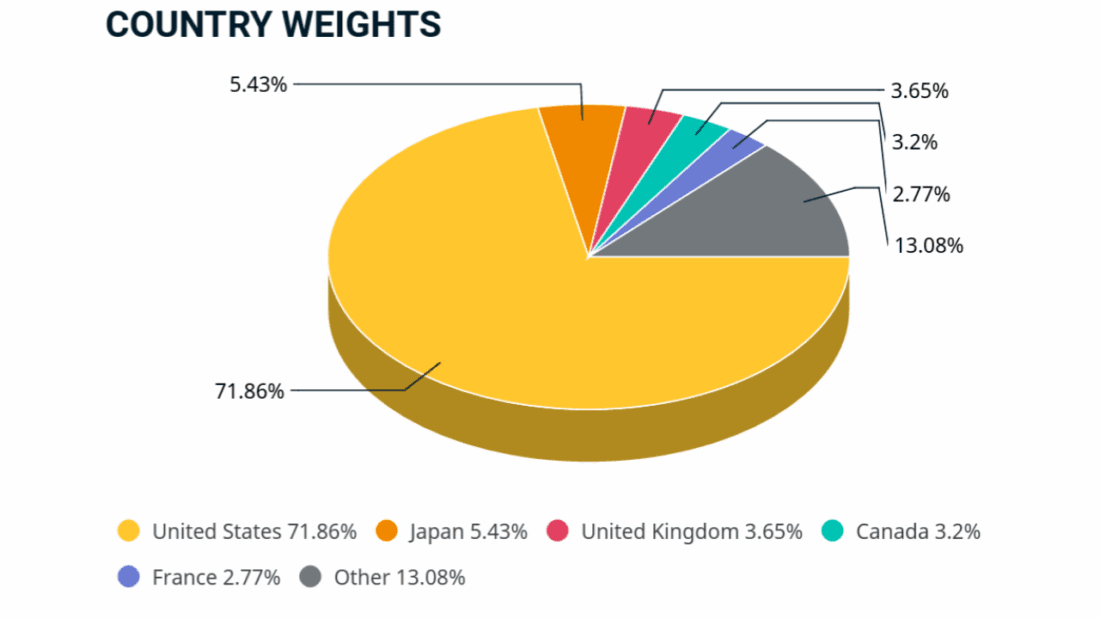
The MSCI World Index is heavily concentrated in the United States, which represents 71.86% of its total weight. – Source: MSCI
Past performance is not indicative of future results
The Case for Quality Over Geography
The S&P 500 is often dismissed for lacking geographic diversification. However, this view ignores the global operations of S&P 500 companies. Firms like Apple, Microsoft, or Johnson & Johnson derive substantial revenue from outside the United States — offering functional global exposure without relying on structurally weaker markets.
From a qualitative standpoint, the U.S. remains the epicenter of technological innovation, capital access, and business scalability. As a result, even many European champions — like Birkenstock, a German brand — choose to list on U.S. exchanges. The magnetism of U.S. capital markets reflects where value is increasingly created.
What the Data Tells Us: 30-Year Historical Returns
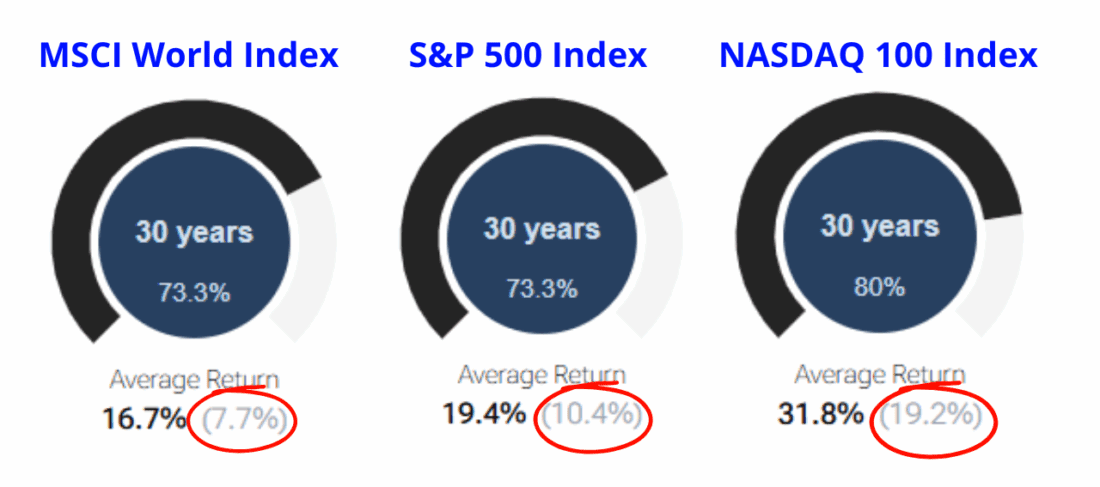
Let’s move beyond theory and look at the numbers. Analyzing 30 years of historical returns from January 1 to December 31, the average annualized performance of the following indices (including both positive and negative years) was:
Past performance is not indicative of future results
The circled values represent the average annual return for each index over the past 30 years – Source: Forecaster.biz
Assuming a long-term strategy with an initial investment of €1,000 and €1,000 added monthly over 20 years, here’s what the final outcomes would look like based on these average returns:
| Index | Average Annual Return | Total Invested ($) | Final Value ($) |
| MSCI World | 7.7% | 240,000 | 572,179 |
| S&P 500 | 10.4% | 240,000 | 807,901 |
| NASDAQ 100 | 19.2% | 240,000 | 2,803,417 |
Note: This model is useful to understand the compounding power of small return differences over time. Past performance is not indicative of future results.
The Bottom Line: Rethink “Diversification”
Too often, investors are told to diversify without a clear understanding of what they’re diversifying into. Owning the MSCI World Index may feel globally inclusive, but in practice, it often means paying for weak exposure to underperforming markets — and missing the upside from innovation leaders.
Final Thoughts
If you’re using dollar-cost averaging to build wealth over 15 to 30 years, the choice of index matters — immensely. Choosing the wrong benchmark could mean hundreds of thousands in lost potential gains. While MSCI World remains popular, investors should carefully assess whether it truly aligns with their goals, risk profile, and belief in future value creation.
—
Originally Posted July 21, 2025
Disclosure: Interactive Brokers Third Party
Information posted on IBKR Campus that is provided by third-parties does NOT constitute a recommendation that you should contract for the services of that third party. Third-party participants who contribute to IBKR Campus are independent of Interactive Brokers and Interactive Brokers does not make any representations or warranties concerning the services offered, their past or future performance, or the accuracy of the information provided by the third party. Past performance is no guarantee of future results.
This material is from Forecaster.biz and is being posted with its permission. The views expressed in this material are solely those of the author and/or Forecaster.biz and Interactive Brokers is not endorsing or recommending any investment or trading discussed in the material. This material is not and should not be construed as an offer to buy or sell any security. It should not be construed as research or investment advice or a recommendation to buy, sell or hold any security or commodity. This material does not and is not intended to take into account the particular financial conditions, investment objectives or requirements of individual customers. Before acting on this material, you should consider whether it is suitable for your particular circumstances and, as necessary, seek professional advice.
Disclosure: ETFs
Any discussion or mention of an ETF is not to be construed as recommendation, promotion or solicitation. All investors should review and consider associated investment risks, charges and expenses of the investment company or fund prior to investing. Before acting on this material, you should consider whether it is suitable for your particular circumstances and, as necessary, seek professional advice.
Disclosure: Bonds
As with all investments, your capital is at risk.
Disclosure: Futures Trading
Futures are not suitable for all investors. The amount you may lose may be greater than your initial investment. Before trading futures, please read the CFTC Risk Disclosure. A copy and additional information are available at the Warnings and Disclosures section of your local Interactive Brokers website.





Join The Conversation
If you have a general question, it may already be covered in our FAQs page. go to: IBKR Ireland FAQs or IBKR U.K. FAQs. If you have an account-specific question or concern, please reach out to Client Services: IBKR Ireland or IBKR U.K..
Visit IBKR U.K. Open an IBKR U.K. Account