








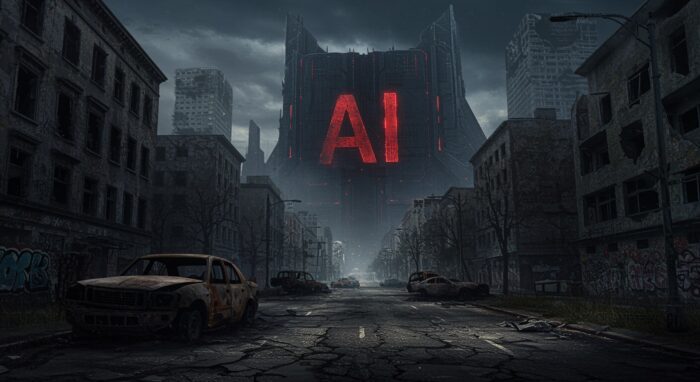

Even as the pace of AI adoption and investment exploded, there was a consistent chorus of those who asked the industry to concern itself not only with the rewards of the new technology, but also with its potential societal risks. For the most part, they were largely confined to the margins of the discussion as markets and the overall economy became happily tethered to all things related to artificial intelligence. This weekend, Dario Amodei, co-founder and CEO of Anthropic, shook up the discussion with a post that frankly outlined the risks that the technology might bring.
While I urge you to read the piece yourself (if you haven’t already done so), it seems fair to sum up Amodei’s message as “slow down, you move too fast.” In the long article’s fourth paragraph, he writes in boldface:
We must slow the pace at which we improve the capabilities of AI models. Progress will still seem fast, and we must make wise use of the time we gain.
He then lays out:
…a three-step plan with the goal of pacing the frontier: building AI at a balanced rate that aims to ensure its safety while still achieving its benefits and grappling with important geopolitical dilemmas.
Although this is quite a public change coming from one of the people at the forefront of AI development, there has been a groundswell of “risk versus reward” commentary coming from other figures in the industry recently. Last week, in a post that went viral, Jacob Coxon, a recently resigned researcher at both OpenAI and Anthropic, outlined his concerns with the new technology, including:
The people building AI earnestly believe that it could kill us all by the end of the decade.
Um, that doesn’t sound good.
Thus, many were relieved to learn of such a visible industry leader’s desire to tap the brakes, even if doing so might have some undesirable side effects for related companies and even the economy as a whole. Certainly, the stock market has benefitted tremendously since the launch of ChatGPT in November 2022, particularly the shares of hyperscalers, semiconductors, and other suppliers to the AI buildout that has proceeded apace since then. It is even fair to say that the entire US economy, along with those of some other countries at the technological forefront, has gotten a notable boost from the data center boom. Yet stocks, even at their worst, never fully gave back Friday’s rally – the one that ensued despite (?) or because of (?) a higher CPI print. Here’s why…
There is also a self-serving aspect to Amodei’s essay. A slowdown in AI development could slow the expensive race to build capacity while entrenching the already established leaders at the expense of new competitors – including those from China. Other key leaders in artificial intelligence, like SpaceXAi’s Elon Musk, OpenAI’s Sam Altman, and Google DeepMind’s Demis Hassabis, put out statements supporting Amodei’s call for caution. While it would be nice to think that seemingly vicious competitors all saw the light in rapid succession, it is not unreasonable to think that they also perceived the commercial benefits of slowing the incredibly rapid, if not unsustainable, pace of debt- and equity-funded spending.
We can debate whether these leaders have a greater debt to society or to their shareholders, but I am quite sure that they don’t mind when those two sometimes-conflicting interests neatly coincide.
Attention to the potential risks is also a shrewd political move right now. There is a clear political backlash against AI data centers facing many of those on the campaign trail, and when we can find an event pushing human-controlled AI that features the stupefying paring of Senator Bernie Sanders and former Trump advisor Steve Bannon, we know that there are some deep political nerves being hit.
Speaking of strange bedfellows, major equity indices have recovered about two-thirds of their worst intraday losses by midday, led by an odd mix of sectors. We have defensive sectors like healthcare and consumer staples trailing only communications among the relatively few advancing groups. Part of the reason for the bouncing indexes can be attributed to what seemed all along like a market that was unwilling to mount a real selloff. Traders remain conditioned to see dips as buying opportunities, which was evident in the relatively tame pre-opening drop in pre-market futures despite higher oil futures and ominous sounding tech news. Equity selling mounted as bond yields rose, culminating with the 10-year’s seemingly inevitable assault on the 5% level, and then recovering when the bond market’s own set of dip buyers stepped in, causing yields to quickly reverse from a peak of 5.01% to about 4.95% – a 2-basis-point improvement over Friday’s close. Equity markets remain focused on the positives, even when revelatory comments about the key technology initially seem to indicate otherwise.
New to Interactive Brokers?
Open AccountAlready an Interactive Brokers Client?
Request Trading PermissionDisclosure: Interactive Brokers
The analysis in this material is provided for information only and is not and should not be construed as an offer to sell or the solicitation of an offer to buy any security. To the extent that this material discusses general market activity, industry or sector trends or other broad-based economic or political conditions, it should not be construed as research or investment advice. To the extent that it includes references to specific securities, commodities, currencies, or other instruments, those references do not constitute a recommendation by IBKR to buy, sell or hold such investments. This material does not and is not intended to take into account the particular financial conditions, investment objectives or requirements of individual customers. Before acting on this material, you should consider whether it is suitable for your particular circumstances and, as necessary, seek professional advice.
The views and opinions expressed herein are those of the author and do not necessarily reflect the views of Interactive Brokers, its affiliates, or its employees.
Disclosure: Futures Trading
Futures are not suitable for all investors. The amount you may lose may be greater than your initial investment. Before trading futures, please read the CFTC Risk Disclosure. A copy and additional information are available at the Warnings and Disclosures section of your local Interactive Brokers website.




Join The Conversation
If you have a general question, it may already be covered in our FAQs page. go to: IBKR Ireland FAQs or IBKR U.K. FAQs. If you have an account-specific question or concern, please reach out to Client Services: IBKR Ireland or IBKR U.K..
Visit IBKR U.K. Open an IBKR U.K. Account