








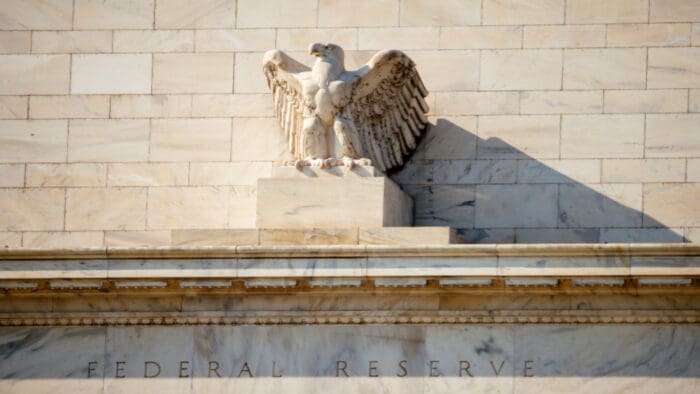

Anxiety regarding this week’s Fed policy decision alongside ongoing concerns about sticky inflation caused interest rates to climb globally on Monday. Rising yields were also propelled by expectations of widening fiscal deficits heading into 2026 that are bolstering economic growth prospects. But heavier borrowing costs amidst the anticipation of a hawkish cut on Wednesday blunted the bullish enthusiasm normally associated with an eventful Merger Monday with the start of the trading week featuring M&A developments in the media, technology, aviation and financial industries.
Risk Appetites Decline
US stocks suffered modest but widespread losses on Monday, with every major sector retreating minus tech. Similarly, commodities were down broadly, and bitcoin fell. Volatility protection instruments experienced increased demand as traders geared up for potential turbulence post FOMC and forecast contracts caught bids. Also on Monday, Treasuries slipped, which helped the greenback advance.
US Monetary Policy is Likely to Ease
This Wednesday’s anticipated 25-basis point cut carries a 93% probability, according to IBKR ForecastTrader and would place the central bank’s benchmark at a midpoint of 3.63%, while the summary of economic projections is likely to signal one or two cuts ahead, placing 2026’s potential trough between 3.13% and 3.38%. Meanwhile, there’s growing confidence that President Trump will nominate Kevin Hassett as the next chair. He carries 76% odds on the IBKR ForecastTrader, and he’s geared to tilt toward a dovish posture that rewards risk assets. A reduction this week and additional trims around the corner amidst a landscape of stabilizing inflation and decelerating hiring don’t support a 10-year yield elevation of 4.19% and fixed-income is likely poised for an imminent rate reversal. A post Fed U-turn would offer ideal timing for equity bulls during a seasonally friendly environment, paving the way for a Santa Claus rally into year-end, as subdued costs of capital coincide with expectations of solid economic performance and robust earnings growth in the coming months.
International Roundup
China’s Trade Surplus Sets New Record
China’s trade surplus totaled $1.08 trillion during the first 11 months of this year, an all-time high for any country. Exports jumped 5.4% year over year (y/y) while imports slipped 0.6%, according to the General Administration of Customs. The surplus comes as China’s trade shifts in response to US tariffs. Overall exports grew 5.9% y/y in November despite shipments to the US falling 29% y/y. Purchases from the European Union and Southeast Asia picked up the slack, growing 15% and 8.2%, respectively. Also in November, imports climbed 1.9%.
Real Wages and GDP Fall as BOJ Prepares to Tighten
The Bank of Japan’s battle against inflation, which is expected to include hiking the key interest rate from 0.5% to 0.75% in 10 days, just became more complicated with new data revealing a worse-than-anticipated economic contraction and another month of declining real wages. With inflation exceeding the organization’s 2% goal, the latest data from the Cabinet Office depicts third-quarter gross domestic product (GDP) falling 2.3% on an annualized basis. The economist consensus estimate called for a 1.8% drop following the prior period’s 2.1% expansion. Relative to the three-month period ended in June, GDP sank 0.6%, a surprise to economists who estimated a drop of only 0.4%. In the preceding period, activity expanded 0.5% quarter over quarter.
A temporary decline in real estate investment driven by new government regulations contributed to the third-quarter contraction. In addition, tariffs have crimped manufacturing, and the government is refraining from making large-ticket purchases.
At the same time, inflation is causing pain among workers with real wages slipping 0.7% y/y in October, the 10th consecutive monthly decline, according to the Ministry of Economy, Trade & Industry. Without factoring the impact of inflation, nominal wages, which include base compensation and overtime pay, increased 2.6%.
While Economic Sentiment Index Falls
Fears of a potential decline in Chinese tourists contributed to the Japan Economy Watchers Current Index falling from 49.1 in October to 48.7 last month. Economists anticipated that the gauge would climb to 49.5.
The government of the world’s second-largest economy recently advised its citizens to refrain from traveling to the country after Japanese Prime Minister Sanae Takaichi proposed developing a contingency, including a military buildup, for a possible Chinese invasion of Taiwan. Higher consumer prices also contributed to the weaker score. The index, based on a survey of businesses in economically sensitive industries such as retail and tourism, experienced declines in all three of its subindices—household activities, corporate activities and the employment situation. Survey respondents’ outlook for the next three months also worsened.
But Outstanding Loan Growth Accelerates
The total value of outstanding commercial and personal loans from Japan banks grew 4.2% in October, exceeding the 4% economist consensus estimate and accelerating from 4.1% in September.
Investor Sentiment Improves in Eurozone
Morale among eurozone market participants strengthened this month with the Sentix Investor Confidence Index climbing from -7.2 in November to -6.4 and matching the economist consensus estimate. Survey respondents’ views of the next six months also strengthened with a score of 4.8 after November’s 3.3 print. As with other recent months, Germany continued to dampen results. The overall index for the country sank from -20.4 to -22.7.
New to Interactive Brokers?
Open AccountAlready an Interactive Brokers Client?
Request Trading Permission





Join The Conversation
If you have a general question, it may already be covered in our FAQs page. go to: IBKR Ireland FAQs or IBKR U.K. FAQs. If you have an account-specific question or concern, please reach out to Client Services: IBKR Ireland or IBKR U.K..
Visit IBKR U.K. Open an IBKR U.K. Account