










It appears Wall Street did the right thing yesterday by front running today’s selloff in what could end up being the start of a challenging September for markets. The two-day period of profit-taking, moreover, isn’t just seasonal weakness, with military attacks in the Middle East dampening investor sentiment by driving oil and interest rates north. Treasuries did catch a modest breather intraday, as a trio of misses on the economic calendar hit the wire precisely at 10AM. ISM, JOLTS and construction spending all arrived beneath expectations and motivated bids across the government debt complex. Still, yields are higher this afternoon, and so is the greenback, but rising slowdown risk, a result of elevated fuel costs, tighter financial conditions and softer-than-expected activity figures, has duration outperforming the shorter-dated maturities as the curve climbs in bear-flattening fashion while signaling a 70% chance of a Fed hike in 15 days. The partial recovery in fixed income is helping six of the principal equity sectors post gains, even as the four major domestic benchmarks are sinking although they are well off the lows. Non-energy commodities are getting crushed as the stronger dollar weighs on the cyclical ones while greater chances of increasingly restrictive monetary policy derails precious metals. Elsewhere, volatility protection instruments are seeing demand as traders turn defensive.
Manufacturing Slows but Remains Buoyant
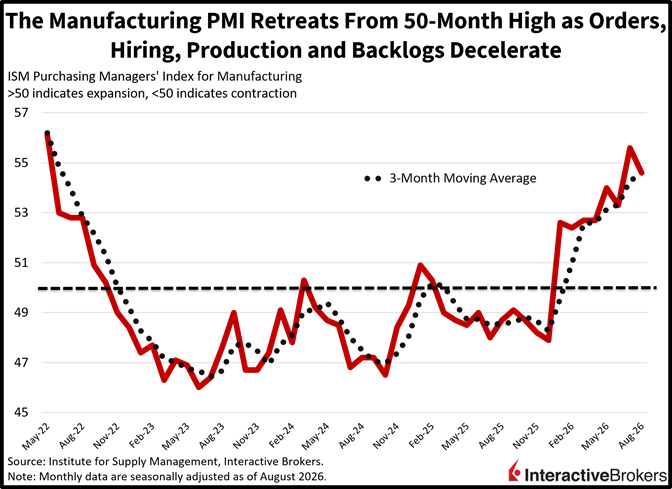
Manufacturing activity remained buoyant in August although the sector’s momentum slowed from July’s 50-month high. The institute for Supply Management’s Purchasing Managers’ Index (PMI) decelerated from the prior print’s 55.6 to 54.6 and arrived below the median estimate of 55.2. Production, new orders, backlogs and employment all grew at slower paces of 58.3, 53.7, 51.8 and 51.2 following June’s 58.5, 56.7, 52.8 and 55 results. Pricing issues persisted, meanwhile, with the category registering an unchanged speed of 71.1. Cost pressures were responsible for the weaker demand reading, according to some survey respondents who reflected problems passing higher charges to customers. Exports were a bright spot, however, accelerating modestly from 53 to 53.2.
Past performance is not indicative of future results.
Job Openings Increased in July
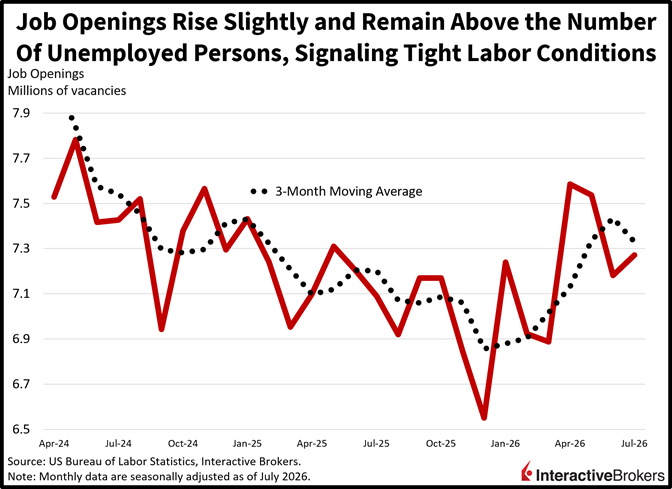
There were more for-hire signs across the US economy in July, according to this morning’s Job Openings and Labor Turnover Survey (JOLTS). The headline figure of 7.271 million was below the median estimate calling for 7.3 million, but it arrived above the downwardly revised 7.181 million from June. The progress was led by the manufacturing, municipal government, health care/social assistance and wholesale trade sectors, which registered month-over-month (m/m) gains of 79k, 65k, 54k and 50k, while the transportation/warehousing/utilities, professional/business services, and the leisure/hospitality categories saw declines of 67k, 65k and 42k. The level of employment vacancies remains well above the number of unemployed people, which stands at 6.9 million, signaling tight conditions for prospective workers.
Past performance is not indicative of future results.
Decline In Construction Industry Continues
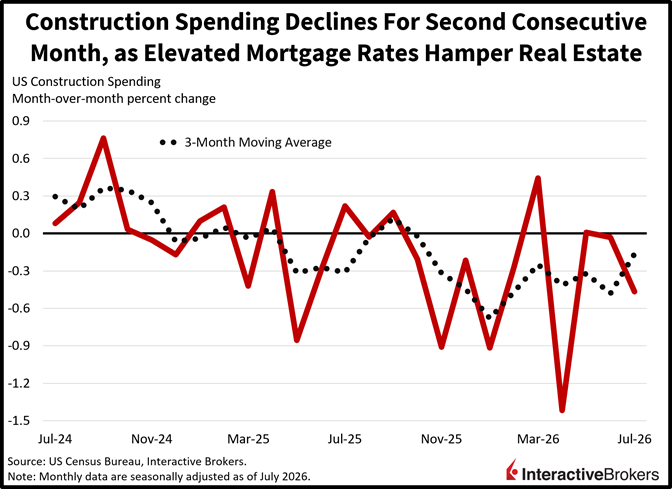
Construction activity remains in the tombs as 5 of the 7 months of 2026 have posted declines. Overall spending fell 0.5% m/m in July, missing the median estimate of 0 which would’ve matched the June result. The residential sector weighed on momentum, falling 1.3% m/m with single-family new builds down 3.2% while fresh multifamily unit investments rose 0.2%. The non-housing category didn’t do too terribly, meanwhile, posting growth of 0.1% m/m, because it’s not as sensitive to elevated mortgage rates. Office building expenditures drove the positive figure, as the segment expanded 2.9% m/m, offsetting 1.4% and 1% subtractions in the conservation/development and manufacturing areas.
Past performance is not indicative of future results.
Geopolitical Relief Could Offset September Blues
Markets need some geopolitical relief to offset September blues, as West Texas Intermediate oil prices nearing $90 per barrel are a heavy burden on the Treasury complex. Costs that high are poised to generate an acceleration in inflation that is already too elevated for the Fed’s liking, for consumers and for the sustainability of corporate margins. Further upside momentum in energy charges can spark significant volatility on Wall Street and lead to a major drawdown in stocks against the backdrop of a central bank hike and midterm elections that can intensify the turbulence. Moreover, this bearish situation would likely cause yields to extend their breakout, with the 10- and 30-year maturities geared to jump north of 5% and 5.5%; however, there’s a lot of room for good news on the Middle East front, which if paired with more slow labor data, could potentially drive a terrific bond rally of over 35 basis points.
International Roundup
Eurozone Inflation at Nearly a Three-Year High
Eurozone inflation as measured by the Harmonized Index of Consumer Prices accelerated from an annual rate of 2.9% as of July to 3.3% last month, matching the economist consensus and supporting expectations that the European Central Bank will hike its key interest rate at its Sept. 10 meeting. It is the hottest result from the Harmonized Index of Consumer Prices in nearly three years and follows ECB President Christine Lagarde’s July warning the energy shock from the US-Iran war could worsen and contribute to stronger oil and natural gas price pressures. In releasing the August data, Eurostat noted that energy costs were up 14.3% y/y following the 10.3% July climb. The HICP also accelerated significantly on a month-over-month (m/m) basis, jumping from 0.2% in July to 2.9%. When excluding energy, food and alcohol, however, the resulting core version of the gauge eased from its 2.5% y/y pace as of July to 2.4% and fell below the economist consensus estimate of 2.5%. The m/m pace, meanwhile, accelerated from being flat in July to 0.2% in August.
China’s Manufacturing Conditions Continue To Improve
Manufacturing conditions in China improved during August with the RatingDog China General Manufacturing PMI ascending by 0.6 points to 51.5 and exceeding the economist consensus estimate of 51. It was the strongest print in six months and was substantially above the contraction-expansion threshold of 50. Output, new orders and exports all expanded at a faster pace than during July. Purchasing and order backlogs also increased. Manufacturers, furthermore, remained positive about the coming 12 months but didn’t expand their payrolls. At the same time, input prices climbed but gate prices fell modestly. While companies cited strong client demand, new product launches, business development and improving economic conditions, overall confidence was the softest since January.
Canada Manufacturing Expansion Slows Marginally
Canada’s manufacturing sector extended its expansion to five consecutive months in August, but the growth slowed slightly with the S&P Global PMI falling from 53.5 to 53.0. Despite growing concerns about tariffs, inflation and supply-chain issues, the PMI remained solidly above the contraction-expansion threshold of 50. The following items helped sustain the expansion:
- Output and new orders expanded for the fifth consecutive month
- Purchasing activity grew in response to higher production requirements and decisions to bolster inventories
- Hiring strengthened with job creation reaching its highest level since October 2024
- Despite expanding payrolls, companies reported that work backlogs had increased
- Companies forecasted that sales will improve in the next year
Conversely, companies reported growing concerns about the availability of input items. Additionally, even though input price inflation eased to a four-month low, it remained historically elevated. Businesses cited US tariffs, higher fuel prices and increased costs for certain metals as key inflation drivers. Finally, the increased optimism for sales did not prevent overall sentiment from staying below trend, a result of worries about tariffs.
New to Interactive Brokers?
Open AccountDisclosure: Interactive Brokers Affiliate
Information posted on IBKR Campus that is provided by third-parties does NOT constitute a recommendation that you should contract for the services of that third party. Third-party participants who contribute to IBKR Campus are independent of Interactive Brokers and Interactive Brokers does not make any representations or warranties concerning the services offered, their past or future performance, or the accuracy of the information provided by the third party. Past performance is no guarantee of future results.
This material is from IBKR Macroeconomics, an affiliate of Interactive Brokers LLC, and is being posted with its permission. The views expressed in this material are solely those of the author and/or IBKR Macroeconomics and Interactive Brokers is not endorsing or recommending any investment or trading discussed in the material. This material is not and should not be construed as an offer to buy or sell any security. It should not be construed as research or investment advice or a recommendation to buy, sell or hold any security or commodity. This material does not and is not intended to take into account the particular financial conditions, investment objectives or requirements of individual customers. Before acting on this material, you should consider whether it is suitable for your particular circumstances and, as necessary, seek professional advice.
Disclosure: Precious Metals
Precious metals may not be available in all locations, please check your local IBKR website for availability.





Join The Conversation
If you have a general question, it may already be covered in our FAQs page. go to: IBKR Ireland FAQs or IBKR U.K. FAQs. If you have an account-specific question or concern, please reach out to Client Services: IBKR Ireland or IBKR U.K..
Visit IBKR U.K. Open an IBKR U.K. Account