











Today marks the end of the second quarter – and what a quarter it’s been! We’ll do a more substantial review of the phenomenal move in global equities overall, and tech stocks specifically, tomorrow after the final results are in. For today, I’d like to focus on a particular casualty of the recent secular move in the US dollar: the Japanese yen (JPY) and its ramifications for US stocks.
JPY is now trading at 162.5, definitively above the 160 level that has concerned monetary authorities in Japan for some time. In fact, this is the weakest level for that currency against the USD since 1986. (Remember that the JPY quotes in that format represent yen per dollar; thus, a higher number means a weaker yen because each dollar buys more.) Remember, in those days, Japan was ascendant, with huge global exports and management successes leading their stock market and real estate prices to hit long-term secular highs. Japan was HOT, though it eventually gave rise to a bubble economy in the ensuing years.
Coincidentally, I did a summer semester in Japan that year. I had accepted a full-time job offer at Salomon Brothers that was supposed to start in August, but they let me defer it until January because they thought it would be worthwhile to continue my education in one of the most desirable business climates in the world. (The rest of the deferred time was spent backpacking through Asia and Oceania, which happened to prove more useful in the early part of my career.) I remember thinking that Japan was quite expensive at the time because the yen had appreciated rapidly. It zoomed from roughly 250 in June 1985 to about 164 when I arrived. For contrast, my son lived and worked in Japan for a few years, during which time the yen traded between 100–115 quite consistently.
There are several reasons for the JPY weakness. Some are secular, such as the US dollar’s overall strength and Japan’s aging population. Others are timelier, including Prime Minister Takaichi’s somewhat mixed messages about a weaker currency. She understands both the yen’s role in bolstering Japan’s export economy but also recognizes that a weaker yen risks importing inflationary pressures. This will require a delicate balancing act for her administration and the Bank of Japan. For now, currency traders are assuming that the balance will tip towards a weaker JPY.
That weaker JPY could be abetting the risk-on mood in global markets. Remember the “carry trade,” where leveraged investors borrow money in a low-yielding currency and invest it in higher-yielding assets. Those can be in fixed income, such as in higher-rate US Treasuries, or in stocks that have shown positive momentum. It is difficult to quantify how much the falling JPY has abetted global stocks, but it clearly has done so.
That points out a risk to broader markets. If the BOJ intervenes or raises rates, that could jolt carry traders. Of course, if they are forced out of leveraged positions, that would pressure the assets that have benefited from those borrowed funds.
The party can continue for quite some time if the current trends in stocks and/or JPY continue. Momentum rules in this market, and it has emboldened many traders to assume as much risk as they can handle. We see that in the popularity of leveraged ETFs, among other things. But the more that we embrace leverage, whether through the carry trade or simply through aggressive investments, the more fragile the market can become. The trend has been, and generally remains, a great friend. Just don’t get too carried away with the friendship.
JPY/USD Since 1970
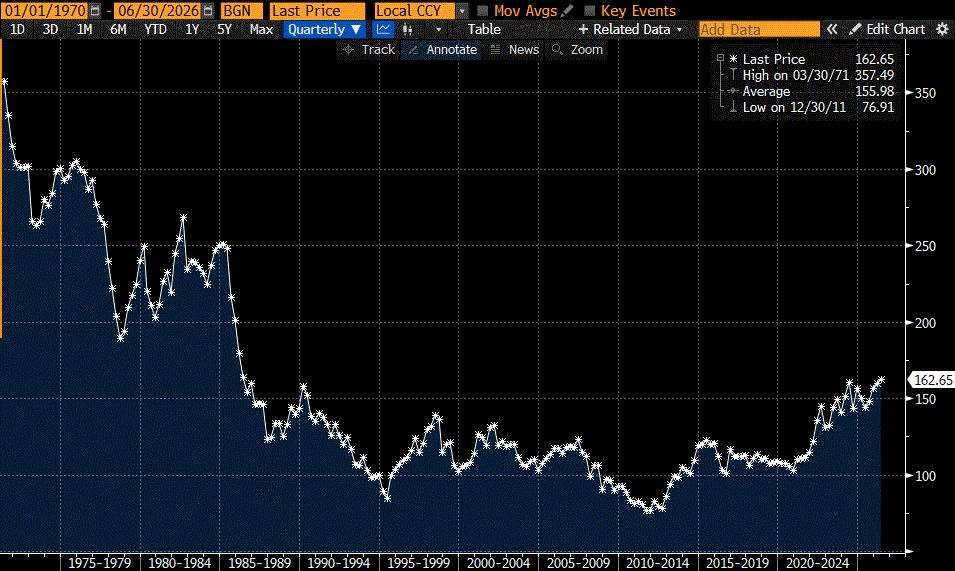
Source: Bloomberg, past performance is not indicative of future returns.
New to Interactive Brokers?
Open AccountAlready an Interactive Brokers Client?
Request Trading PermissionDisclosure: Interactive Brokers
The analysis in this material is provided for information only and is not and should not be construed as an offer to sell or the solicitation of an offer to buy any security. To the extent that this material discusses general market activity, industry or sector trends or other broad-based economic or political conditions, it should not be construed as research or investment advice. To the extent that it includes references to specific securities, commodities, currencies, or other instruments, those references do not constitute a recommendation by IBKR to buy, sell or hold such investments. This material does not and is not intended to take into account the particular financial conditions, investment objectives or requirements of individual customers. Before acting on this material, you should consider whether it is suitable for your particular circumstances and, as necessary, seek professional advice.
The views and opinions expressed herein are those of the author and do not necessarily reflect the views of Interactive Brokers, its affiliates, or its employees.
Disclosure: Forex
There is a substantial risk of loss in foreign exchange trading. The settlement date of foreign exchange trades can vary due to time zone differences and bank holidays. When trading across foreign exchange markets, this may necessitate borrowing funds to settle foreign exchange trades. The interest rate on borrowed funds must be considered when computing the cost of trades across multiple markets.
Disclosure: Margin Trading
Trading on margin is only for sophisticated investors with high risk tolerance. You may lose more than your initial investment. Before trading, read the Disclosure of Risks of Margin Trading, available in the Forms and Disclosures section of your local Interactive Brokers website. For additional information regarding margin loan rates, see the Pricing section of your local Interactive Brokers website.
Disclosure: Short Selling
Short selling is an advanced trading strategy involving potentially unlimited risks and must be done in a margin account.






Join The Conversation
If you have a general question, it may already be covered in our FAQs page. go to: IBKR Ireland FAQs or IBKR U.K. FAQs. If you have an account-specific question or concern, please reach out to Client Services: IBKR Ireland or IBKR U.K..
Visit IBKR U.K. Open an IBKR U.K. Account