












Treasuries are rallying for the second consecutive day as lower oil prices and downbeat economic data drive bids across the curve. Energy costs are falling after Washington decided to send diplomats back to their assignments in the Middle East, which is raising optimism that the conflict with Iran has shifted to a cold war characterized by sanctions, isolation and political pressures rather than the recent violence consisting of missiles, drones and direct attacks. The development is plunging inflation expectations and the fixed-income complex is descending in bull-flattening motion once again, led south by the longer-dated tenors, which have been top of mind for fiscal officials who are focusing debt buybacks from the 10- through 30-year maturities. Weaker-than-anticipated consumer confidence and new home sales also supported bonds via rising slowdown anxiety, although increases in residential valuations and in ADP’s weekly hiring gauge countered some of those concerns. Additionally, heightening tariff jabs between the US and Canada limited the gains in credit assets. The loosening of financial conditions paired by a depreciating greenback and revived animal spirits in cryptocurrency is certainly helping stocks, too, with the four major domestic benchmarks climbing and led by tech, but only 5 of the 11 principal sectors are in the green. Elsewhere, commodities are broadly sinking with the exception of the cyclically sensitive copper and lumber inputs which are benefiting from sliding rates via amidst slightly better outlooks for manufacturing and real estate as a result. Volatility protection instruments are seeing premiums decline due to lighter hedging demands and a risk-on session.
Shoppers Become More Pessimistic About the Future
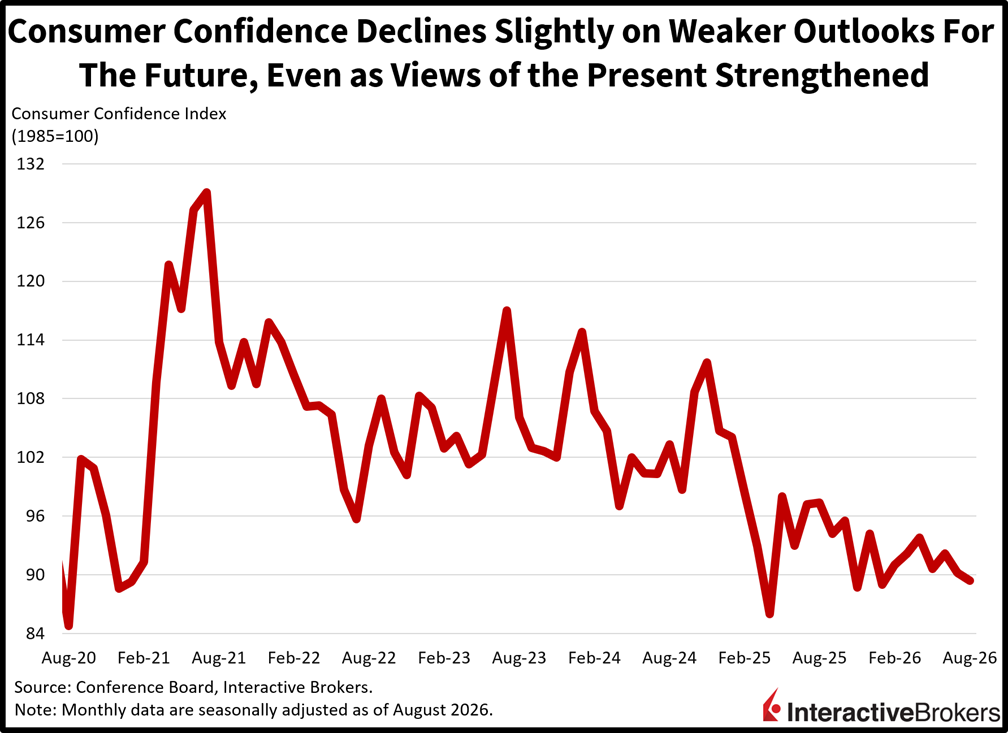
Consumer confidence deteriorated modestly this month as improvements in optimism pertaining to current conditions were offset by pessimism about the future. The Conference Board’s headline reading of 89.4 fell below the median estimate of 90.2, which would’ve matched July’s result. The indices covering the present situation and expectations shifted in bifurcations fashion, as the former jumped 6.8 points to 121.2 while the latter declined by 5.8 to 68.2. Perceptions in the moment were bolstered by better sentiment concerning the labor market, as more households saw jobs as easier to get on a relative basis. But the outlook for the next few quarters was tainted by views that strong employment possibilities and robust income opportunities wouldn’t last. Geopolitics, inflation and pain at the pump were top headwinds; however, folks still project advancing stock prices and higher interest rates a year from today. Spending plans were mixed, with autos strengthening, although purchase prospects for homes, television, smartphones and discretionary services weakened.
New Home Sales Plunge
New home sales dropped to the second slowest pace of the year last month as elevated mortgage rates, lofty construction costs and heightened valuations continued to weigh on the residential affordability picture. July’s 607k seasonally adjusted annualized units came in under the expected 620k as well as June’s 678k, which was the strongest in 2026 so far. But regional performance was mixed in this report, as the Northeast and West saw month over month (m/m) accelerations characterized by growth of 30.3% and 6.2% month over month (m/m). But the larger South geography declined 13% m/m while the Midwest tanked 42.7% m/m, countering the positivity in the former pair. Inventories rose significantly, from a months’ supply ratio of 8.5 to 9.6, a 6-month high, as builders are having trouble unloading fresh dwellings. Prices shifted in bifurcated fashion, with the median closing valuation declining from $403.1k to $393.8k while the average increased from $488.9k to $508.8k.

Private-Sector Hiring Increases Again
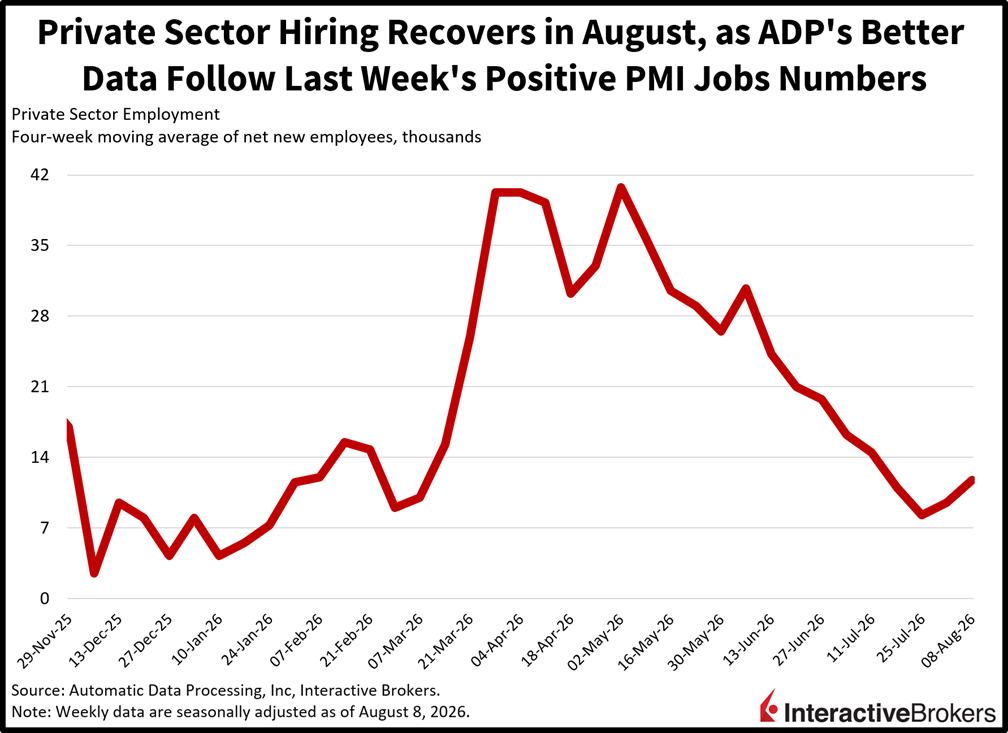
Private-sector hiring accelerated for the second consecutive print following the first increase in eight weeks and the improvement is confirming the recent buoyancy reported in Friday’s flash Purchasing Managers’ Indices from S&P Global. This morning’s ADP report reflected 11.75k average jobs added in each of the four weeks leading to Aug. 8, above the 9.5k from the prior publication. The headline figure signals monthly roster gains of around 51k, which is still lackluster but much better than some of the July numbers that depicted a fall to below 40k. Immigration continues to be a significant headwind for payroll expansions.
Better Backdrop for Bond Buybacks
This week is providing a better backdrop for yields to respond positively to the Treasury’s buyback plans as lighter-than-expected economic data and sinking oil prices lift momentum in the fixed-income complex. Additionally, Monday’s news that fiscal officials may tap the general account at the Fed that is approaching $1 trillion to fund purchases of debt securities was much more significant than last week’s announcement of potentially raising the total from $2 billion to $4 billion. Furthermore, the previous statements were accompanied by strong cyclical numbers paired with soaring energy costs in response to heightening geopolitical tensions that together trumped Washington’s messaging, signaling to government executives that they must do more to quell the pressure across the curve. That reaction probably prompted this week’s aggressive turn to a posture of pulling whatever levers are necessary to imminently reduce interest rates, hell or high water. That move, alongside some good luck thanks to help from the economic calendar and cheaper crude, seems to be working in the moment, however, the longer-term fundamentals, namely the expanding and unsustainable budget deficit, pose ongoing challenges for duration, although my estimate of August core inflation in the lows 2s compels heavy buying of the long-end right now.
International Roundup
Hong Kong Trade Deficit Narrows as Shipments to China Jump
Hong Kong’s July trade deficit fell from HK$52 billion to HK$4.9 billion, or approximately $624 million, in July, with shipments to China jumping 56.6% year over year (y/y) and helping push exports higher by 50.7% relative to the year-ago period. The pace was slower than the 53.4% y/y June expansion, but import growth also slowed, decelerating from 45.4% y/y in June to 41% last month. Within Asia, exports to the following countries grew y/y as stated:
- Taiwan, 95.7%
- Vietnam, 77.7%
- Thailand, 63.1%
- Singapore, 46.5%
Outside of Asia, exports were particularly strong with Mexico and the US. The values of shipments to those countries climbed 92.9% and 48.9%. Strong demand for AI technology helped South Korea boost shipments abroad as illustrated by the electrical machinery, apparatus and appliances, and electrical parts thereof category and the group consisting of office machines and automatic data processing machines experiencing y/y growth of 54% and 106.5%.
Regarding imports, the value of products from Korea, India, the UK and Malaysia grew the fastest with y/y jumps of 146.6%, 110.7%, 106.3% and 66.7%. The following categories and the extent of their increases led the jump in imports:
- Electrical machinery, apparatus and appliances, and electrical parts thereof, 47.1%
- Office machines and automatic data processing machines, 78.9%
- Non-ferrous metals, 242.5%
A government spokesman says strong demand for AI technology is likely to support the country’s export volumes, but he cautioned that geopolitical tensions in the Middle East, trade protectionism, and risks associated with the rapid expansion of global investment in AI need to be monitored closely.
South Korea Consumer Sentiment Falls
A dramatic drop in the Kospi equity benchmark and persistent price pressures caused consumer sentiment in South Korea to slip 2.3 points this month with a headline score of 104.5, according to the Bank of Korea. It was the first decline in four months. The result, which is still above the neutral 100 threshold, was pulled down by the Kospi tanking 24.6% in July, a result of investors’ fears about future investments in AI infrastructure. On a positive note, inflation cooled from an annual rate of 3.2% to 2.8% in July, but price pressures were still strong enough to dampen consumers’ moods. Shoppers’ perspective on current economic conditions fell five points to 79 and their outlook, with a score of 89, was three points lower than in July.
Reserve Bank of Australia Appears More Hawkish
Minutes of the last Reserve Bank of Australia meeting point to the organization embracing a hawkish outlook for rate setting decisions. The minutes from the July meeting note that while inflation has eased in recent months it is still too high and probably won’t return to the organization’s target until late 2027. Policymakers, however, believe inflation risks are titled to the upside with the country experiencing strong demand while oil supply concerns persist due to the Middle East crisis. Expanding AI facilities and corporations passing higher costs onto customers are additional threats to stabilizing prices.
New to Interactive Brokers?
Open AccountDisclosure: Interactive Brokers Affiliate
Information posted on IBKR Campus that is provided by third-parties does NOT constitute a recommendation that you should contract for the services of that third party. Third-party participants who contribute to IBKR Campus are independent of Interactive Brokers and Interactive Brokers does not make any representations or warranties concerning the services offered, their past or future performance, or the accuracy of the information provided by the third party. Past performance is no guarantee of future results.
This material is from IBKR Macroeconomics, an affiliate of Interactive Brokers LLC, and is being posted with its permission. The views expressed in this material are solely those of the author and/or IBKR Macroeconomics and Interactive Brokers is not endorsing or recommending any investment or trading discussed in the material. This material is not and should not be construed as an offer to buy or sell any security. It should not be construed as research or investment advice or a recommendation to buy, sell or hold any security or commodity. This material does not and is not intended to take into account the particular financial conditions, investment objectives or requirements of individual customers. Before acting on this material, you should consider whether it is suitable for your particular circumstances and, as necessary, seek professional advice.



Join The Conversation
If you have a general question, it may already be covered in our FAQs page. go to: IBKR Ireland FAQs or IBKR U.K. FAQs. If you have an account-specific question or concern, please reach out to Client Services: IBKR Ireland or IBKR U.K..
Visit IBKR U.K. Open an IBKR U.K. Account