











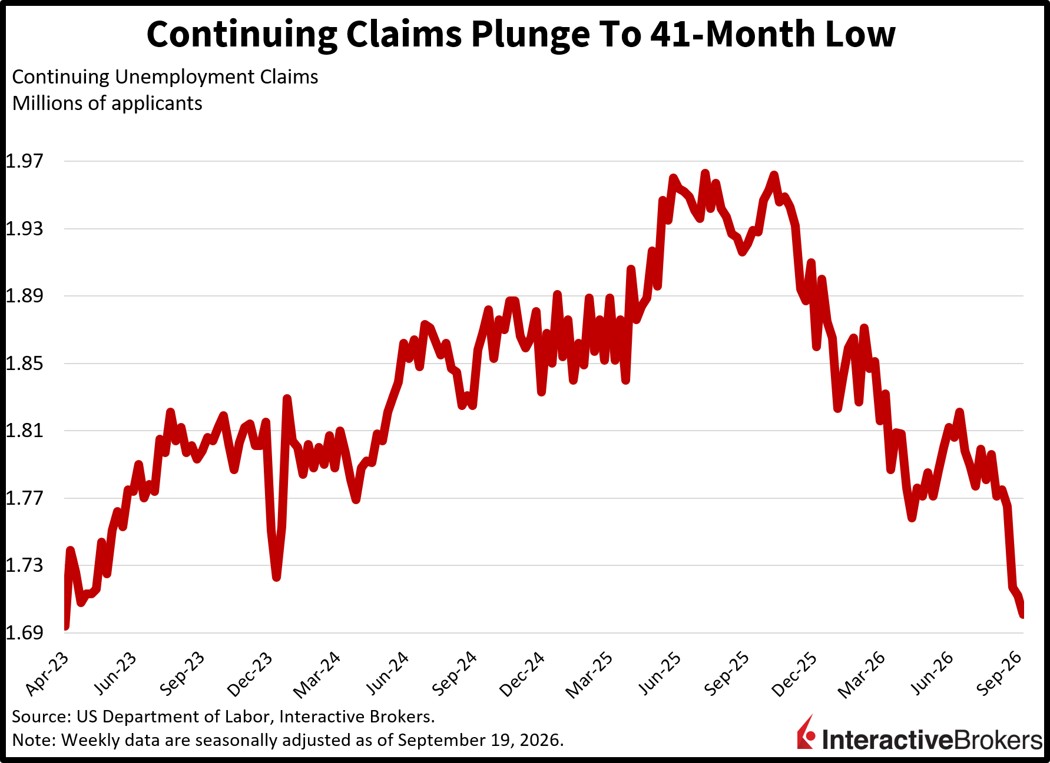
Stocks opened October in the green following a dramatic September, a month in which equities wouldn’t have posted a loss had it not been for intense selling pressure in the final 20 minutes of yesterday’s session. Today, the turbulence hit markets at exactly 10 a.m., when ISM released the hottest prices-paid figure since May, which triggered a U-turn for equities while the 10- and 30-year Treasury maturities extended their jump to multi-decade highs. But it wasn’t just the manufacturing numbers that weighed on markets intraday—labor figures did too, as continuing unemployment claims plunged to a 41-month low, or going back to April 2023, while initial filings and challenger job cuts prospects also declined and arrived beneath estimates. Those buoyant employment statistics, and to a lesser extent a beat on construction spending, added fresh evidence that the cycle remains on solid footing, which bolstered yields and the dollar further and hurt Wall Street sentiment. Additionally, President Trump stating that the US military could ramp up bombing of Iran after midterms generated geopolitical angst that propelled fuel charges as future attacks could inflict new damage on energy infrastructure at a time when Middle East producers have found workarounds to successfully send crude to export destinations. The combination of strong econ data, fiery cost forces and ongoing transnational disagreements has the four major equity benchmarks along with 8 of the 11 principal index sectors declining, but technology is hanging in there in response to a robust quarterly performance from memory juggernaut Micron that supported the semiconductors and the Mag7. Elsewhere, volatility protection instruments are catching bids, while commodities excluding precious metals and oil decline.
Manufacturing Expansion Continued Last Month
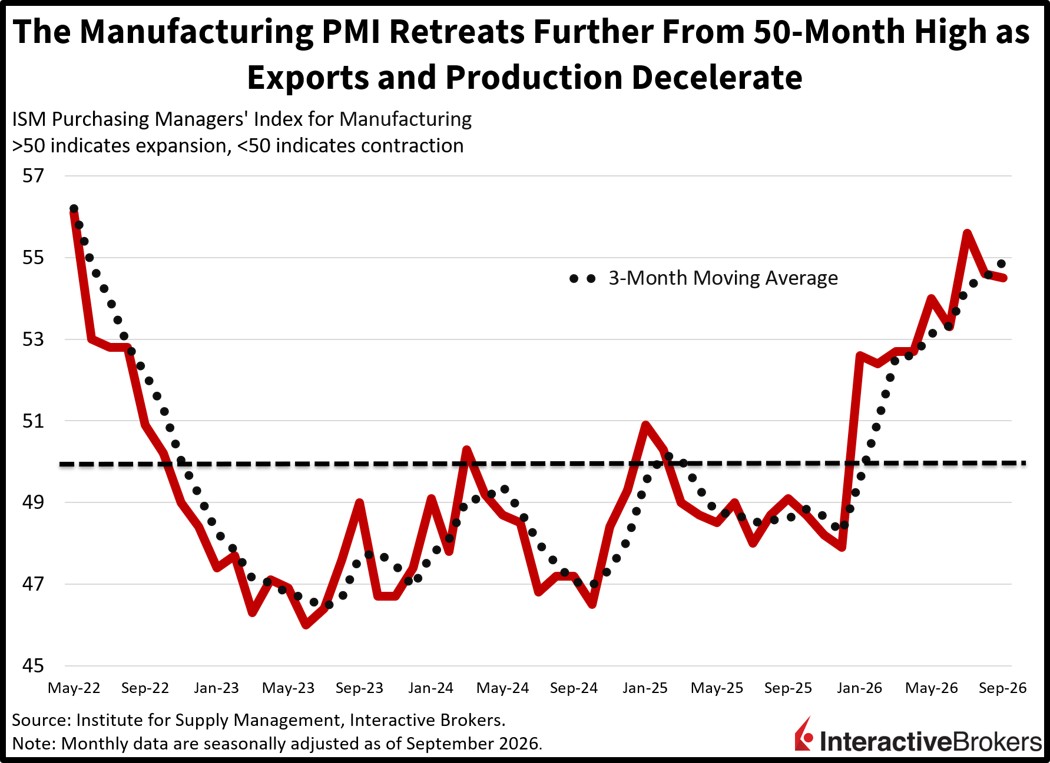
Manufacturing activity expanded at a fast pace last month, although it slowed marginally from August on decelerating output and weaker interest from international buyers. September’s Institute for Supply Management’s Purchasing Managers’ Index hit 54.5, beneath both the expected 54.8 and the prior period’s 54.6 but well above the contraction-expansion threshold of 50. New orders, employment, and backlogs were the source of the strength, as they improved from scores of 53.7, 51.2 and 51.8 to 55.3, 52.7 and 56.4. Exports and production were positive; however, momentum sank, as those categories experienced decreases from levels of 53.2 and 58.3 to 50.9 and 56.7. Inflationary pressures were fiery, meanwhile, with the prices paid category soaring to 77.9 from 71.1 because heavier fuel charges and the trade war with Canada have bolstered costs.
Past performance is not indicative of future results.
More Data Point to Ongoing Labor Market Strength
This morning’s labor data signaled ongoing strength in the employment space, as continuing claims fell to a 41-month low of 1.701 million. The result for the week that ended Sept. 19 was well beneath the 1.730 million expected and the 1.712 million from the prior interval. Initial filings also arrived under expectations of 200k and the previous print’s 198k, registering 197k for the seven-day timespan culminating on Sept. 26. Four-week moving averages sank from 202.5k and 1.742 million to 200k and 1.724 million.
Past performance is not indicative of future results.
Hiring and Firing Expectations Falls
A separate labor report from Challenger Gray and Christmas additionally pointed to stability. Indeed, job cut plans sank 18% month over month (m/m) and 20% year over year (y/y) in September to 43.4k. Hiring intentions did sink 23% y/y to the most subdued level for that month in 15 years; however, because elevated fuel charges and rising interest rates is warranting patience for some employers, particularly those that traditionally boost rosters around now for the upcoming holiday season.
Bumpy Trading Ahead of Jobs Friday
There’s clearly some hesitation in markets regarding how to position for tomorrow’s huge nonfarm payrolls reports, with Treasurys trading in a wide range of about 11 basis points at the longer-end just today. Duration is certainly a wildcard in terms of how it can perform following the publication, however, Fed speakers this week have generally offered Wall Street a sense of relief after investors priced in four additional rate hikes from the central bank by next summer. The committee isn’t likely to raise that many times in response to an oil supply shock, especially with core cost pressures under control, and that’s driven a strong rally at the short end of the curve. I’m anticipating a miss of around 50k heading into Jobs Friday, beneath the 90k projected, which should provide further alleviation for fixed-income markets across maturities, as tightening prospects slip amidst hiring momentum taking a breather.
International Roundup
Australia’s Trade Surplus Smaller Than Expected
Australia’s August trade surplus was smaller lower than anticipated and sank from $1.35 billion in July to $495 million, according to the Australia Bureau of Statistics. During the month, the value of goods shipped to foreign lands climbed 3.7% m/m after sinking 3.6% in the preceding period while imports reversed from a 2.4% July drop to a 5.8% jump. The broad rural goods category dampened the growth of exports. Its 1% m/m decline was driven by the cereal grains and cereal preparations category and the meat and meat preparation group slipping 4.3% and 2.1%, respectively. Demand from foreign customers for non-rural goods, conversely, grew 2% m/m despite declines of 10.5% and 1.5% for the transport equipment segment and the metal ores and minerals group. The other rural goods component, which includes sugar and beverages, experienced a 37.2% spike in demand. The metals segment was also strong. It posted an 11% increase. Import growth was led by a 79.3% leap in Automatic Data Processing equipment as companies continued to build out data warehouses and artificial intelligence facilities. The strong result along with imports of civil aircraft and confidentialised items contributed to imports of the broader capital goods segment expanding 22.3% m/m.
And South Korea September Trade Surplus Easily Beats Estimates
South Korea’s stellar export growth last month points to the AI buildout continuing unabated. Indeed, the country’s semiconductor manufacturing capabilities contributed to the value of exports exceeding imports by 49.8 billion won, according to the Ministry of Trade, Industry and Resources. During the month, the value of products shipped beyond South Korea’s borders soared by 83.5% y/y, flying past both the economist consensus for a 61.7% expansion and August’s 68.7% ascent. September imports last month were only 26% higher than in the year ago period. The metric surpassed the economist consensus estimate for a 21.5% expansion while slowing from 22.4% in August.
Growth of Canadian Manufacturing Slows
Canada’s manufacturing activity growth slowed in September with new orders falling, cost inflation surging and business confidence weakening, according to the S&P Global Canada Manufacturing PMI. The index dropped from 53 to 51.5 but stayed above the contraction-expansion threshold of 50. It was the lowest reading since March. Manufacturers reported an overall decline in sales triggered by the trade war with the US. The also identified customs delays in the US, the war in Iran and strong demand from AI infrastructure buildouts as sources of supply chain challenges. The problems, which included higher fuel costs, pushed input inflation to its strongest level since July 2022. Delays from suppliers resulting, in part, from container shipping delays prompted firms to draw down inventory and increase purchases of items in anticipation of suppliers facing hurdles in the foreseeable future. While firms responded by passing some of the higher costs on to customers, some said weak demand limited their pricing power. Despite those headwinds, firms expanded their payrolls for the sixth consecutive month although the pace of expansion was the slowest since May. Firms cited shortages of skilled workers and desire to increase capacity for serving long-term contracts in justifying the hiring. The staffing expansions and the slowdown in new orders resulted in firms working down their back orders. While output increased, confidence in the coming months sank to its lowest level since December 2025.
Europe Unemployment Rate Was Unchanged In August
The euro area unemployment rate for August remained unchanged from July’s 6.4% print and matched the economist consensus expectation. Rates among women and men, at 6.7% and 6.2%, were also unchanged from July, according to the data released today by Eurostat. Conditions improved modestly for youth with the unemployment rate descending 0.1 percentage point from July’s 15.1% level.
New to Interactive Brokers?
Open AccountDisclosure: Interactive Brokers Affiliate
Information posted on IBKR Campus that is provided by third-parties does NOT constitute a recommendation that you should contract for the services of that third party. Third-party participants who contribute to IBKR Campus are independent of Interactive Brokers and Interactive Brokers does not make any representations or warranties concerning the services offered, their past or future performance, or the accuracy of the information provided by the third party. Past performance is no guarantee of future results.
This material is from IBKR Macroeconomics, an affiliate of Interactive Brokers LLC, and is being posted with its permission. The views expressed in this material are solely those of the author and/or IBKR Macroeconomics and Interactive Brokers is not endorsing or recommending any investment or trading discussed in the material. This material is not and should not be construed as an offer to buy or sell any security. It should not be construed as research or investment advice or a recommendation to buy, sell or hold any security or commodity. This material does not and is not intended to take into account the particular financial conditions, investment objectives or requirements of individual customers. Before acting on this material, you should consider whether it is suitable for your particular circumstances and, as necessary, seek professional advice.






Join The Conversation
If you have a general question, it may already be covered in our FAQs page. go to: IBKR Ireland FAQs or IBKR U.K. FAQs. If you have an account-specific question or concern, please reach out to Client Services: IBKR Ireland or IBKR U.K..
Visit IBKR U.K. Open an IBKR U.K. Account