







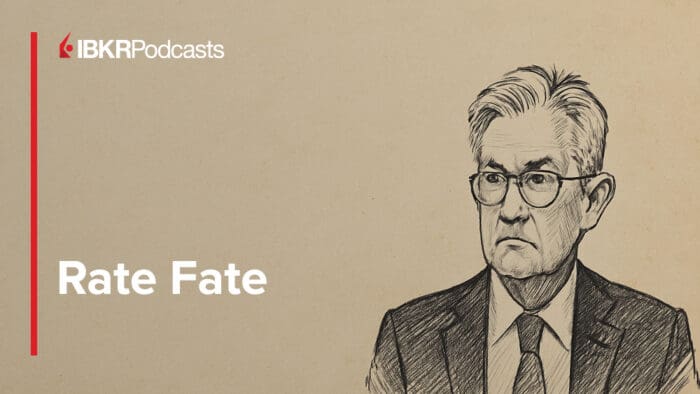


In this episode, IBKR’s own Chief Market Strategist Steve Sosnick breaks down Jerome Powell’s latest Jackson Hole speech and what it could mean for September rate cuts, inflation targets, and market psychology.
AUDIO PLACEHOLDER
Summary – IBKR Podcasts Ep. 287
The following is a summary of a live audio recording and may contain errors in spelling or grammar. Although IBKR has edited for clarity no material changes have been made.
Andrew Wilkinson
Welcome to today’s podcast. So on Friday, Jerome Powell delivered his annual speech in Wyoming and seemingly opened the door to an interest rate cut at the September FOMC. Joining me today is Chief Market Strategist here at InteractiveBrokers.com, Steve Sosnick. Steve, I want to dive into the speech to understand the enthusiasm surrounding it, but also to consider how investors have digested Powell’s remarks in the aftermath. So what changed?
Steve Sosnick
I would say the thing that changed in Powell’s speech is… I don’t know whether to say he’s looking at the glass half full or half empty. Basically, instead of saying that the onus is on the data to justify an interest rate cut, it’s now, “We’re probably going to cut rates unless the data tells us otherwise.”
That’s really the only real difference. It’s interesting because rate cut expectations definitely rose on Friday, but not to the level they were just a little over a week ago. A week ago it was a dead certainty that rates would get cut, and actually the CME futures were pricing in a decent likelihood for something greater than a cut. It was like 105%. The ForecastX markets never got quite that exuberant, but it’s interesting. To me, this says more about market psychology than what Powell actually said.
If you break apart the two facets of his speech:
- We’re going to lean toward a rate cut as opposed to away from it. That was, in many ways, already priced in.
- What got buried was the FOMC statement being changed to say that the inflation target is 2%. Not a little more than 2%, not 2.5, not 2.7. It’s 2.
So at the same time, he was preaching uncertainty about inflation concerns, yet that’s not what the market wanted to hear. Once again, he was Goldilocks in a suit— not too hot, not too cold. But the market definitely wanted to hear the parts it liked.
Andrew Wilkinson
Do you think he changed his mind about being tough on inflation or not?
Steve Sosnick
Not if they made the FOMC statement read that way. And we’re going to find out very soon, because the core PCE Deflator comes out on Friday. Bear with me one second, I have it up on another screen. The number the market expectation is pricing in is about a 0.3% rise this month, on a month-over-month basis. That would get us to about a 2.9% annualized rate. Clearly, 2.9 is above 2. The other thing that’s concerning is that each of the last three monthly core PCE readings were higher than the month before. So it’s trending in the wrong direction. And it’s also possible—if not likely—that some of the pressure is coming from services, and that’s not tariff-related. Remember, we have yet to really see the effect of the tariffs. They’ve only been in full effect for just over two weeks now, and a lot of inventory accumulation was done earlier to try to avoid the tariff effects.
I don’t think the Fed has let up on its inflation targets. To me, that provides a bit of a risk as we go into Friday, because if that number comes in high… The market will probably be okay with “inline,” because “inline” has been more than good enough to get this market moving. But we’ve already started to see some pushback from a couple of Fed governors—Beth Hammack among others, regional Fed presidents, etc. So I think the Fed is going to be watching inflation just as closely as they ever were.
Andrew Wilkinson
So Steve, define the stock market’s reaction. Some sectors liked it, and some sectors didn’t. Broadly, it was taken very well. But what sectors did well and what didn’t?
Steve Sosnick
Small caps were the real leaders, because small caps have been this “hopium trade” for months, if not years. It’s a constant question I get: “Are small caps poised to outperform?” My frequent answer is that they either need really low interest rates or a really strong economy to get going. The economy’s strong enough, but not strong enough for a good portion of the Russell 2000, which is unprofitable. Rates are not low enough for people to just throw their money at anything—although there have been plenty of instances of that anyway.
One of the other things I say is I hate shorting the Russell 2000, because the total market cap of the Russell 2000 fits neatly into Nvidia or Microsoft or some of these larger companies. To the extent that they can get moving on something, yeah. But do I think it’s sustainable? Time will tell. I think what we saw Friday was more of what I’ve been calling the “ratchet effect” in markets. We go down slowly when we go down. When we do have down days—as rare as they seem—they tend not to be of a huge magnitude. But when we go up, we go up big. So we have this big up move, then ratchet lower, then up again. It’s akin to turning a ratchet. Fridays are the ultimate ratchet days because not only do you have the usual daily expirations in major indices and ETFs, you also have weekly options expiring for over 600 big companies and other decent-sized ETFs. So it’s much easier to get these things running on a Friday. I don’t think it was a coincidence.
Another thing to keep in mind: we had actually seen what this market construes as risk aversion. Despite that enormous rally on Friday, we were up only 0.3% on the week. As we’re taping this, we’ve given back some of that gain—almost all of it in the pre-market. We’ve run hard, but ultimately we’re running hard to stay in place. Once again, I’m keeping a close eye on the bond market—specifically the twos-tens spread. The twos are pricing in rate cuts. The tens would be pricing in inflation expectations. On Friday, the twos fell 11 basis points, the tens fell 7, and the thirties fell 4. That’s a steepening of the yield curve. That may come back to earth a little if the market decides the Fed isn’t willing to throw inflation concerns to the wind. But that remains a primary tell for the stock market as a whole, because it reflects what inflation fears are embedded.
Andrew Wilkinson
Steve, you said that the early morning US action has taken back a little bit. What has been the follow-through response around the global markets to Powell’s discussion on Friday?
Steve Sosnick
The global markets liked it. We saw big rallies in most of Asia. The US does drive the bus. I’m just gonna turn over the other screen. We did see a little bit of a pullback in Europe, but I don’t think it affects Europe all that much. They’ve got their own issues going on. But Asia took it really well.
As I look across my screen—Australia modestly up. It was mostly in China, but the Nii was up a little, less than half a percent. So in general, overseas markets have a bit more of a sober view about this type of stuff. They’re not caught up in the euphoria. They’re not caught up in chasing short-dated rallies. On the other hand, European and Asian markets have been doing quite well this year. So it’s okay if they don’t necessarily follow through with euphoria, because they’ve been doing so well as the year’s progressed.
Andrew Wilkinson
So earnings have been very good so far this season, and we’re close—and this is Nvidia. What are your thoughts on what we might hear from Nvidia this week, Steve?
Steve Sosnick
Yeah, I’m just pulling up some of my notes on that. If you gimme one sec. Basically, Nvidia to me is the single most important stock. I’m not breaking news here. Nvidia is by far the most important stock in the market.
It’s not only the biggest stock, meaning it has the highest weight in the S&P 500, the NASDAQ 100, etc. But psychologically its importance is even greater than that. It’s perpetually among the most actively traded stocks—certainly always one of the most actively traded here on our platform. More importantly, from a psychological viewpoint, this whole bull market we’ve been in since late 2022 has been powered by enthusiasm for artificial intelligence. And there is no bigger poster child for artificial intelligence than Nvidia. There’s been no bigger beneficiary. There’s been no bigger driving force. At some point, it seems logical that the phenomenal growth will need to take a bit of a breather as we digest all this. Now, it’s not clear when, because we’ve heard about Meta and some other companies just continuing to fire money at AI. Although maybe there’s a little bit of a breather, because at least Meta, having committed $10 billion more in capital spending, maybe isn’t just throwing NFL quarterback–size pay packages at AI developers.
If Nvidia sees some sort of slowdown—it doesn’t have to be negative—even if they just say the rate of growth is tapering off, the first derivative doesn’t have to turn negative for people to freak out. The second derivative—the rate of change in that growth—if that starts to slow, that could get people a bit spooked. As of now, I don’t know. I’m not an Nvidia analyst. The market’s pricing in roughly a 6% move for the stock post-earnings, which is maybe a little light, but not terrible. Then again, with high-volatility stocks, a lot of people tend to wait to close in. The higher the volatility, the faster the decay—so people don’t want the decay. And that affects the pricing.
I will be doing a piece later this week with more detail about what markets are expecting for Nvidia earnings. But I think right now, if it goes well, then the AI-driven rally can continue. If it goes poorly… At this point, beating on revenues and earnings is a necessary case for a rally, but not a sufficient case. It’s about guidance. Particularly in the case of Nvidia, where there are such lofty expectations priced in, they have to meet them. If they do—carry on. If they don’t, you may want to check how much risk you’re taking going into those numbers.
Andrew Wilkinson
Keep calm and carry on is the message there from Chief Market Strategist Steve Sosnick here at Interactive Brokers. Thanks for joining me, Steve.
Steve Sosnick
My pleasure as always, Andrew. Take care. See ya.
Andrew Wilkinson
And you can catch Steve’s articles on Traders’ Insight under the Interactive Brokers campus on the Education page, so please look out for those. And I know Steve’s gonna be on Bloomberg later this week. If you enjoyed today’s podcast—later today, I think Monday—we’re gonna get this podcast out shortly to you on Monday, and he’ll be on Bloomberg Television this afternoon. If you enjoyed today’s podcast, don’t forget—subscribe wherever you download from. Thanks everybody. Bye for now.
Steve Sosnick
Thanks.
Disclosure: Interactive Brokers
The analysis in this material is provided for information only and is not and should not be construed as an offer to sell or the solicitation of an offer to buy any security. To the extent that this material discusses general market activity, industry or sector trends or other broad-based economic or political conditions, it should not be construed as research or investment advice. To the extent that it includes references to specific securities, commodities, currencies, or other instruments, those references do not constitute a recommendation by IBKR to buy, sell or hold such investments. This material does not and is not intended to take into account the particular financial conditions, investment objectives or requirements of individual customers. Before acting on this material, you should consider whether it is suitable for your particular circumstances and, as necessary, seek professional advice.
The views and opinions expressed herein are those of the author and do not necessarily reflect the views of Interactive Brokers, its affiliates, or its employees.
Disclosure: Options Trading
Options involve risk and are not suitable for all investors. For information on the uses and risks of options read the "Characteristics and Risks of Standardized Options" also known as the options disclosure document (ODD). Multiple leg strategies, including spreads, will incur multiple transaction costs.
Join The Conversation
If you have a general question, it may already be covered in our FAQs page. go to: IBKR Ireland FAQs or IBKR U.K. FAQs. If you have an account-specific question or concern, please reach out to Client Services: IBKR Ireland or IBKR U.K..
Visit IBKR U.K. Open an IBKR U.K. Account