







Investopedia is partnering with All Star Charts on this newsletter. The contents of this newsletter are for informational and educational purposes only.
A Four-Year Base Just Broke In Healthcare
Healthcare just had its best week ever against the S&P 500.
Most investors are buying the wrong half of it. Money went where it always goes first, into Lilly, J&J, AbbVie and UnitedHealth, and those names earned the move. But a four-year base in a much smaller corner of the sector resolved to the upside this month, and it carries a measured objective back toward the 2021 peak, roughly 25% above where it trades today.
The large-cap move is well advanced. This one is barely underway.
Where healthcare has been
The sector returned 0.3% in 2023, 0.9% in 2024 and 12.5% in 2025, trailing the S&P 500 every year while capital crowded into semiconductors and AI. The ratio measuring healthcare against the broader index fell all the way to a quarter-century low.
Then it rejected off those lows with its largest single-week jump on record, and the equal-weighted version of the sector pushed to an all-time high.
Something changed, and it did not change quietly.
The base that took four years to build
Past performance is not indicative of future returns.
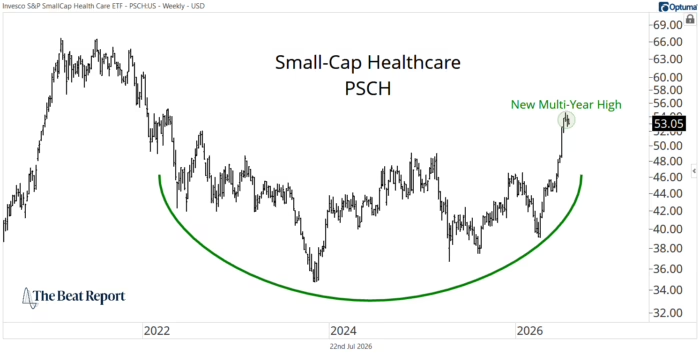
The Invesco S&P SmallCap Health Care ETF (PSCH) has broken out to new multi-year highs after completing one of the longest bases on the board.
Price rolled over in 2021, ground lower through 2022, bottomed in 2024, then spent two years curling back up in the rounded formation technicians call a saucer bottom. Four years, start to finish, and it just cleared the top.
Base length matters for a specific reason. Over a stretch that long, every buyer who bought higher either sold in frustration or gave up entirely. By the time price clears the range, almost nobody is left holding a losing position and waiting to get out even.
There is very little supply overhead to absorb demand, which is why breakouts from long bases tend to run further than breakouts from short ones.
The measured objective on a structure this size is the prior cycle peak. For small-cap healthcare, that sits about a quarter above current prices.
Why the small caps matter more than the large caps
Rotations start at the top of the market-cap spectrum and work down.
Institutional money moves first and it moves into the biggest, most liquid names, because those are the only ones that can absorb the size.
That is why a rotation shows up in mega-caps before anywhere else, and it is also why the mega-cap move tells you almost nothing about staying power.
The small-cap version answers the question the large-cap version cannot. Defensive rotations park in large, stable, dividend-paying businesses and stop there.
When capital keeps traveling down the cap spectrum into higher-beta, less liquid names, that is conviction rather than caution.
Small-cap healthcare at multi-year highs, with the equal-weighted sector at an all-time high, points to the second one.
What could go wrong
Small-cap healthcare is not a defensive asset and treating it like one is a mistake.
The group is dominated by clinical-stage biotech, where outcomes are binary. A drug clears its trial or it does not, and the index can climb while individual names go to zero.
Position sizing and breadth of exposure do very different work here than they do in large-cap pharma.
Rates are the second problem. Unprofitable biotech is a long-duration asset whose value sits in cash flows years out, which makes it acutely sensitive to the rate path.
The Fed held in June with nine of eighteen officials projecting at least one hike this year, a reversal from the prior cutting bias. A meaningfully higher path pressures exactly this corner.
And breakouts fail. A four-year base gives you a clean invalidation level, and price slipping back inside the range would say the move was a false start.
Where we are already positioned
We have been buying into this. The Beat Report currently holds two small-cap biotech names and one medical-device company, and we are working through the rest of the group as this leadership develops.
The opportunity set is wider than biotech alone. Medical devices, managed care, insurance providers and nursing homes are all producing setups right now, which is what a real sector turn looks like from the inside.
The Beat Report finds the companies with the strongest setups going into their numbers and pairs each one with a short-term options strategy built to capture the move. Healthcare is where that work is concentrated at the moment.
—
Originally posted 27th July 2026
Disclosure: ETFs
Any discussion or mention of an ETF is not to be construed as recommendation, promotion or solicitation. All investors should review and consider associated investment risks, charges and expenses of the investment company or fund prior to investing. Before acting on this material, you should consider whether it is suitable for your particular circumstances and, as necessary, seek professional advice.






Join The Conversation
If you have a general question, it may already be covered in our FAQs page. go to: IBKR Ireland FAQs or IBKR U.K. FAQs. If you have an account-specific question or concern, please reach out to Client Services: IBKR Ireland or IBKR U.K..
Visit IBKR U.K. Open an IBKR U.K. Account