






Originally Posted 23 September 2024 Trading the U.S. Globally – David Howson
As a Brit who has lived all over the world and currently calls the U.S. home, I have always been interested how markets around the globe are intertwined. Lately, I have had a lot of conversations with people around the world who are interested in participating in their own local markets and the U.S. market. They are not particularly keen on investing in other foreign markets outside of their home country, but nearly everyone wants a piece of the U.S. pie. These conversations piqued my curiosity, and I am always eager for the cold, hard facts, so I looked at the data.
According to the U.S. Department of the Treasury, which releases this data annually in February, foreign investors own $26.86 trillion in U.S. securities as of June 2023, up from $24.8 trillion in June 2022. Nearly half of that — $13.7 trillion — is comprised of U.S. equities. This makes sense, considering the U.S. equities markets have an outsized presence in the global equities landscape, making up approximately 42% of global stock market capitalization, according to research from SIFMA. The remainder of foreign investor securities holdings are in long- and short-term debt securities.
This growth has primarily occurred in the last eight years. Foreign investors’ equity holdings in 2023 were nearly double the total from 2016, climbing from $17.1 trillion to $26.8 trillion in that time frame.
Foreign Portfolio Investment in Long-Term Securities 2016-2023

Source: U.S. Department of the Treasury
And looking back further, foreign holdings of U.S. equities hadn’t even cracked $1 trillion ($1.9 trillion when adjusted for inflation) before the turn of the century.
Foreign Portfolio Investment in Long-Term Securities 1974-1997

Source: U.S. Department of the Treasury
Zoom out to encompass more cross-border investment, and the trend holds firm – for 12 consecutive years the U.S. has led the world in foreign direct investment.
Driving the Interest
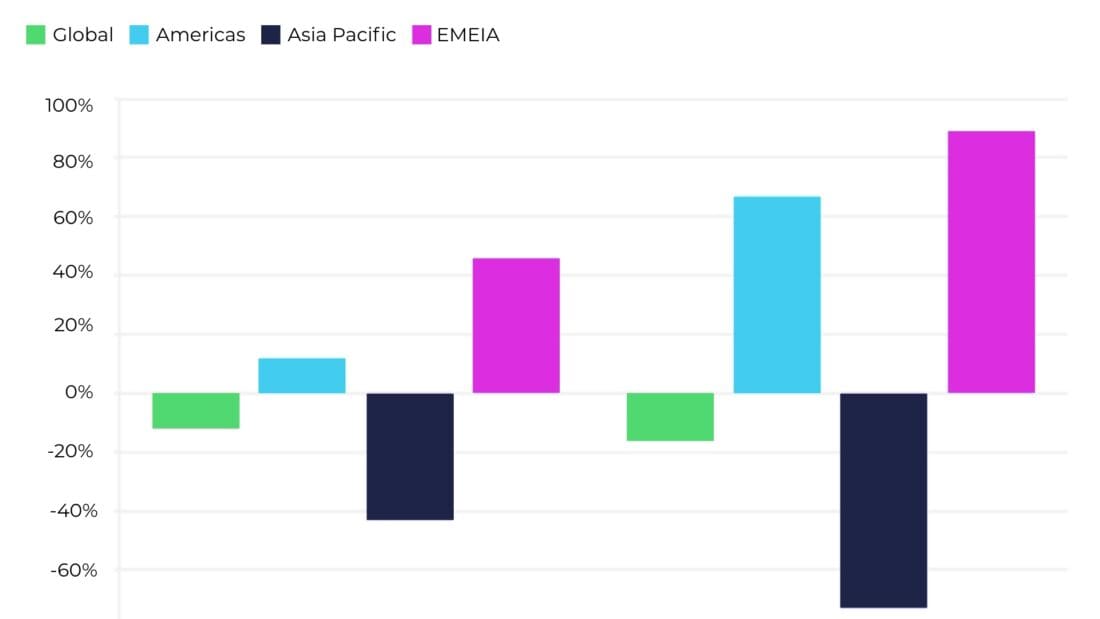
There are a few reasons I suspect to be the motivation behind these investments. The U.S. is the largest consumer market in the world, with a GDP of more than $27 trillion in 2023 and a population greater than 330 million people. Add in the efficiency and liquidity of U.S. capital markets, the fact the market capitalization of the U.S. stock market stood at $53.6 trillion at the end of Q2 2024 and an ongoing recovery — albeit slowing — of the U.S. IPO market and it is clear why foreign investors continue to see opportunities in the U.S.
IPO Activity Year-over-Year Change Q2 2024
Furthermore, there is more data and research about U.S. companies available to investors, compared to other markets where greater information asymmetries can manifest. Markets like Japan have a heavy concentration of small-cap companies with little to no analyst coverage. The U.S. also has a larger set of mega-cap companies, which are more liquid than small or micro-cap companies, creating more trading and investing opportunities in the U.S.
The trends in our data distribution follow a similar story. More than 75% of Cboe Global Cloud customers that subscribe to U.S. data feeds reside outside the U.S. Further, 40% of Cboe’s market data growth in the second quarter of 2024 came from outside of the U.S. Data consumption was especially heavy in Australia and Europe. Like the U.S. investor base, these investors are watching the market and seeking the right opportunities to meet their investment goals.
It is also worth noting that the U.S. dollar is a global reserve currency, which leads to strength, stability and the ability to borrow at lower rates and run trade deficits. These factors signal to foreign investors that the U.S. is a safe place to invest as geopolitical tensions remain present.
This sentiment is also reflected in the U.S. Dollar Index [1], which is nearing a 15-year high. As more investors worldwide see value in the U.S. market and economy, we are focused on helping them gain access to investments that capture that potential. The recent unwind of the yen carry trade— borrowing at very low interest rates in Japan and investing the proceeds — is important to note here. The sharp rise of the yen against the dollar—up 14% in less than a month—forced many investors to unwind their trades and created global market distress.
U.S. Dollar Index

Past performance is not indicative of future results.
Source: TradingView
How Did We Get Here?
For decades, access to U.S. markets was restricted by the physical nature of how transactions took place. You had to be on the right trading floor in Chicago or another global city or know the phone number of someone who had access to someone else on the right trading floor. The shift to electronic and hybrid markets ushered in a drastic shift in accessibility, not only eventually bringing us to a rise in retail trading, but kickstarting the growth of foreign investments in the U.S. Now, anybody with a smartphone, nearly anywhere in the world, can access and trade U.S. markets. Not only that, but they can also easily access real-time market data and analytics, market-moving news and market education. This accessibility to trading, analytics and education similarly granted retail traders greater ability to handle their own finances, with fewer intermediaries and without cost prohibitive fees. It made global connectivity possible.
Similarly empowering changes continue to surface worldwide. Case in point, in Japan, regulatory changes at the start of 2024 have allowed individuals to invest more capital in tax-protected accounts. As a result, equity funds in January saw $9.3 billion in net inflows.
Global participants are highly valuable to the U.S. market, as diversity of opinion and goals leads to a better trading ecosystem. At Cboe, we continuously strive to better the trading and investing experience for market participants worldwide, and we know that there is a growing desire from investors for more time to trade in the U.S. markets. Early trading hours on Cboe EDGX Equities create an opportunity for investors outside of the U.S. to trade U.S. equities. In Canada, we offer Canadian Depositary Receipts (CDR), which provide Canadian investors seamless access to U.S. equities market. CDR volume has continued to grow since launching in 2021, further demonstrating this global interest.
The Derivatives Connection
It is no coincidence that the growth in foreign investor participation in U.S. equities and debt markets is similarly playing out in the derivatives industry. After all, options allow investors to gain both upside and downside exposure to that $27 trillion in foreign-owned U.S. securities. Industry data shows that total options average daily volume has grown from 29.04 million contracts in 2020 to 46.6 million contracts through the first half of 2024. The growth in U.S. options trading demonstrates that a diverse range of market participants are integrating options into their portfolios to hedge their existing investments and potentially enhance their wealth.
As the creator of listed options, Cboe has led the way in making options more widely accessible, transforming them from a small asset class into a key component of the global trading ecosystem. Our approach is deliberate – we take the time to understand client needs across various regions and deliver tailored solutions that effectively meet those needs. For example, we first launched nearly 24/5 Global Trading Hours (GTH) for VIX Futures in 2014, followed by the launch of GTH in SPX and VIX options in 2015 and the extension of its duration to be nearly 24/5 at the end of 2021. This enables market participants to react to news in real time, regardless of when ‘morning’ is for them.
Global Trading Hours for SPX and VIX Options

Since then, we have seen a significant uptake of trading in VIX and SPX options during GTH. In 2023, average volume per GTH session was up 85% year-over-year in SPX options to a record 69,000 contracts and up 45% year-over-year in VIX options to 5,500 contracts.
While these products are based on U.S. indices and markets, many investors view the S&P 500 Index and VIX Index as de facto global indices. Just consider some of the largest S&P 500 Index constituents like Microsoft and Apple. These are U.S.-based companies doing a great deal of business globally. In fact, recall Japan’s incredible growth in investing we discussed above? According to the Financial Times, brokerages estimate as much as 90% was directed at funds tracking to global equity markets, and particularly the S&P 500 Index. There is an estimated $16 trillion benchmarked and indexed to the S&P 500 Index, more than any other nation’s country’s individual market cap globally. The S&P 500 Index serves as a litmus test for the global economy and a necessary input to track, and the index options serve an accessible way for investors to gain exposure.
Connecting the Dots
As of year-end 2023, the U.S. Department of the Treasury reported that foreign investors held exchange-traded derivatives with $66 billion in gross negative fair value and $65 billion in gross positive fair value. This doesn’t include holdings of OTC derivatives like forwards and swaps, which would bring these numbers even higher.
I share this to emphasize the overwhelming interest and participation in U.S. markets across the board. To help feed that interest, Cboe looks at building trusted markets through the lens of an import and export business. On the export side, we expanded into new geographies, deploying our exchange technology and data to create better trading experiences for customers across the globe. We brought our U.S. derivatives playbook to Europe, leveraging our proven blueprint to develop new markets and attract customers, meeting the need for a vibrant lit options market in Europe by building Cboe Europe Derivatives Exchange (CEDX).
Now, we are increasing our focus on our import business. Traveling and listening to our global customer base in the last year, it is clear there is a huge appetite to invest in the U.S. market, and the data confirms this trend. While our global customers want to trade and invest in their local markets, they are eager to gain access to the investment opportunities of the U.S. market, and Cboe is eager to deliver that access.
Whether it be through increased accessibility, new products or education, we’ll continue to help people access the liquidity, efficiency and stability of the U.S. markets while also providing trusted markets in local regions worldwide.
A key piece of our purpose of building trusted markets is to ensure that our markets are accessible to investors of all kinds and that they can invest to meet their objectives. With the U.S. leading the world as the largest consumer market and a strong national currency, it is no surprise that investors around the globe want a piece of that pie in their diversified portfolios — and there is no clear end in sight.
Originally Posted 23 September 2024 Trading the U.S. Globally by David Howson
Disclosure: Cboe Global Markets
Options involve risk and are not suitable for all investors. Prior to buying or selling an option, a person must receive a copy of Characteristics and Risks of Standardized Options. Copies are available from your broker, or at www.theocc.com. The information in this program is provided solely for general education and information purposes. No statement within the program should be construed as a recommendation to buy or sell a security or to provide investment advice. The opinions expressed in this program are solely the opinions of the participants, and do not necessarily reflect the opinions of Cboe or any of its subsidiaries or affiliates. You agree that under no circumstances will Cboe or its affiliates, or their respective directors, officers, trading permit holders, employees, and agents, be liable for any loss or damage caused by your reliance on information obtained from the program.
Copyright © 2023 Chicago Board Options Exchange, Incorporated. All rights reserved.
Disclosure: Interactive Brokers Third Party
Information posted on IBKR Campus that is provided by third-parties does NOT constitute a recommendation that you should contract for the services of that third party. Third-party participants who contribute to IBKR Campus are independent of Interactive Brokers and Interactive Brokers does not make any representations or warranties concerning the services offered, their past or future performance, or the accuracy of the information provided by the third party. Past performance is no guarantee of future results.
This material is from Cboe Global Markets and is being posted with its permission. The views expressed in this material are solely those of the author and/or Cboe Global Markets and Interactive Brokers is not endorsing or recommending any investment or trading discussed in the material. This material is not and should not be construed as an offer to buy or sell any security. It should not be construed as research or investment advice or a recommendation to buy, sell or hold any security or commodity. This material does not and is not intended to take into account the particular financial conditions, investment objectives or requirements of individual customers. Before acting on this material, you should consider whether it is suitable for your particular circumstances and, as necessary, seek professional advice.
Disclosure: Options Trading
Options involve risk and are not suitable for all investors. For information on the uses and risks of options read the "Characteristics and Risks of Standardized Options" also known as the options disclosure document (ODD). Multiple leg strategies, including spreads, will incur multiple transaction costs.





Join The Conversation
If you have a general question, it may already be covered in our FAQs page. go to: IBKR Ireland FAQs or IBKR U.K. FAQs. If you have an account-specific question or concern, please reach out to Client Services: IBKR Ireland or IBKR U.K..
Visit IBKR U.K. Open an IBKR U.K. Account