




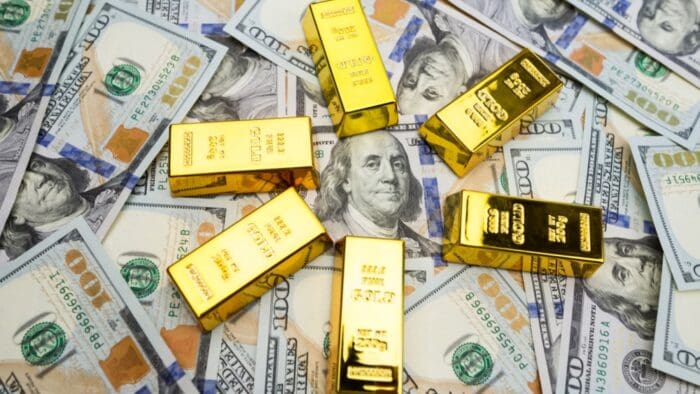


Weaker durable goods data helped ease the dollar and Treasury yields, nudging November gold to about $4,145 an ounce.
What’s going on here?
Gold edged higher for a second straight session after softer US durable goods data cooled the dollar and Treasury yields, pushing November futures to around $4,145 an ounce.
What does this mean?
Fresh data hinted the US economy is losing some steam. The US Census Bureau said durable goods orders rose 0.3% in June after a 4.0% drop in May, far below the 2.1% gain economists expected, according to MarketWatch.
That miss took some pressure off the “rates and dollar” complex: the two-year Treasury yield slipped to 4.327%, the 10-year to 4.651%, and the ICE dollar index eased to 101.38. When yields and the dollar fall, gold often looks more appealing, because it doesn’t pay interest and is priced in dollars for most of the world.
The bigger point is what the mix of weaker growth and stubborn inflation could mean for the Federal Reserve. If activity cools while energy costs keep inflation firm, markets can start to expect lower inflation-adjusted returns on safe bonds, even if nominal yields don’t drop much. Those “real” yields are a key swing factor for gold, alongside the dollar.
Zooming out, Saxo Bank noted gold is up about 0.9% this month to near $4,090, supported by central-bank reserve buying and ongoing worries about government debt.
Why should I care?
For markets: With the 2-year at 4.327% and gold near $4,145, real yields are the tell.
Gold doesn’t really react to “rates” in the abstract. It tends to track the inflation-adjusted return investors can get in safe assets, plus moves in the dollar. So when June durable goods (0.3% versus 2.1% expected) points to softer growth while energy-driven price pressure keeps inflation from fading fast, expectations for real yields can fall even if headline yields stay elevated. A softer dollar adds fuel by lowering the effective price for overseas buyers. The result is that the next leg for gold may depend more on where inflation expectations settle than on the day-to-day level of the 10-year yield.
—
Originally Posted July 27, 2026 – Gold Ticks Up As The US Economy Shows More Soft Spots
Disclosure: Interactive Brokers Third Party
Information posted on IBKR Campus that is provided by third-parties does NOT constitute a recommendation that you should contract for the services of that third party. Third-party participants who contribute to IBKR Campus are independent of Interactive Brokers and Interactive Brokers does not make any representations or warranties concerning the services offered, their past or future performance, or the accuracy of the information provided by the third party. Past performance is no guarantee of future results.
This material is from Finimize and is being posted with its permission. The views expressed in this material are solely those of the author and/or Finimize and Interactive Brokers is not endorsing or recommending any investment or trading discussed in the material. This material is not and should not be construed as an offer to buy or sell any security. It should not be construed as research or investment advice or a recommendation to buy, sell or hold any security or commodity. This material does not and is not intended to take into account the particular financial conditions, investment objectives or requirements of individual customers. Before acting on this material, you should consider whether it is suitable for your particular circumstances and, as necessary, seek professional advice.
Disclosure: Precious Metals
Precious metals may not be available in all locations, please check your local IBKR website for availability.





Join The Conversation
If you have a general question, it may already be covered in our FAQs page. go to: IBKR Ireland FAQs or IBKR U.K. FAQs. If you have an account-specific question or concern, please reach out to Client Services: IBKR Ireland or IBKR U.K..
Visit IBKR U.K. Open an IBKR U.K. Account