









At a Glance
- A mix of heightened demand for advanced fuels and geopolitical uncertainty has pushed the Soybean Oil futures forward curve into backwardation, with spot prices trading at a premium to deferred contracts
- Palm Oil and Rapeseed Oil futures are seeing trading activity as market participants look to manage biofuel-related risks from the feedstock perspective
Global energy markets are being transformed as agricultural feedstocks, such as soybean oil, palm oil and rapeseed oil, become more integrated in global fuel supply chains. Supply disruptions in the traditional fossil fuel markets through events, such as the ongoing Russia-Ukraine conflict and the uncertainty surrounding the situation in Iran, have prompted a wider discussion around the use of biofuels as an additional energy source.
Biofuels usage is largely driven by environmental regulations, and their prices reflect the constantly evolving set of complex rules that govern their supply and demand. European regulations look set to tighten further and incentives (credits) in the U.S. seem to be increasing, boosting supply to meet the growing demand for both finished biofuels as well as their feedstocks. Higher price volatility in the vegetable oil markets could also benefit the related futures and options markets as traders seek liquidity and risk management tools.
The mainstay of biofuel demand remains in road transportation and, to a lesser extent, in aviation. The International Energy Agency projects that demand from the transportation sector for energy sources, like renewables, biofuels and biogas, will increase 50% by 2030. Biofuels used in road transportation are expected to make up over 35% of the total increase, with a further 10% coming from the aviation sector. An increase in consumption at this scale will likely contribute to a rise in overall demand for a wide range of biofuel feedstocks.
Soybean Oil Futures Trading Interest Expands Globally
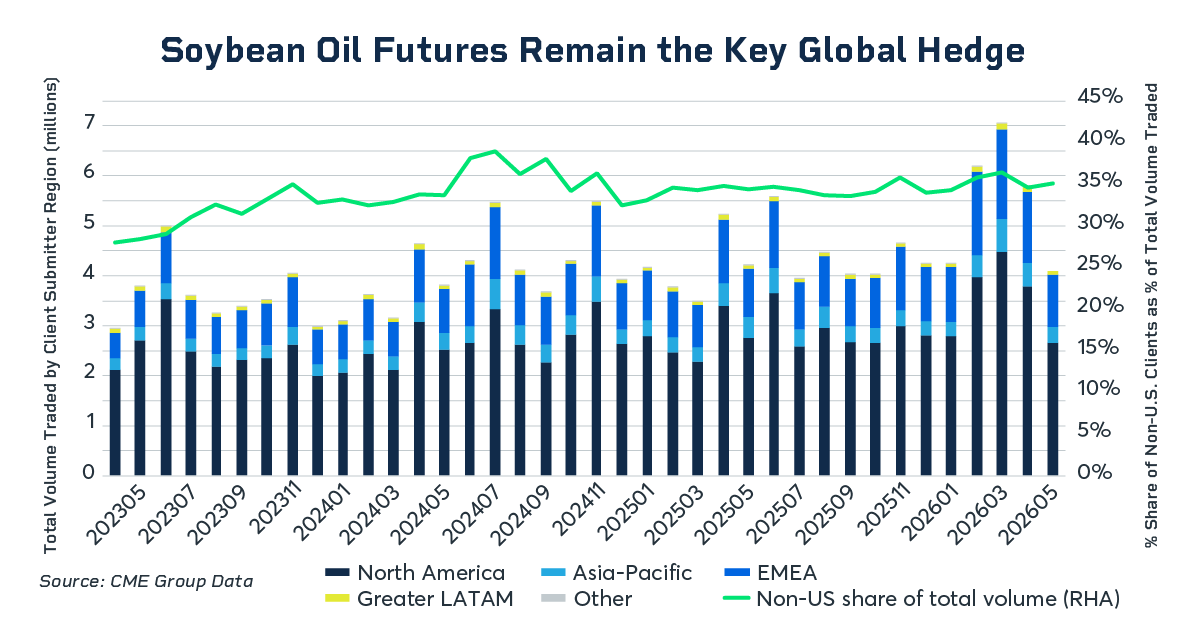
Soybean Oil is the largest among the Soybean complex of futures and options that are actively traded by a suite of international market participants looking to hedge a variety of different underlying price risks. Data from CME Group shows that Soybean Oil futures and options trading volumes executed by non-U.S.-based firms have increased steadily since early 2024. Trading volumes from Asia-Pacific, EMEA, Latin America and other jurisdictions have nearly doubled, reaching 6.8 million contracts in the first quarter of 2026 compared to the first quarter in 2025. International participation in Soybean Oil futures specifically is also rising, with trading volumes from non-U.S. clients accounting for around 35% of the overall total daily futures volume.
Oilshare Points to Growing Vegetable Oil Interest
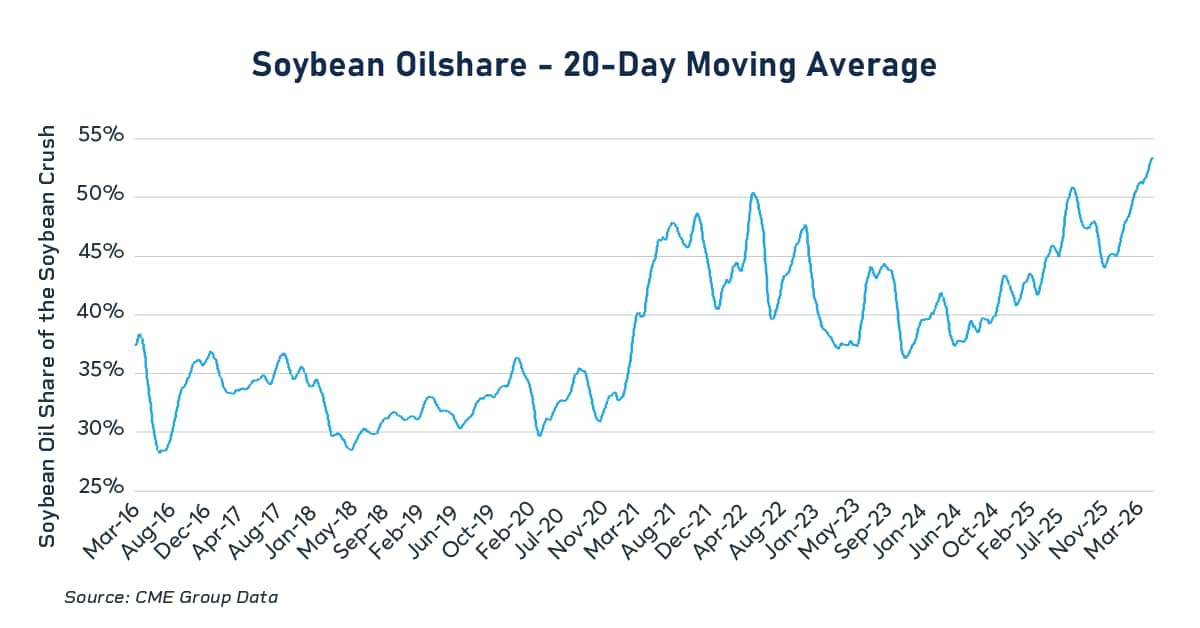
Another way to express the value of soybean oil is to look at the oilshare, a financial benchmark that measures the percentage of total soybean crushing revenue that comes from selling soybean oil, relative to soybean meal. In other words, the higher the oilshare, the greater the emphasis the market places on soybean oil compared to soybean meal. Soybean Oilshare futures and options, settled to the CME Group Soybean Oilshare Index®, allow market participants to directly trade the relative value of soybean oil to meal. Over the last 12 months, Soybean Oilshare has pushed past 50%, which is an increase from around 37% in March 2024. The current level is one of the highest in many years, partly reflecting the rising demand for biofuels and other bioenergy products, such as sustainable aviation fuels.
Energy Demand and Heightened Geopolitical Events Push Futures Term Structure to Backwardation
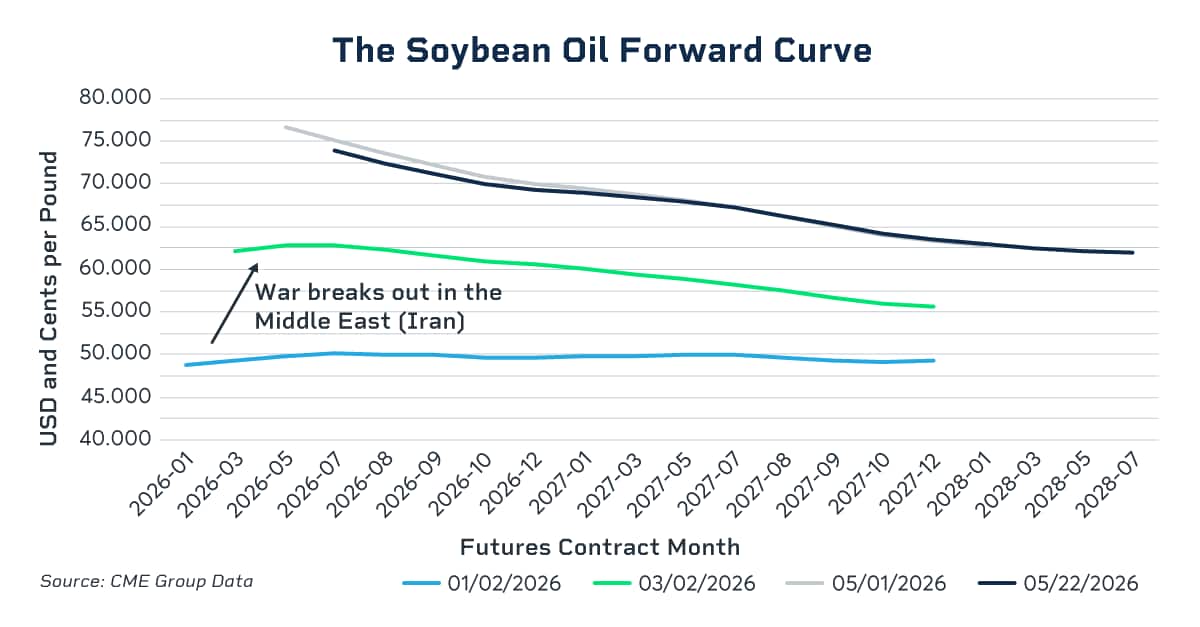
The structure of the futures forward curve for soybean oil has changed significantly since the beginning of 2026 as various factors have impacted possible supply and demand in the market. In the energy market, rising demand for advanced fuels, like renewable diesel, have helped to support prices and create backwardation, which is when spot prices trade at a premium to contracts for deferred delivery.
At the end of May 2026, the price of Soybean Oil futures for July 2026 delivery was 73.98 cents per pound, trading at a premium of 1.52 cents over the August 2026 delivery contract and a premium of 4.60 cents over the December 2026 delivery contract. This compares to a price of 62.81 cents in early March and a premium of just 0.55 cents over the August 2026 delivery and a premium of 2.29 cents over the December 2026 contract.
The other factor impacting the market is the ongoing conflict in the Middle East, which has affected its supply-and-demand dynamics. As oil prices rise, some consumers are seeking alternative energy sources.
Palm Oil, the Asia-Focused Hedging Response to Bioenergy Volatility
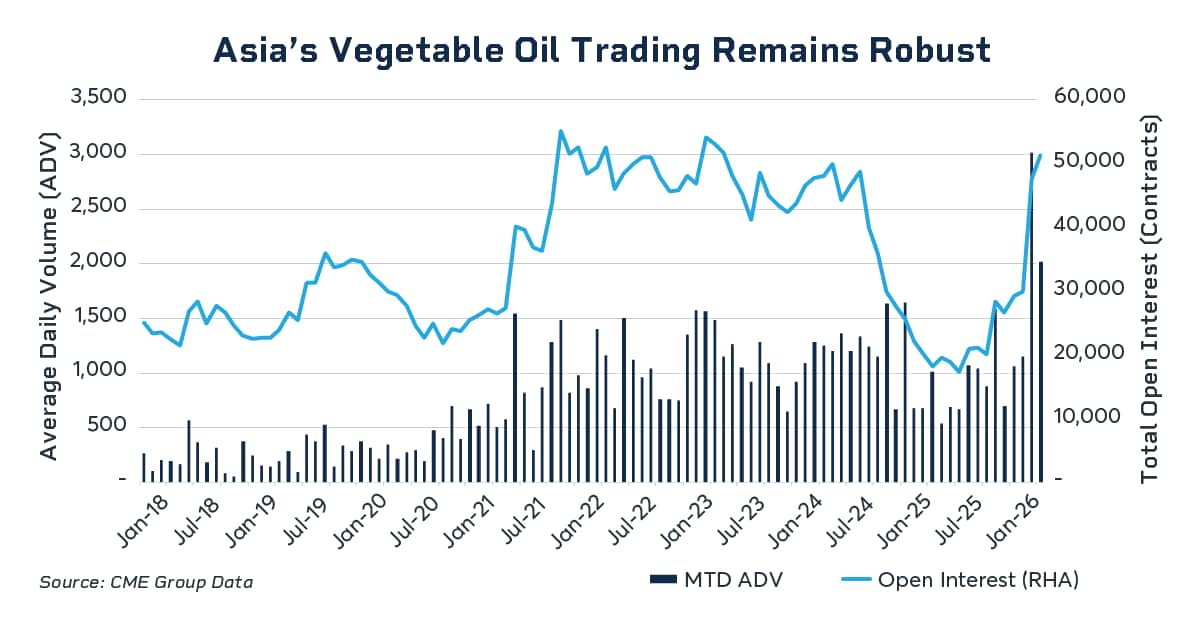
In Asian markets, trading volumes have also been rising sharply for Palm Oil futures. In the first quarter of 2026, the contract saw volumes of around 109,600 contracts, which is the highest level since the first quarter of 2023, according to the latest CME Group data. While some markets will phase out palm oil usage in 2027, palm oil derivative markets continue to thrive as companies turn to the futures markets to hedge a variety of biofuel-related risks.
Rapeseed Oil Futures: The Newest Entrant into the Bio Space
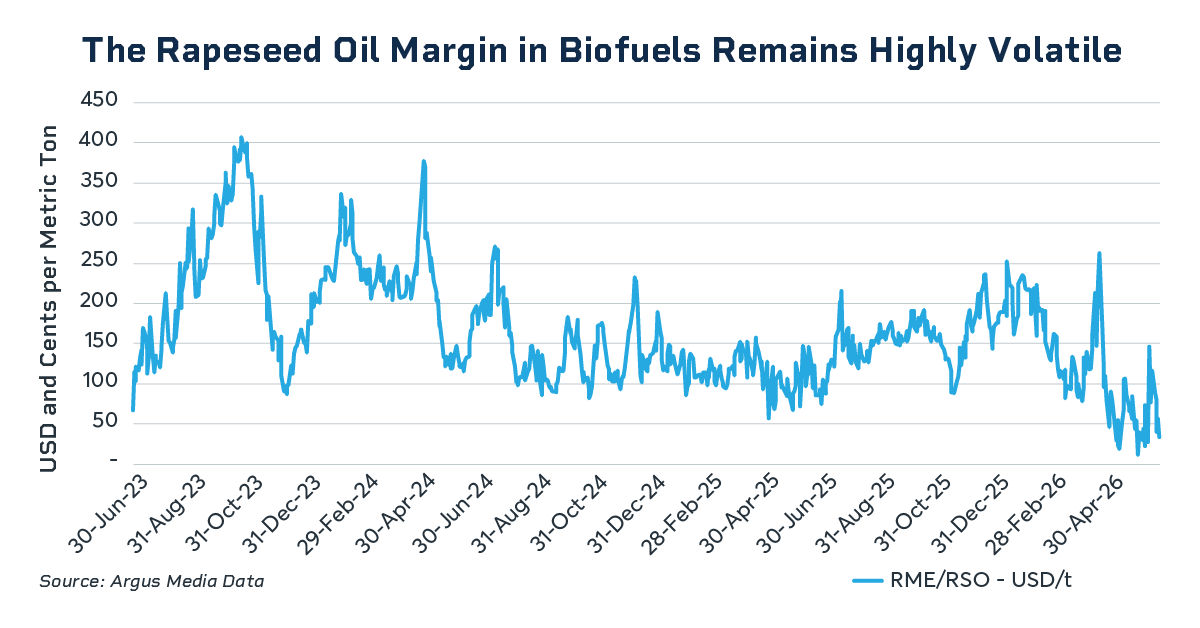
Rapeseed oil is a significant feedstock for the European biofuel markets and interest around it is growing given its role in feed and fuel. Pricing is influenced by both its relationship to rapeseed as well as the value of the oil itself within the bioenergy complex. Therefore, the trading dynamics for rapeseed oil are relatively complex.
In the energy market, the margin between rapeseed oil and the finished biofuel has been variable since 2023, with prices trading up to around $250 per metric ton on a regular basis. CME Group Rapeseed Oil futures provide a mechanism for hedging fluctuating feedstock costs in biodiesel production. The contract has traded a number of times since its launch in early March 2026, highlighting the growing importance of the product in the European feedstock market.
Looking Ahead
The role of vegetable oil markets is expanding alongside the continued development of the biofuel and broader energy markets. Consequently, traders and hedgers are increasingly utilizing robust derivatives, such as CME Group Soybean Oil futures, to navigate complex price dynamics, including the shift to backwardation. As the bioenergy equation continues to unfold, deep and accessible vegetable oil futures markets remain a critical tool for global market participants to effectively hedge their underlying supply and price risks.
—
Originally Posted June 30, 2026 – How Rising Biofuel Demand Impacts Vegetable Oil Markets
Disclosure: CME Group
© [2023] CME Group Inc. All rights reserved. This information is reproduced by permission of CME Group Inc. and its affiliates under license. CME Group Inc. and its affiliates accept no liability or responsibility for the information contained herein, including but not limited to the currency, accuracy and/or completeness of this information, and delays, interruptions, errors or omissions. This information is an unofficial copy and may not reflect the official and accurate version. For the definitive and up-to-date version of any of this information, please see cmegroup.com.
Disclosure: Interactive Brokers Third Party
Information posted on IBKR Campus that is provided by third-parties does NOT constitute a recommendation that you should contract for the services of that third party. Third-party participants who contribute to IBKR Campus are independent of Interactive Brokers and Interactive Brokers does not make any representations or warranties concerning the services offered, their past or future performance, or the accuracy of the information provided by the third party. Past performance is no guarantee of future results.
This material is from CME Group and is being posted with its permission. The views expressed in this material are solely those of the author and/or CME Group and Interactive Brokers is not endorsing or recommending any investment or trading discussed in the material. This material is not and should not be construed as an offer to buy or sell any security. It should not be construed as research or investment advice or a recommendation to buy, sell or hold any security or commodity. This material does not and is not intended to take into account the particular financial conditions, investment objectives or requirements of individual customers. Before acting on this material, you should consider whether it is suitable for your particular circumstances and, as necessary, seek professional advice.
Disclosure: Futures Trading
Futures are not suitable for all investors. The amount you may lose may be greater than your initial investment. Before trading futures, please read the CFTC Risk Disclosure. A copy and additional information are available at the Warnings and Disclosures section of your local Interactive Brokers website.
Disclosure: Options (with multiple legs)
Options involve risk and are not suitable for all investors. For information on the uses and risks of options read the "Characteristics and Risks of Standardized Options" also known as the options disclosure document (ODD). Multiple leg strategies, including spreads, will incur multiple transaction costs.






Join The Conversation
If you have a general question, it may already be covered in our FAQs page. go to: IBKR Ireland FAQs or IBKR U.K. FAQs. If you have an account-specific question or concern, please reach out to Client Services: IBKR Ireland or IBKR U.K..
Visit IBKR U.K. Open an IBKR U.K. Account