











One of the questions plaguing investors in recent weeks is why major stock indices have been able to rally to new highs even as interest rates reach levels that have not been seen for decades. Yesterday, a concise answer to that question occurred to me during a conversation with a reporter. To my pleasant surprise, it became the Wall Street Journal’s Money Quote of the day.
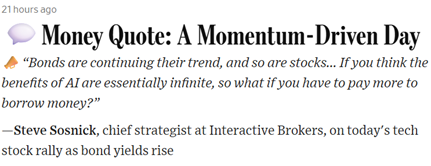
The quote contains a degree of exaggeration, or perhaps snark, but the comment is rooted in sound economics. The general perception surrounding the adoption of artificial intelligence is that its potential is limitless. While we are years, if not decades, away from realizing the technology’s full potential – good or bad – the belief is that it will offer huge productivity benefits for which end users will pay handsomely. So far, the benefits have resulted in huge profits for the “makers” of the new technology – semiconductor manufacturers, cloud vendors, the builders of data centers – even as profitability remains elusive so far for industry leaders like Anthropic and OpenAI.
That distinction is crucially important. The latter two companies are not public – at least not yet – while the top-heavy S&P 500 (SPX) and Nasdaq 100 (NDX) are dominated by the sort of names that are benefiting most from the waves of spending.
It creates an interesting positive feedback loop. Last week, we pointed out that during the third quarter, and September specifically, large-cap technology stocks generally outperformed most other shares, whether delineated by size or sector. Thus, the already top-heavy, market-cap-weighted benchmarks became even more concentrated and top-heavy. This, of course, is great news for those who are invested in those key stocks and funds that are proxies for those key indices. It also explains why higher rates aren’t mattering to stocks right now.
There are, of course, many potential reasons for the current bout of higher rates. Remember, while those of us in the USA are primarily focused on rising Treasury yields, rates are going up throughout the world’s economies. The combination of rising deficits in many countries and higher input prices, such as energy, copper, and agricultural commodities, is undoubtedly a key factor. But another factor is that the AI buildout is creating a huge demand for funding, and many of those with the highest demand for funds were recently huge providers of cash flow.
Interest rates are the price of money, and the price of any good or service is set at the margin. The marginal demand for money on a local and global basis is rising; so, too, is its price. This is a premise of basic economics.
Another is that companies will find it profitable to borrow money to finance investments as long as the likely return on that investment exceeds the cost of that borrowing. If that potential return on investment is deemed to be huge, it makes the borrowers insensitive to changes in rates. If my company has the opportunity to finance a project that is likely to return significant double-digit percentage returns – if not even higher – then why should I care if I have to pay 50 basis points, a full percentage point, or even several percentage points more to be able to undertake it? Thus, we have the rationale for the comment I offered to the WSJ yesterday.
Today, with yields ticking slightly lower, we see those indices turbocharged as investors hope for a breakout after SPX charged to a new all-time high shortly after the open. For the short term, we are likely to see stock traders treat changes in interest rates as another ratchet effect for stocks. Indexes will rally when rates tick lower and yawn when they rise. That could change dramatically after companies begin offering guidance along with their quarterly results later this month. But for now, inertia continues to rule.
New to Interactive Brokers?
Open AccountAlready an Interactive Brokers Client?
Request Trading PermissionDisclosure: Interactive Brokers
The analysis in this material is provided for information only and is not and should not be construed as an offer to sell or the solicitation of an offer to buy any security. To the extent that this material discusses general market activity, industry or sector trends or other broad-based economic or political conditions, it should not be construed as research or investment advice. To the extent that it includes references to specific securities, commodities, currencies, or other instruments, those references do not constitute a recommendation by IBKR to buy, sell or hold such investments. This material does not and is not intended to take into account the particular financial conditions, investment objectives or requirements of individual customers. Before acting on this material, you should consider whether it is suitable for your particular circumstances and, as necessary, seek professional advice.
The views and opinions expressed herein are those of the author and do not necessarily reflect the views of Interactive Brokers, its affiliates, or its employees.
Disclosure: Bonds
As with all investments, your capital is at risk.





Join The Conversation
If you have a general question, it may already be covered in our FAQs page. go to: IBKR Ireland FAQs or IBKR U.K. FAQs. If you have an account-specific question or concern, please reach out to Client Services: IBKR Ireland or IBKR U.K..
Visit IBKR U.K. Open an IBKR U.K. Account