










An end to the five-day streak of sinking oil prices combined with Flash PMIs depicting the strongest month of economic growth in over five years is sending yields to the nosebleeds and hurting risk sentiments on Wall Street. Fuel charges are rising for the first session in six as investors wonder whether there’s a realistic path for peace between the US and Iran, with traders balancing President Trump’s hardline rhetoric during his UN speech against his more conciliatory tone following talks with Tehran, which he described as very good. The confusion paired with Iranian leadership remaining committed to its firm positions is triggering a turnaround for crude prices and generating much heavier interest rates. Meanwhile, big beats across services and manufacturing in the economic calendar that signaled fast hiring and raging inflation point to an excellent environment for corporate earnings amidst harsh headwinds for Treasuries, as fixed-income observers dial up Fed hike probabilities, GDP projections and cost pressure expectations. The curve’s climb is increasingly pronounced at the monetary policy sensitive short end as the complex shifts in bear-flattening fashion. Tighter financial conditions alongside an appreciating greenback are derailing animal spirits, with equities and non-energy commodities suffering losses. Indeed, the four major domestic stock benchmarks are declining with 9 of the 11 principal sectors dropping. Volatility protection instruments are catching bids as a result, as folks brace for more potential downside.
Economic Activity Expands at Fastest Pace in More Than Five Years
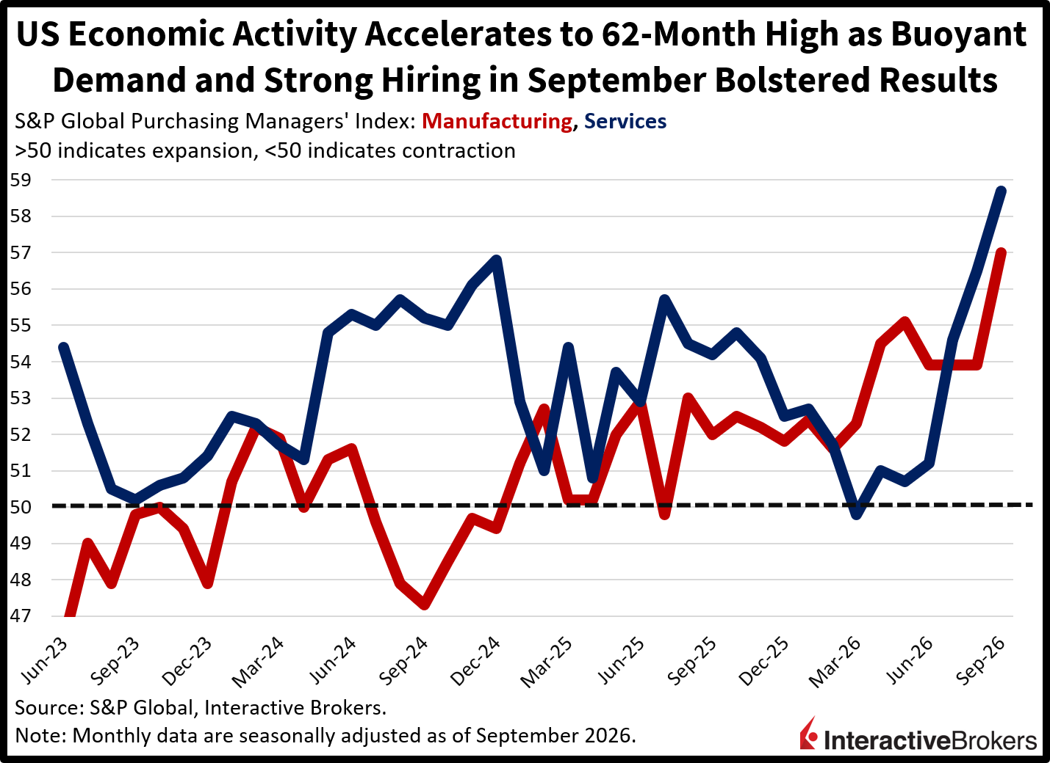
Economic activity expanded at the fastest rate in over five years so far this month, as firms rushed to add staff and boost technology to meet robust demand amidst heavier backlogs. The S&P Global Flash Purchasing Managers’ Indices (PMI) for services and manufacturing rose to 59- and 52-month highs of 58.7 and 57, storming past expectations of 56 and 53.6 as well as August’s results of 56.5 and 53.9. Perhaps even more impressive, the composite number, which collectively includes both sectors, jumped to a 62-month high of 58.4. The services gauge posted its fourth consecutive month of acceleration, while payroll employment additions climbed to their loftiest level in more than four years. New orders were buoyant across the two categories, but purchasing was increasingly driven by domestic demand as exports remained subdued in services and continued to fall in manufacturing. Still, goods producers were more upbeat about the future, while servicers were concerned about cost-of-living pressures, elevated interest rates and political uncertainty. Despite the overall positivity, the report signaled fiery inflationary trends stemming from rising fuel and materials charges, supply chain disruptions and pricing power amongst businesses against the backdrop of resilient customers.
Past performance is not indicative of future results
Fixed-Income Investors May Be Overreacting
The short end of the Treasury complex is becoming incredibly hawkish by pricing in two additional hikes this year and a couple more in 2027, which would bring the fed funds benchmark to an upper range of 5% in just a few months. But with inflationary pressures being dominated by energy and annualized core cost forces running at 2.4%, I think it’s unreasonable to envision that much tightening right around the corner. Besides, I believe Fed Warsh and the committee will pause in October to avoid the potential for political backlash associated with the midterm elections in November amidst prediction markets forecasting that the GOP has lost its Senate lead. Moreover, too many central bank increases from here risk derailing the economic expansion, slowing the pace of corporate earnings growth, generating job losses and causing financial instability.
International Roundup
Australia Business Activity Slows as Central Bank Tightens
The growth of Australia’s private sector business activity continued for the fourth-consecutive month in September but slowed considerably, according to the S&P Global Flash Australia PMI Composite Output Index. Meanwhile, Interactive Brokers Prediction Markets investors are placing a 99% chance of the Bank of Australia hiking its key interest rate by 25 basis points during its Sept. 30 meeting.
The broad S&P composite output index sank from 52.7 in August to 50.8, narrowly exceeding the contraction-expansion threshold of 50. Declines among various metrics were broad based as follows:
- Flash Australia Services PMI Business Activity Index slipped from 53.2 to 51.4
- Flash Australia Manufacturing PMI descended from 52 to 49.3
- Flash Australia Manufacturing PMI Output Index weakened from 49.6 to 46.4
Employers across the economy laid off workers for the first time in four months. While S&P described the payroll contraction as modest, it notes that it was the largest number of pink slips since October 2020. Export business weakened, largely due to a dip in new orders. At the same time, businesses reported input price inflation hitting the strongest pace in three months. Businesses responded by increasing output prices more aggressively than in the preceding month. With higher input costs, economic concerns, weakening demand and client retention challenges, business confidence sank to its lowest reading in three months. Businesses frequently cited the Middle East conflict and its impact on energy costs as possible drivers of hotter inflation in the coming months. The Bank of Australia, meanwhile, is working to push inflation down to its target range of 2% to 3%. In July, the country’s Consumer Price Index was up 3.5% after hitting 3.8% in June. The largest contributors to annual inflation were housing, up 5.0%, and food and non-alcoholic beverages, which grew 3.2% more costly.
Euro Area Services Sector Fuels Stronger Economic Activity
Economic activity in the euro area picked up this month, reaching its fast pace in three-and-a-half years, but the acceleration was largely driven by the region’s services sector, according to S&P Global Flash PMI reports. The broad Flash Eurozone PMI Composite climbed from 52 in August to 53.1, a 41-month high and considerably above the economist consensus estimate of 51.7. The services gauge powered the strong print with its respective index jumping 1.4 points to a 10-month high of 53. Economists anticipated a decline to 51.4. Also this month, the manufacturing output index was up 0.1 point to 53.3, the strongest reading in 55 months. The overall Flash Eurozone Manufacturing PMI, however, remained unchanged at 52.7 but it surpassed the 52.6 anticipated by economists. Firms reported the strongest input and output inflation since May and job creation was muted by confidence in the year-ahead outlook falling to a three-month low. On a positive note, new order expansion for manufacturers was supported by foreign customers, although export demand weakened for service providers. Nevertheless, the sustained uptick in new orders contributed to an accumulation of backlogs. Services providers responded to new order growth by expanding payrolls while manufacturers made no changes. Looking ahead, optimism weakened in both services and manufacturing sectors, largely due to French companies while sentiment in Germany was unchanged. The rest of the eurozone zone posted stronger sentiment.
UK Economic Activity Grows at Slower Pace
Overall economic activity in the UK’s private sector grew at a slower pace this month with the Flash S&P Global Composite PMI weakening from 52.5 in July to 51.7 and dropping below the economist consensus estimate of 52. The result was pulled down by the services gauge falling from 52.5 to 51.7, which underperformed expectations for 52. Manufacturing, however, climbed from 51.7 to 52, surpassing the estimate of 51.5. Services firms said subdued domestic economic conditions and geopolitical uncertainty constrained growth. The sector, nevertheless, experienced increased demand for technology services. The manufacturing sector attributed its growth in economic activity to AI investment and increased defense spending supporting output, but weak consumer demand was a headwind.
Singapore Headline Inflation Strengthens Modestly
Singapore’s Consumer Price Index depicted prices climbing 0.6% month over month (m/m) and 2.3% year over year (y/y) in August. In July, prices sank 0.2% m/m and ascended 2.2% y/y. The 12-month core version, which excludes items with volatile prices, was more benign, climbing 2.2% and matching the economist consensus estimate while accelerating from July’s 2% pace. Within the m/m headline, clothing and footwear was up 1.8%, a reversal from July’s 1% descent. In a similar manner, housing and utilities, after falling 0.7% in July, became 1.7% more costly last month. The miscellaneous goods and services category also reversed. After prices sank 0.1% m/m in July, they ascended 0.7% last month. In other areas, transportation, education and food were up 0.4%, 0.2% and 0.1%. Conversely, stickers fell 0.4% and 0.1% for the recreation, sport and culture category and the group consisting of household durables and services.
New to Interactive Brokers?
Open AccountDisclosure: Interactive Brokers Affiliate
Information posted on IBKR Campus that is provided by third-parties does NOT constitute a recommendation that you should contract for the services of that third party. Third-party participants who contribute to IBKR Campus are independent of Interactive Brokers and Interactive Brokers does not make any representations or warranties concerning the services offered, their past or future performance, or the accuracy of the information provided by the third party. Past performance is no guarantee of future results.
This material is from IBKR Macroeconomics, an affiliate of Interactive Brokers LLC, and is being posted with its permission. The views expressed in this material are solely those of the author and/or IBKR Macroeconomics and Interactive Brokers is not endorsing or recommending any investment or trading discussed in the material. This material is not and should not be construed as an offer to buy or sell any security. It should not be construed as research or investment advice or a recommendation to buy, sell or hold any security or commodity. This material does not and is not intended to take into account the particular financial conditions, investment objectives or requirements of individual customers. Before acting on this material, you should consider whether it is suitable for your particular circumstances and, as necessary, seek professional advice.
Disclosure: Futures Trading
Futures are not suitable for all investors. The amount you may lose may be greater than your initial investment. Before trading futures, please read the CFTC Risk Disclosure. A copy and additional information are available at the Warnings and Disclosures section of your local Interactive Brokers website.






Join The Conversation
If you have a general question, it may already be covered in our FAQs page. go to: IBKR Ireland FAQs or IBKR U.K. FAQs. If you have an account-specific question or concern, please reach out to Client Services: IBKR Ireland or IBKR U.K..
Visit IBKR U.K. Open an IBKR U.K. Account