










This morning’s hotter-than-anticipated CPI is sparking Wall Street turbulence as investors fear that the Federal Reserve will extend its hiking cycle in light of price pressures that are drifting away from the organization’s 2% target. Despite cost forces being propelled predominantly by heavier fuel charges, as illustrated by the core indicator being 110 bps below the headline, the oil situation isn’t improving, as Houthi attacks on Saudi Arabia pushed WTI crude to a fresh October high earlier today, raising the chances for worsening reports in future months. September marked the third consecutive monthly acceleration in inflation, amidst an annualized figure that leaped to 3.7%, its loftiest level in four months and before that, May 2023. Markets are getting creamed against the risk-off backdrop, with the four major US equity benchmarks and all subcategories sliding while the 11 principal sectors retreat minus the defensive healthcare and consumer staples segments. Treasurys are plunging as well, as the yield curve climbs in bear-flattening fashion led by the monetary policy sensitive short end, reflecting heightening probabilities of tighter credit conditions that would create a headwind to economic activity, all else equal, but beneficial to the greenback because of narrowing rate differentials that have the US tender trading at its strongest position in 18 months. Non-energy commodities are declining in consideration of the fixed-income complex’s hawkish tilt. Volatility protection instruments, conversely, are catching bids.
Energy and Shelter Bolster CPI
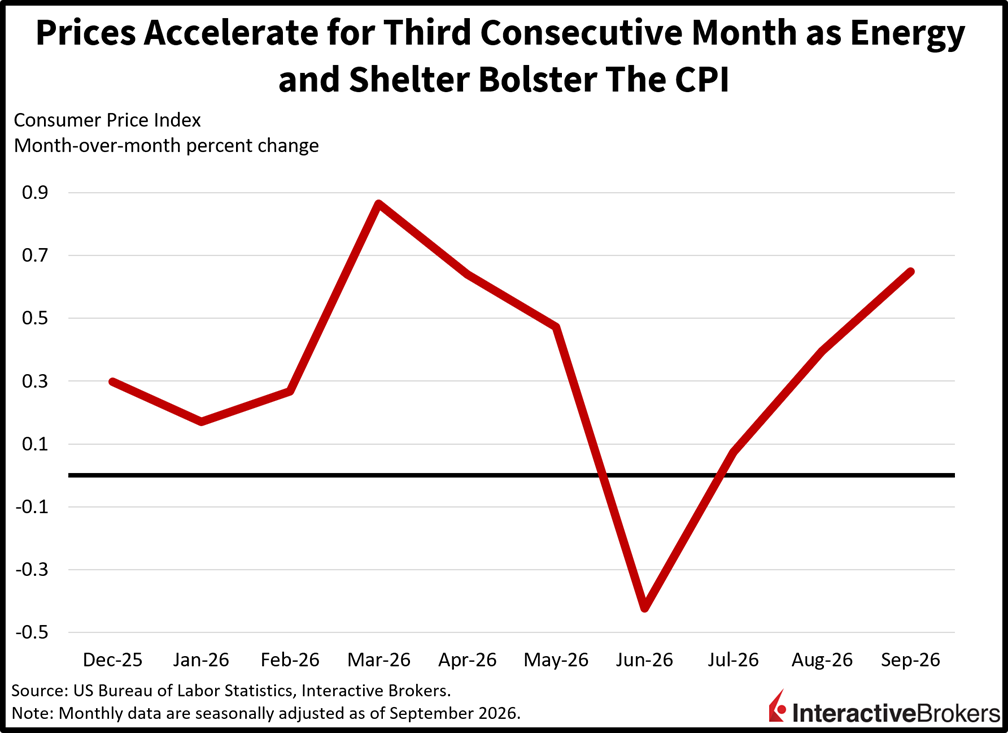
September’s Consumer Price Index (CPI) signaled broad cost pressures that are squeezing household budgets and are likely to compel the Federal Reserve to tighten policy further. Increases of 0.6% month over month (m/m) and 3.7% year over year (y/y) accelerated meaningfully from 0.4% and 3.4% in August, and the annualized figure surpassed the 3.6% estimate. The core indicator, which excludes food and energy due to their volatile characteristics, climbed 0.3% m/m and 2.6% y/y, 0.1% faster than projections on both fronts, and hotter than the prior period’s 0.3% and 2.4% overall. Categories leading the surge and the extent of their changes were as follows:
- Gasoline, 9.1%
- Used cars/trucks, 0.7%
- Transportation services, 0.6%
- Shelter, 0.4%,
- Apparel, 0.3%
- Medical care services, 0.3%
Additionally, the dining establishments and bars, new automobiles and electricity segments each rose 0.2% m/m, while heating service and food at markets were 0.3% and 0.1% cheaper.
Past performance is not indicative of future results.
Shelter Unreasonably Elevated
This morning’s hot CPI was due in large part to an unexpected acceleration in shelter costs, a category that came in at 0.1% in June and July before ramping up to 0.3% and 0.4% in August and September. The quickening is countering what we’re seeing in the real economy, as home prices and rents struggle to increase amidst elevated mortgage rates, lofty valuations, worsening affordability dynamics, heightened vacancies and immigration restrictiveness. Had the heaviest component of inflation gone the other way, we could have very likely seen a lighter-than-anticipated number that Wall Street would have liked. Unfortunately, getting closer to 4% is incredibly problematic for financial assets, as it’s almost double the Fed’s 2% target. More encouraging is the silver lining of expensive energy having failed to expand like wildfire to the core areas, as the spread between it and the headline widened from 100 basis points (bps) to 110 m/m, signaling that we are poised to be in the vicinity of the monetary policy objective if geopolitical tensions cool and peace reaches the Middle East.
International Roundup
Singapore GDP Exceeds Estimates Despite Slowing
Singapore’s third-quarter gross domestic product expanded by 5.4% y/y and 1.1% quarter over quarter after posting 6.2% and 1.5% y/y and q/q growth in the preceding three months, according to a preliminary release from the Ministry of Energy, Trade and Industry. Despite the deceleration, the annual pace exceeded the 5% economist consensus estimate while the q/q print missed the 1.2% estimate. When compared to the April through June period, services producing industries led the expansion with growth of 1.2%. Within this broad classification, the wholesale and retail trade and transportation storage segment was up 2.2% after being flat q/q in the preceding period. The accommodation and food services, real estate, administrative services and support services and other services industries, however, slowed from its second-quarter 0.8% jump to 0.6%. In a similar manner, the information and communications, finance, insurance and professional services decelerated from 2.8% to 0.4%. The goods producing industries category was flat after posting a 4.2% gain in the second quarter. While construction output climbed 3.4% after contracting by 2.7% in the preceding period, the larger manufacturing segment slipped by 0.9%, a strong reversal from the preceding period’s 6.3% q/q ascent.
But Core Inflation Expected to Climb
The Monetary Authority of Singapore expects core inflation, which was 2% in August, to average from 1.5% to 2% this year but to climb as high as 2.5% in 2027, according to the organization’s recently released macroeconomic review. Elevated energy costs are likely to push up prices in industries that are heavily dependent on fuel. Moreover, agricultural input costs and adverse weather are expected to make food more costly. Price pressures have the potential to ease in the middle of 2027, a result of anticipated improvements in import supply conditions.
Input Cost Pressures and Weak Demand Hit Chinese Businesses
China’s businesses appear to be stuck between a rock and a hard place with input price inflation intensifying while lethargic domestic demand, in all likelihood, is limiting companies’ ability to pass higher costs onto customers. Last night, China’s National Bureau of Statistics reported that the country’s Producer Price Index, a gauge of business’ input costs, unexpectedly jumped 5% y/y last month, a strong acceleration from 3.8% in August and hotter than the economist consensus estimate of 4.4%. Companies also faced a 1.2% m/m cost hike following the 0.4% August ascent. Yet weak retail activity as implied by the Consumer Price Index could limit businesses’ ability to pass higher costs onto customers. The gauge depicted lethargic y/y and m/m increases of 0.9% and 0.2%, pointing to ongoing weakness in domestic demand despite the government having previously launched subsidies to lure shoppers to cash registers. The CPI’s m/m result fell from 0.4% in August to 0.2% and missed the economist consensus estimate of 0.3% while the y/y indicator, at 0.9%, was 0.1 percentage point higher than August’s gain. It nevertheless trailed the economist consensus estimate of 1%.
But Chinese Trade Surplus Grows
China’s trade surplus strengthened from $119 billion in August to $133.5 billion last month, easily surpassing the economist consensus expectation for a decline to $116.8 billion. Exports were 36.3% higher than in the year-ago period, outpacing the economist expectation from the metric to advance 0.5% percentage points from August’s 25% y/y gain. Purchases from abroad were 31% higher than in September 2025. Economists anticipated that the uptick in import growth would slow from August’s 28.5% y/y rate to 24.5%. Shipments abroad of automobiles soared 56.3% y/y with escalating pain at the pump stoking demand for electric vehicles. The surge in shipments dampened the impacts of domestic automobile sales in the retail channel falling 28% y/y last month, according to the China Passenger Car Association. Going forward, the trend faces a few headwinds. China has recently trimmed its new energy automobile export rebate from 13% to 9%. It applies to hybrid and full electric vehicles. At the same time, the European Union has slapped an annual automobile import limit of 350,000 on Chinese cars. Last year, EU member countries imported 302,000 hybrid cars from the world’s second-largest economy, according to Dow Jones Newswire. Regarding countries and regions, China’s overall exports to Southeast Asia, the European Union and the US exceeded year-ago levels by 25.3%, 52.3% and 40%.
New to Interactive Brokers?
Open AccountDisclosure: Interactive Brokers Affiliate
Information posted on IBKR Campus that is provided by third-parties does NOT constitute a recommendation that you should contract for the services of that third party. Third-party participants who contribute to IBKR Campus are independent of Interactive Brokers and Interactive Brokers does not make any representations or warranties concerning the services offered, their past or future performance, or the accuracy of the information provided by the third party. Past performance is no guarantee of future results.
This material is from IBKR Macroeconomics, an affiliate of Interactive Brokers LLC, and is being posted with its permission. The views expressed in this material are solely those of the author and/or IBKR Macroeconomics and Interactive Brokers is not endorsing or recommending any investment or trading discussed in the material. This material is not and should not be construed as an offer to buy or sell any security. It should not be construed as research or investment advice or a recommendation to buy, sell or hold any security or commodity. This material does not and is not intended to take into account the particular financial conditions, investment objectives or requirements of individual customers. Before acting on this material, you should consider whether it is suitable for your particular circumstances and, as necessary, seek professional advice.
Disclosure: Bonds
As with all investments, your capital is at risk.






Join The Conversation
If you have a general question, it may already be covered in our FAQs page. go to: IBKR Ireland FAQs or IBKR U.K. FAQs. If you have an account-specific question or concern, please reach out to Client Services: IBKR Ireland or IBKR U.K..
Visit IBKR U.K. Open an IBKR U.K. Account