










The 30-year yield hit its highest level since 2002 this morning with lofty corporate issuance and unfavorable seasonal dynamics weighing on fixed income. Cheaper oil hasn’t helped to limit the carnage much as investors continue to overlook improving supply prospects resulting from Saudi Arabian barrels making it to export destinations following a key pipeline repair. Additionally, weaker-than-expected data consisting of a 12-year low in consumer confidence amidst the softest number of job openings in five months hasn’t tempered selling pressures in Treasuries, as the curve climbs in bear-steepening fashion led north by duration. Heavy fiscal deficits, financing demands for AI and WTI crude still above $90 appear to be driving this session’s turbulence, with participants generally disregarding slumping household sentiment alongside lighter hiring appetites, a combination that would normally benefit bonds. Stocks are trying to hang in there, but the tighter financial conditions are emboldening the bears and lifting demand for downside hedges as the four major benchmarks are declining against the backdrop of all 11 sectors with the exceptions of technology and utilities sliding. Non-energy commodities are catching bids, however, irrespective of the appreciating greenback.
Inflation and Labor Conditions Ding Consumer Confidence
Consumer confidence slumped to its weakest level in 12 years as heavy inflation and pessimism regarding labor conditions weighed on overall household moods, according to the Conference Board. The September headline of 81.9 missed the expected 89.2 by a mile and then some and slipped from 89.4 in August. The sub-indices measuring present and future views both plunged, falling from 117.2 and 69.5 to 109.3 and 63.6, respectively. Survey respondents also mentioned general anxiety regarding the potential for more interest rate hikes and ongoing geopolitical tensions.
Demand for White Collar Workers Falls
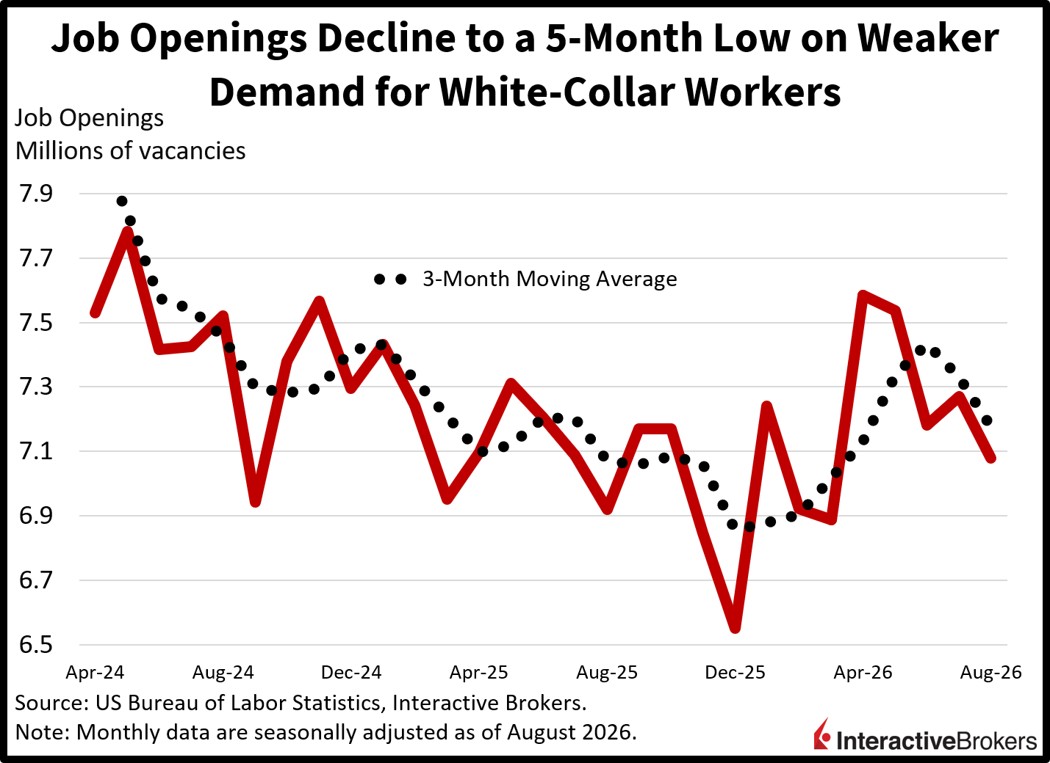
Job openings plunged to the lowest level since March amidst a sizeable pullback in demand for whitecollar workers, according to this morning’s update. The 7.079 million vacancies reported for August missed the median estimate of 7.23 million and sank from 7.335 million in July. The professional business services and health care/social assistance sectors were the heaviest drags on results, registering month-over-month (m/m) decreases of 119k and 115k in for-hire signs. Leisure and hospitality and retail trade led with increases of 61k and 59k, but those gains were hardly enough to offset declines in other categories.
Past performance is not indicative of future results.
Weak Econ Data, Falling Oil Prices Failing To Rescue Bonds
This morning’s weaker-than-expected economic data paired with falling oil prices are failing to rescue bonds, which is a troublesome sign for Wall Street. Deficit worries, competition from corporate supply, ongoing geopolitical tensions and a sluggish seasonal backdrop are overwhelming softer growth estimates amidst lightening inflation expectations, which are traditionally beneficial for fixed income. We’ll see more employment, price and activity numbers in the next few sessions, during which credit markets may recover, but based on today’s bearish reaction to what would normally warrant a bullish response, the clear vulnerability here is that hotter-than-anticipated statistics, particularly after this Friday’s nonfarm payrolls, could send yields further higher into the nosebleeds. Stocks are going to have trouble advancing with these rate pressures that are raising the bar for earnings performances, as the risk premium sinks to the basement in light of rapidly rising borrowing costs. At some point in the near future, barring a Middle East resolution or the beginning of a brand new quantitative easing program from the Fed, demand for AI financing and adoption will decelerate as financial conditions turn increasingly restrictive, hampering cyclical momentum and reducing the pace of profit expansions.
International Roundup
Canada’s Third-Quarter GDP Appears to Be Decelerating
A flat July for Canada’s gross domestic product and an estimate of only 0.2% economic expansion for August points to slowing growth for the third quarter, according to data from Statistics Canada. Preliminary data shows that the retail trade segment and the mining and quarrying category supported GDP last month while the oil and gas extraction sector contracted, limiting the headline estimate. The weak July and August prints follow growth of 0.6%, 0.3% and 0.4% in April, May and June, respectively. The third quarter got off to a weak start with Statistics Canada’s final publication for July depicting weakness in the retail and wholesale sectors, which offset gains in construction and utilities. The construction industry grew 1.3% with engineering and other construction activities gaining 1.5% and non-residential building construction jumping 2.9%. An increase in home alterations and improvement, furthermore, contributed to residential construction growing 0.9%. In the utilities sector, the summer heatwave increased demand for electricity and all categories of customers increased their natural gas consumption. The sector, in aggregate, grew 1.7%. July headwinds included the manufacturing sector and the category of mining, quarrying and oil and gas extraction contracting 0.9% and 0.5%. Retail and wholesale were additional drags on the result with contractions of 1% and 0.4%.
UK Retail Price Pressures Lower Than Expected
Retailers increased prices by 1.4% year over year this month, according to the BRC Shop Price Index. The result was slightly cooler than the economist consensus estimate for a repeat of August’s 1.5$ y/y ascent. Despite the slight decline, the gauge still exceeded the three-month average of 1.3%.
Price pressures eased across sectors as follows:
- Non-food inflation was 0.8% following August’s 0.9% pace. The three-month average is 0.6%.
- Food inflation went from 2.8% to 2.5% and matched the three-month average.
- Fresh food inflation, at 2.6%, cooled from 3% in August and dropped below the three-month average of 2.9%.
- Inflation for ambient food, which consists of non‑fresh, shelf‑stable food and drink items, moved from 2.5% to 2.2%, but it remained above the three-month average of 1.9%.
BRC explains that poor harvests in Europe pushed up the cost of fruit and more expensive commodities had a similar impact on chocolate and confectionary items. On a favorable note for consumers, store promotions pushed down prices for meat and dairy. Among non-food items, back-to-school discounts helped dampen price pressures. After shoppers splurged during August, sales slowed this month, incentivizing stores to offer promotional pricing.
While UK Consumer Credit Growth Accelerates
Outstanding consumer debt in the UK grew at an annual rate of 9.6% in August after increasing at a 9.3% rate in July, according to the Bank of England. Credit card borrowing climbed 13.3% following July’s 12.6% rate. Other forms of consumer debt, which ascended by 7.7% in July, were up 7.9% last month.
But Mortgage Approvals Point to Contraction
The number of mortgage approvals in the UK fell from 55.93k to 54.92k and considerably underperformed the economist consensus estimate of 56k. The data is a future indicator of new mortgage debt issuance because it consists only of approvals rather than loans that have been finalized. Also last month, mortgage debt increased to £4.4 billion in August, from £4.1 billion in July, below the previous 6-month average of £5.2 billion.
Economic Sentiment Falls in Euro Area
The overall moods of individuals and businesses sank in September with the European Commission’s Economic Sentiment Indicator retreating 0.5 points this month to 97.9. A consensus of economists anticipated a 0.6 point increase to 99, which would have put the indicator close to its long-term average of 100. Increased confidence in industry was fully offset by consumers’ views moving in the opposite direction. Businesses upgraded their assessments of current and future production levels. In the services sector, the overall result was fairly stable. Managers’ views of past conditions improved and expectations for future demand deteriorated.
New to Interactive Brokers?
Open AccountDisclosure: Interactive Brokers Affiliate
Information posted on IBKR Campus that is provided by third-parties does NOT constitute a recommendation that you should contract for the services of that third party. Third-party participants who contribute to IBKR Campus are independent of Interactive Brokers and Interactive Brokers does not make any representations or warranties concerning the services offered, their past or future performance, or the accuracy of the information provided by the third party. Past performance is no guarantee of future results.
This material is from IBKR Macroeconomics, an affiliate of Interactive Brokers LLC, and is being posted with its permission. The views expressed in this material are solely those of the author and/or IBKR Macroeconomics and Interactive Brokers is not endorsing or recommending any investment or trading discussed in the material. This material is not and should not be construed as an offer to buy or sell any security. It should not be construed as research or investment advice or a recommendation to buy, sell or hold any security or commodity. This material does not and is not intended to take into account the particular financial conditions, investment objectives or requirements of individual customers. Before acting on this material, you should consider whether it is suitable for your particular circumstances and, as necessary, seek professional advice.






Join The Conversation
If you have a general question, it may already be covered in our FAQs page. go to: IBKR Ireland FAQs or IBKR U.K. FAQs. If you have an account-specific question or concern, please reach out to Client Services: IBKR Ireland or IBKR U.K..
Visit IBKR U.K. Open an IBKR U.K. Account