











Treasuries are suffering losses again as mounting geopolitical tensions combined with doubts about Washington’s ability to sustainably quell borrowing costs via bond buybacks weigh on fixed income. Yesterday’s sharp recovery in credit came as the US fiscal authority announced measures to soothe pressure at the long end of the yield curve by focusing liquidity injections from the 10-year maturity out to the 30, but President Trump’s hardline shift on Iran is lifting inflation expectations as crude oil jumps to a four-week high in light of aggressive economic sanctions that are crushing hopes of a potential peace deal. Still, many on Wall Street are blaming the reversal on investors realizing a day later that Secretary Bessent’s plan to double repurchases to at least $4 billion per operation won’t move the needle much as the national debt is forecast to rise by more than $2 trillion in 2026. The reality, however, is that a combination of factors is raising interest rates this session, and ongoing labor market stability is also contributing with today’s initial unemployment claims falling and coming in lighter than projections. Stocks don’t like the tighter financial conditions either and are being additionally hurt by retail earnings reports that depict cautious consumers who are incrementally sacrificing discretionary purchases for necessities. All four major domestic benchmarks are descending in response amidst 7 of the 11 principal sectors dropping and every subcategory in the red. Elsewhere, the greenback is appreciating modestly, non-energy commodities are retreating, volatility protection instruments are catching bids on greater hedging demand during a weak seasonal period.
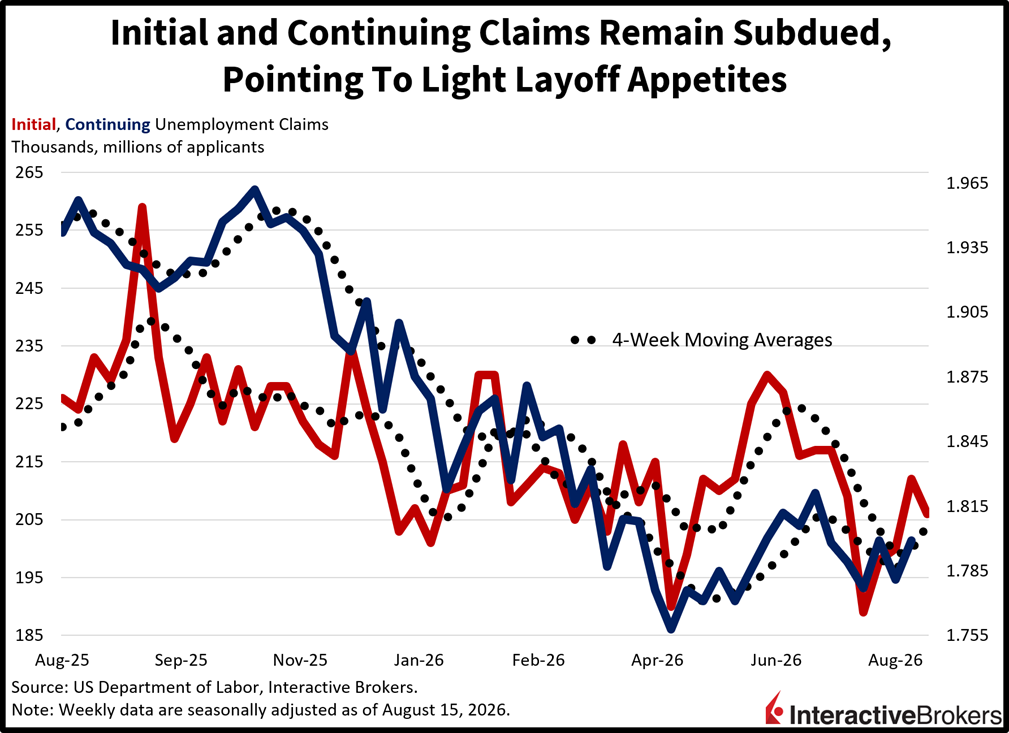
Unemployment Data Signal Labor Market Stability
Unemployment claims remained subdued in the past two weeks as today’s reported figures were little changed from the prior prints. Indeed, initial and continuing filings, at 206k and 1.799 million during the 7-day periods that ended on Saturday the 15th and August 8th, were near expectations of 210k and 1.790 million as well as the previous publication’s 212k and 1.781 million. Four-week moving average trends reflected slight increases to 204k and 1.789 million, nonetheless, the levels are still consistent with strong labor demand, scarce worker supply and light layoff appetites.
Past performance is not indicative of future results.
Tomorrow’s August PMIs to Be Influential
Tomorrow’s Purchasing Managers’ Indices (PMI) from S&P Global will provide the first look at how economic activity is progressing this month and could potentially offset some of July’s evidence of weak cyclical momentum as well as this week’s sluggish retail earnings. The reports will detail the state of consumer spending, hiring, inflation and the extent that AI is bolstering the manufacturing sector, and it may raise confidence that the expansion remains on solid footing or lift slowdown anxieties. And as we cap the week with those numbers, the following one will present investors with the Fed’s preferred price pressure gauge paired with the annual speech from the Fed Chair in Jackson Hole Wyoming. Chief Warsh could seek to reset monetary policy expectations after he was perceived as too dovish in the central bank’s most recent interest rate decision. With yields stubbornly elevated and geopolitical tensions mounting heading into what’s traditionally the worst seasonal stretch of the year, Wall Street participants may need to buckle their seat belts for some possible turbulence subsequent to an extended period of relatively smooth sailing.
International Roundup
Japan’s Trade Deficit Balloons
Rising energy costs and a weak yen caused Japan’s trade deficit to deepen from 409.9 billion yen in June to 634.5 billion yen (approximately $4 billion) last month despite a strong increase in high tech exports, according to the Ministry of Finance. On a positive note, July’s result was better than the economist consensus estimate for a 680 billion yen deficit. The value of imports climbed 27.8% year over year, exceeding both the economist consensus estimate of 26.5% and June’s 25.4% ascent. Mineral fuels purchased from foreign markets increased by 53.5%, led by an 87% jump in petroleum products. Higher oil prices caused by the US-Iran war contributed to the large hike. Additionally, oil is traded in US dollars so the declining value of the yen means that more yen were required when converting the currency to the US dollar for acquiring the commodity. Raw materials were another headwind, with imports of the items growing 36%, largely due to nonferrous ore climbing. Exports also climbed with demand for semiconductors and other high-tech items strengthening. The value of shipments to distant lands was up 23.2% y/y. Economists anticipated a 19.9% lift following June’s 19.3% ascent.
New to Interactive Brokers?
Open AccountDisclosure: Interactive Brokers Affiliate
Information posted on IBKR Campus that is provided by third-parties does NOT constitute a recommendation that you should contract for the services of that third party. Third-party participants who contribute to IBKR Campus are independent of Interactive Brokers and Interactive Brokers does not make any representations or warranties concerning the services offered, their past or future performance, or the accuracy of the information provided by the third party. Past performance is no guarantee of future results.
This material is from IBKR Macroeconomics, an affiliate of Interactive Brokers LLC, and is being posted with its permission. The views expressed in this material are solely those of the author and/or IBKR Macroeconomics and Interactive Brokers is not endorsing or recommending any investment or trading discussed in the material. This material is not and should not be construed as an offer to buy or sell any security. It should not be construed as research or investment advice or a recommendation to buy, sell or hold any security or commodity. This material does not and is not intended to take into account the particular financial conditions, investment objectives or requirements of individual customers. Before acting on this material, you should consider whether it is suitable for your particular circumstances and, as necessary, seek professional advice.






Join The Conversation
If you have a general question, it may already be covered in our FAQs page. go to: IBKR Ireland FAQs or IBKR U.K. FAQs. If you have an account-specific question or concern, please reach out to Client Services: IBKR Ireland or IBKR U.K..
Visit IBKR U.K. Open an IBKR U.K. Account